Institute and Department of Endocrinology and Metabolism, Shanghai Ninth People's Hospital, Shanghai Jiaotong University School of Medicine, Shanghai, China.
Department of Endocrinology, Songjiang Hospital Affiliated to the First People's Hospital of Shanghai Jiaotong University, Shanghai, China.
Mediators Inflamm. 2018 Oct 10;2018:1856137. doi: 10.1155/2018/1856137. eCollection 2018.
The interrelation between thyroid autoimmunity and cardiovascular risks is complex and has not been confirmed. This study aimed at evaluating whether there exists a relationship between thyroid autoimmune diseases (AITDs) and cardiometabolic risks in a large population with normal thyroid-stimulating hormone (TSH) levels.
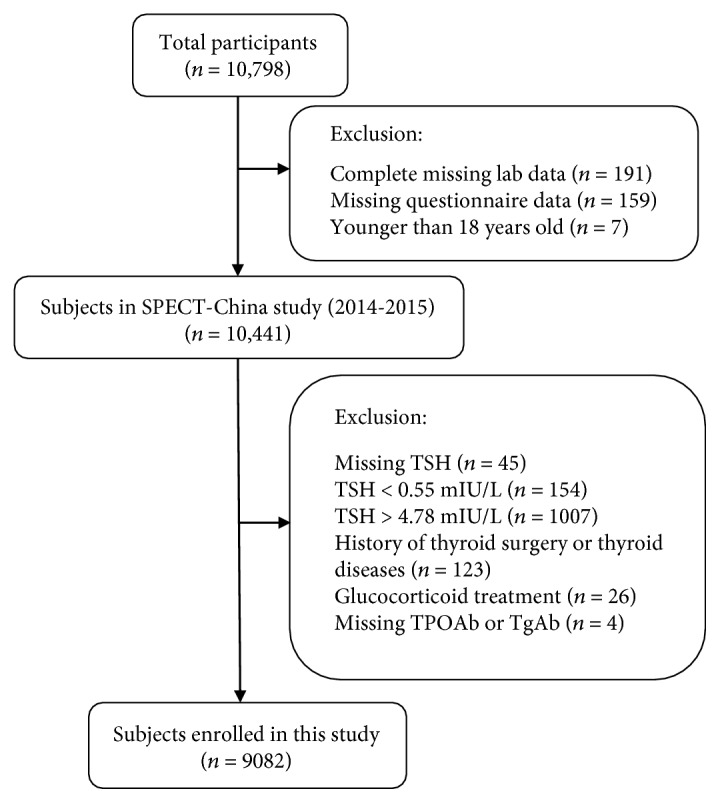
The data was obtained from a cross-sectional study (SPECT-China study). This study enrolled 9082 subjects (3948 males and 5134 females) above 18 years with normal TSH levels. AITD was defined according to the positivity of TPOAb and TgAb as well as thyroid ultrasonography (US) findings.
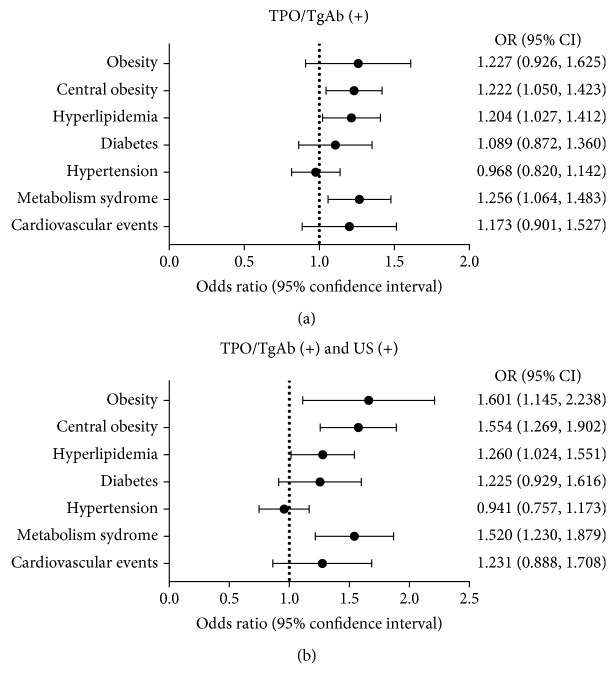
After full adjustment, TPOAb and/or TgAb positivity (TPO/TgAb (+)) was significantly associated with higher BMI, waist circumference (WC), and HbA1c only in women ( = 0.004, 0.026 and 0.032, respectively), while both TPO/TgAb positivity and US positivity (TPO/TgAb (+) and US (+)) were positively associated with BMI and WC in both genders ( = 0.002 and 0.020 in men; < 0.001and <0.001 in women). TPO/TgAb (+) and US (+) were positively associated with HOMA-IR in women ( = 0.021) as well. Binary logistic analysis showed that AITDs had increased risks of central obesity, hyperlipidemia, and metabolic syndrome only in women (all < 0.05). Moreover, TPO/TgAb (+) and US (+) were associated with an increased risk of obesity for both genders ( = 0.014 in men and = 0.006 in women).
Thyroid autoimmunity was positively associated with HbA1c, HOMA-IR, obesity, central obesity, hyperlipidemia, and metabolic syndrome, especially in women. This highlighted that AITDs may be potential risk factors for cardiometabolic disorders even if one's TSH was within the reference range.
甲状腺自身免疫与心血管风险之间的相互关系很复杂,尚未得到证实。本研究旨在评估甲状腺自身免疫性疾病(AITD)与正常促甲状腺激素(TSH)水平人群的心血管代谢风险之间是否存在关联。
该数据来自一项横断面研究(SPECT-China 研究)。该研究纳入了 9082 名年龄在 18 岁以上且 TSH 水平正常的受试者(男性 3948 名,女性 5134 名)。根据 TPOAb 和 TgAb 阳性以及甲状腺超声(US)结果定义 AITD。
经完全调整后,TPOAb 和/或 TgAb 阳性(TPO/TgAb(+))仅在女性中与更高的 BMI、腰围(WC)和 HbA1c 显著相关(分别为 = 0.004、0.026 和 0.032),而 TPO/TgAb 阳性和 US 阳性(TPO/TgAb(+)和 US(+))在两性中均与 BMI 和 WC 呈正相关(男性分别为 = 0.002 和 0.020;女性均为 <0.001)。TPO/TgAb(+)和 US(+)也与女性的 HOMA-IR 呈正相关( = 0.021)。二元逻辑分析显示,AITD 仅使女性发生中心性肥胖、血脂异常和代谢综合征的风险增加(均 <0.05)。此外,TPO/TgAb(+)和 US(+)与两性肥胖的风险增加相关(男性为 = 0.014,女性为 = 0.006)。
甲状腺自身免疫与 HbA1c、HOMA-IR、肥胖、中心性肥胖、血脂异常和代谢综合征呈正相关,尤其是在女性中。这表明,即使 TSH 在参考范围内,AITD 也可能是心血管代谢紊乱的潜在危险因素。