Faculty of Engineering and IT, University of Technology Sydney, Ultimo, NSW, Australia.
Capital Markets Cooperative Research Centre, Sydney, NSW, Australia.
PLoS One. 2018 Nov 8;13(11):e0206274. doi: 10.1371/journal.pone.0206274. eCollection 2018.
Transport injuries commonly result in significant disease burden, leading to physical disability, mental health deterioration and reduced quality of life. Analyzing the patterns of healthcare service utilization after transport injuries can provide an insight into the health of the affected parties, allow improved health system resource planning, and provide a baseline against which any future system-level interventions can be evaluated. Therefore, this research aims to use time series of service utilization provided by a compensation agency to identify groups of claimants with similar utilization patterns, describe such patterns, and characterize the groups in terms of demographic, accident type and injury type.
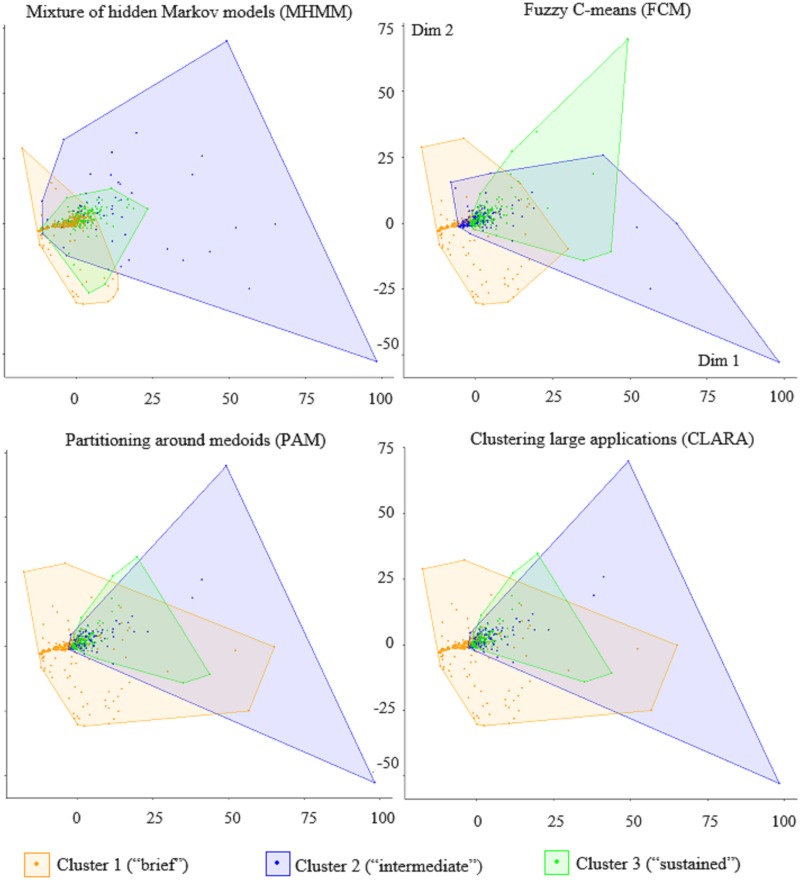
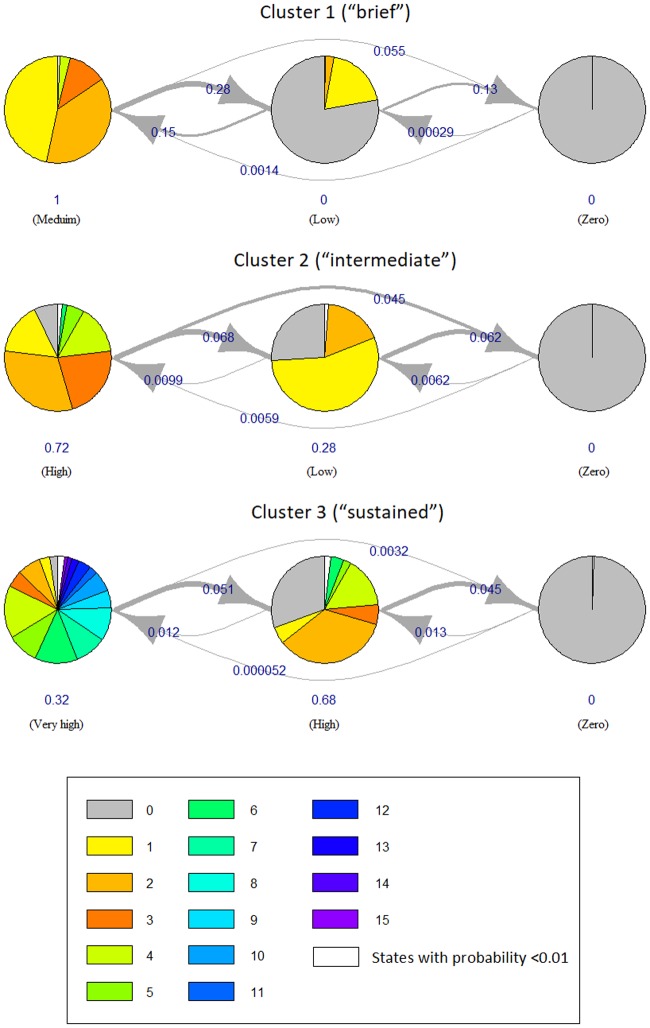
To achieve this aim, we have proposed an analytical framework that utilizes latent variables to describe the utilization patterns over time and group the claimants into clusters based on their service utilization time series. To perform the clustering without dismissing the temporal dimension of the time series, we have used a well-established statistical approach known as the mixture of hidden Markov models (MHMM). Ensuing the clustering, we have applied multinomial logistic regression to provide a description of the clusters against demographic, injury and accident covariates.
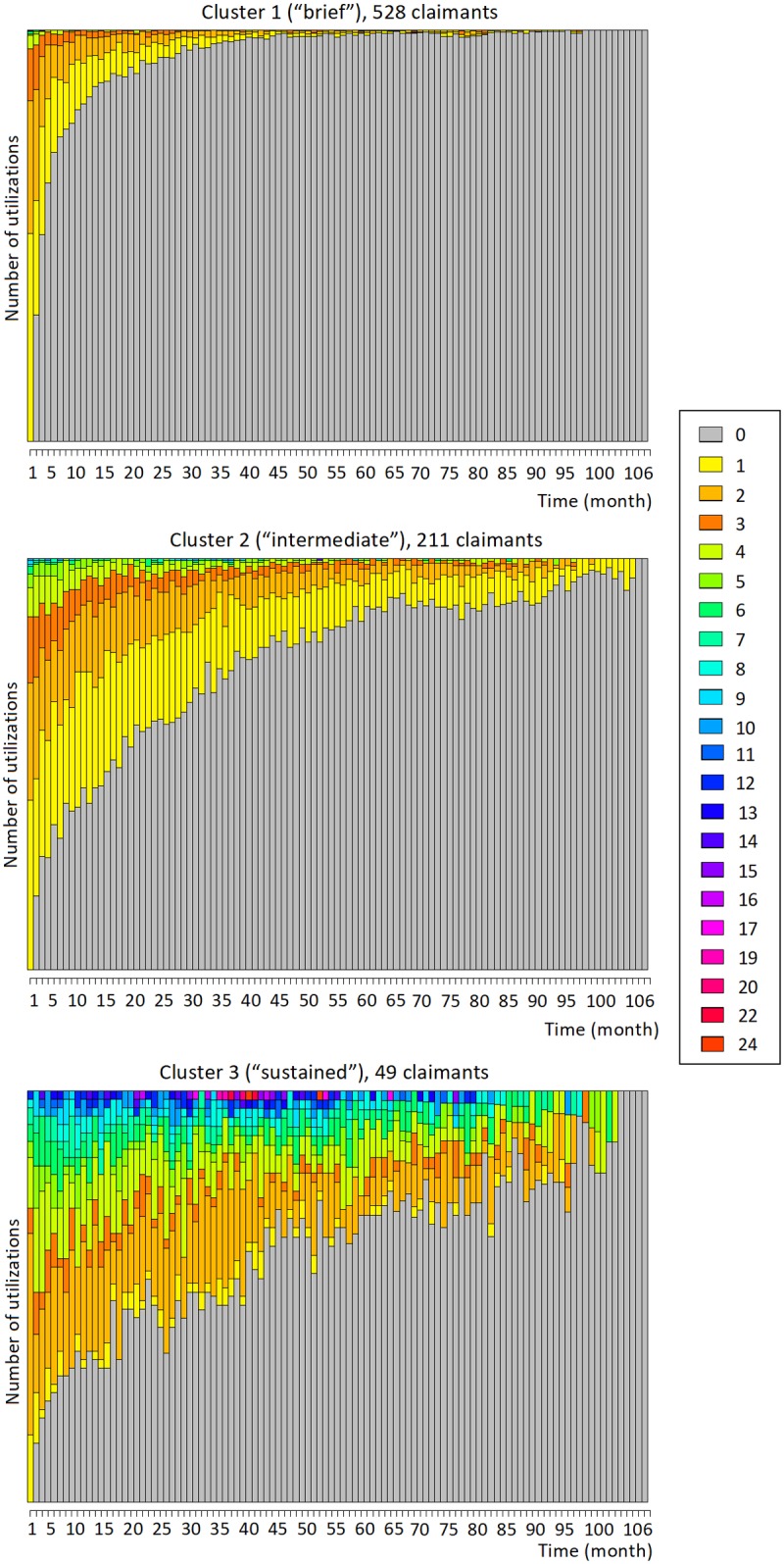
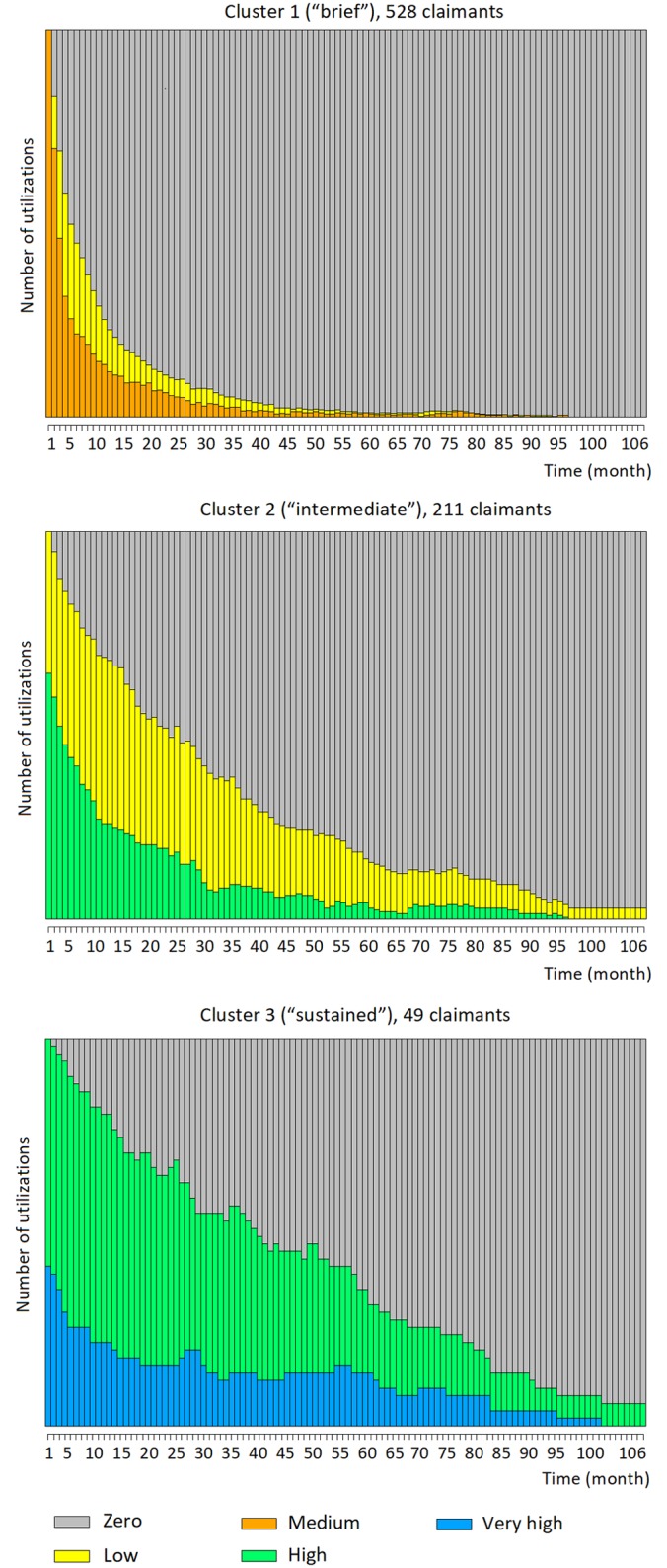
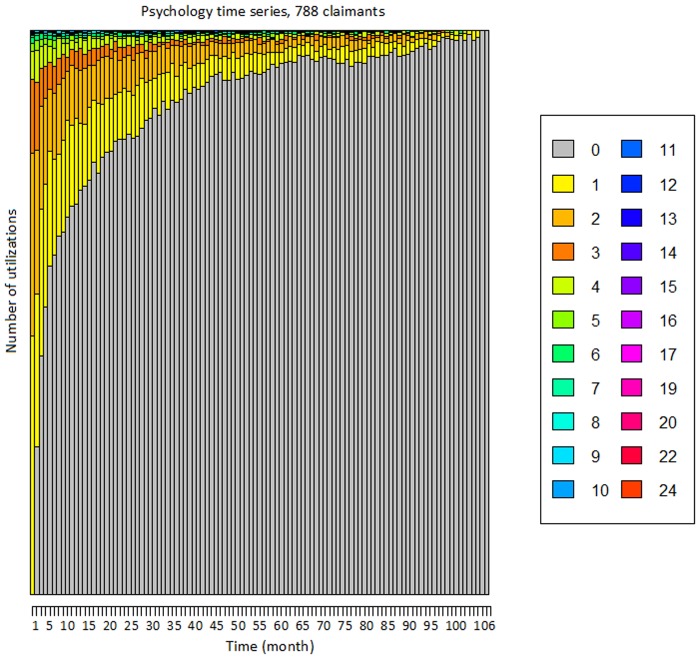
We have tested our model with data on psychology service utilization from one of the main compensation agencies for transport accidents in Australia, and found that three clear clusters of service utilization can be evinced from the data. These three clusters correspond to claimants who have tended to use the services 1) only briefly after the accident; 2) for an intermediate period of time and in moderate amounts; and 3) for a sustained period of time, and intensely. The size of these clusters is approximately 67%, 27% and 6% of the number of claimants, respectively. The multinomial logistic regression analysis has showed that claimants who were 30 to 60-year-old at the time of accident, were witnesses, and who suffered a soft tissue injury were more likely to be part of the intermediate cluster than the majority cluster. Conversely, claimants who suffered more severe injuries such as a brain head injury or anon-limb fracture injury and who started their service utilization later were more likely to be part of the sustained cluster.
This research has showed that clustering of service utilization time series is an effective approach for identifying the main user groups and utilization patterns of a healthcare service. In addition, using logistic regression to describe the clusters in terms of demographic, injury and accident covariates has helped identify the salient attributes of the claimants in each cluster. This finding is very important for the compensation agency and potentially other authorities as it provides a baseline to improve need understanding, resource planning and service provision.
交通伤通常会导致严重的疾病负担,导致身体残疾、心理健康恶化和生活质量下降。分析交通伤后医疗服务利用模式可以深入了解受影响人群的健康状况,有助于改善卫生系统资源规划,并为任何未来的系统干预措施提供基准。因此,本研究旨在利用赔偿机构提供的服务利用时间序列,识别具有相似利用模式的索赔人群组,描述这些模式,并根据人口统计学、事故类型和损伤类型对人群组进行特征描述。
为了实现这一目标,我们提出了一个分析框架,该框架利用潜在变量来描述随时间变化的利用模式,并根据索赔人的服务利用时间序列将其分组到聚类中。为了在不忽略时间序列的时间维度的情况下进行聚类,我们使用了一种成熟的统计方法,即隐马尔可夫模型(HMM)的混合。在聚类之后,我们应用多项逻辑回归来提供对人口统计学、损伤和事故协变量的聚类描述。
我们使用澳大利亚主要交通事故赔偿机构之一的心理学服务利用数据对我们的模型进行了测试,发现可以从数据中得出三个明显的服务利用聚类。这三个聚类分别对应于那些 1)在事故后仅短暂使用服务的索赔人;2)在中等时间和中等数量内使用服务的索赔人;3)持续时间长且强度大的索赔人。这些聚类的大小分别约为索赔人数的 67%、27%和 6%。多项逻辑回归分析表明,事故发生时年龄在 30 至 60 岁之间、作为证人以及患有软组织损伤的索赔人比多数聚类更有可能属于中间聚类。相反,那些遭受更严重损伤(如颅脑损伤或非肢体骨折损伤)且开始服务利用时间较晚的索赔人更有可能属于持续聚类。
本研究表明,服务利用时间序列聚类是识别医疗服务主要使用者群体和利用模式的有效方法。此外,使用逻辑回归根据人口统计学、损伤和事故协变量描述聚类有助于确定每个聚类中索赔人的突出属性。这一发现对赔偿机构和潜在的其他机构非常重要,因为它为改善需求理解、资源规划和服务提供提供了基准。