Lanteri Marion C, Kanias Tamir, Keating Sheila, Stone Mars, Guo Yuelong, Page Grier P, Brambilla Donald J, Endres-Dighe Stacy M, Mast Alan E, Bialkowski Walter, D'Andrea Pam, Cable Ritchard G, Spencer Bryan R, Triulzi Darrell J, Murphy Edward L, Kleinman Steven, Gladwin Mark T, Busch Michael P
Vitalant Research Institute (previously Blood Systems Research Institute), University of San Francisco, San Francisco, California.
Department of Laboratory Medicine, University of San Francisco, San Francisco, California.
Transfusion. 2019 Jan;59(1):79-88. doi: 10.1111/trf.14987. Epub 2018 Nov 8.
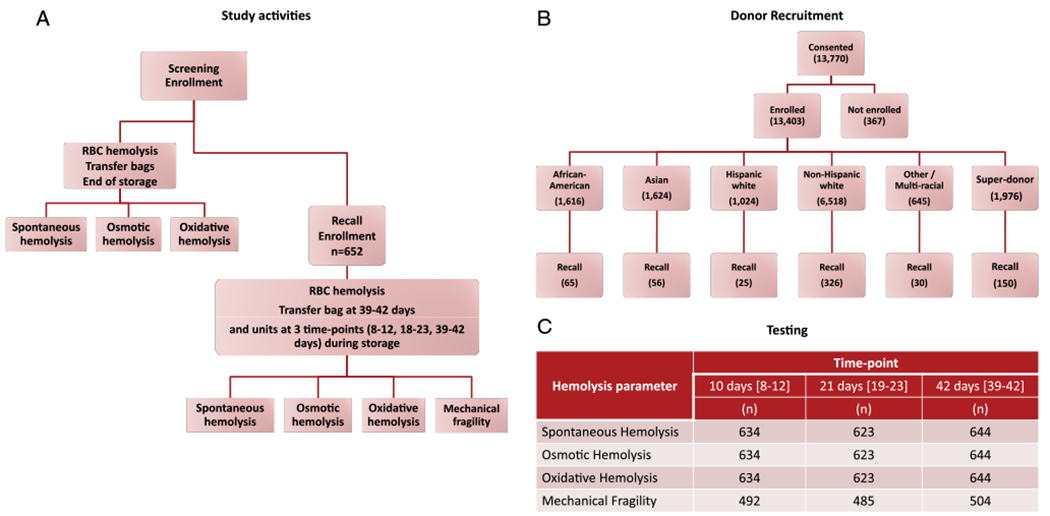
Genetic determinants may underlie the susceptibility of red blood cells (RBCs) to hemolyze in vivo and during routine storage. This study characterized the reproducibility and dynamics of in vitro hemolysis variables from a subset of the 13,403 blood donors enrolled in the RBC-Omics study.
RBC-Omics donors with either low or high hemolysis results on 4°C-stored leukoreduced (LR)-RBC samples from enrollment donations stored for 39 to 42 days were recalled 2 to 12 months later to donate LR-RBCs. Samples of stored LR-RBCs from the unit and from transfer bags were evaluated for spontaneous and stress-induced hemolysis at selected storage time points. Intradonor reproducibility of hemolysis variables was evaluated in transfer bags over two donations. Hemolysis data at serial storage time points were generated on LR-RBCs from parent bags and analyzed by site, sex, race/ethnicity, and donation frequency.
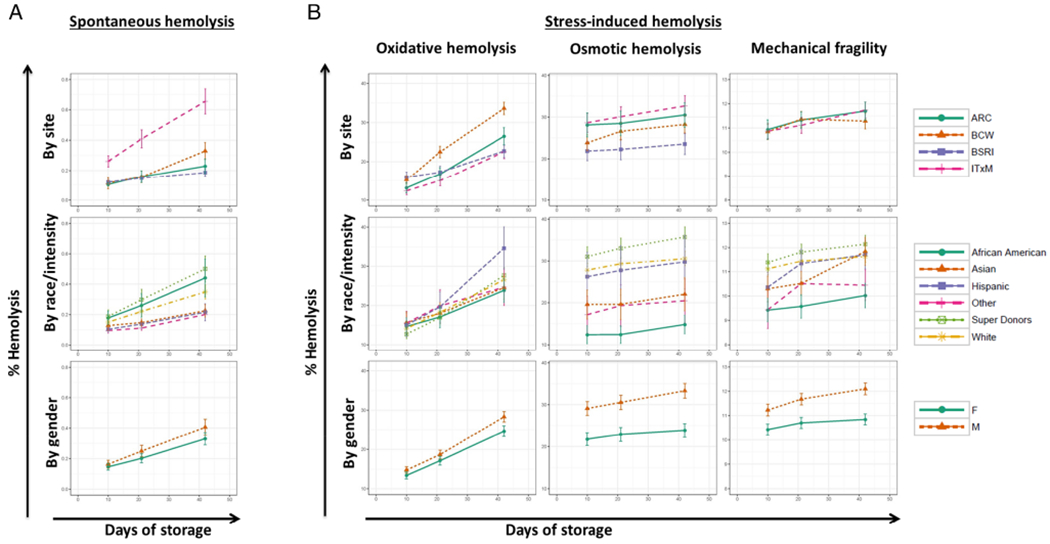
A total of 664 donors were successfully recalled. Analysis of intradonor reproducibility revealed that osmotic and oxidative hemolysis demonstrated good and moderate reproducibility (Pearson's r = 0.85 and r = 0.53, respectively), while spontaneous hemolysis reproducibility was poor (r = 0.40). Longitudinal hemolysis in parent bags showed large increases over time in spontaneous (508.6%) and oxidative hemolysis (399.8%) and smaller increases in osmotic (9.4%) and mechanical fragility (3.4%; all p < 0.0001).
Spontaneous hemolysis is poorly reproducible in donors over time and may depend on site processing methods, while oxidative and osmotic hemolysis were reproducible in donors and hence could reflect consistent heritable phenotypes attributable to genetic traits. Spontaneous and oxidative hemolysis increased over time of storage, whereas osmotic and mechanical hemolysis remained relatively stable.
遗传决定因素可能是红细胞(RBC)在体内及常规储存过程中发生溶血易感性的基础。本研究对参与红细胞组学研究的13403名献血者中的一部分人,体外溶血变量的可重复性和动态变化进行了特征分析。
对红细胞组学研究中,在4℃储存39至42天的白细胞滤除(LR)红细胞样本溶血结果低或高的献血者,在2至12个月后召回,再次捐献LR红细胞。在选定的储存时间点,对储存的单位LR红细胞样本和转移袋中的样本进行自发溶血和应激诱导溶血评估。在两次捐献的转移袋中评估溶血变量的供者内重复性。在母袋的LR红细胞上生成连续储存时间点的溶血数据,并按地点、性别、种族/民族和献血频率进行分析。
共成功召回664名献血者。供者内重复性分析显示,渗透溶血和氧化溶血表现出良好和中等的可重复性(Pearson相关系数分别为r = 0.85和r = 0.53),而自发溶血的可重复性较差(r = 0.40)。母袋中的纵向溶血显示,自发溶血(508.6%)和氧化溶血(399.8%)随时间大幅增加,渗透溶血(9.4%)和机械脆性(3.4%;所有p < 0.0001)增加较小。
随着时间推移,自发溶血在供者中可重复性较差,可能取决于采血点处理方法,而氧化溶血和渗透溶血在供者中具有可重复性,因此可能反映了由遗传特征导致的一致的可遗传表型。自发溶血和氧化溶血随储存时间增加,而渗透溶血和机械溶血相对保持稳定。