Jiang YanChao, Huang Yi, Cai ShiYing, Song YongFeng, Boyer James L, Zhang KeZhong, Gao Ling, Zhao JiaJun, Huang WenDong, Liang Guang, Liangpunsakul Suthat, Wang Li
Department of Physiology and Neurobiology and the Institute of Systems Genomics University of Connecticut Storrs CT.
School of Pharmaceutical Sciences Wenzhou Medical University Wenzhou China.
Hepatol Commun. 2018 Sep 24;2(11):1356-1368. doi: 10.1002/hep4.1252. eCollection 2018 Nov.
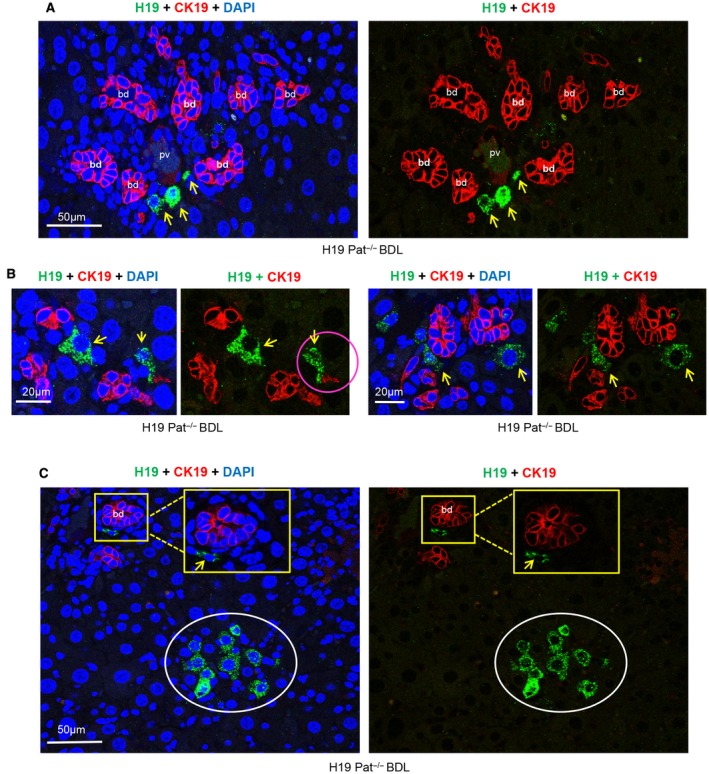
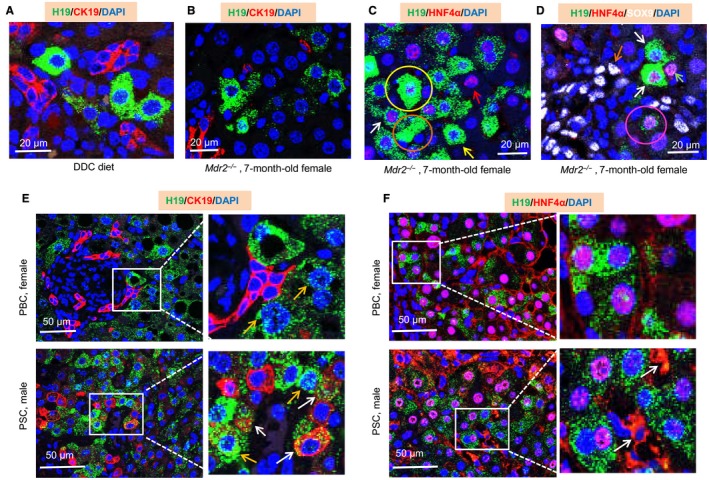
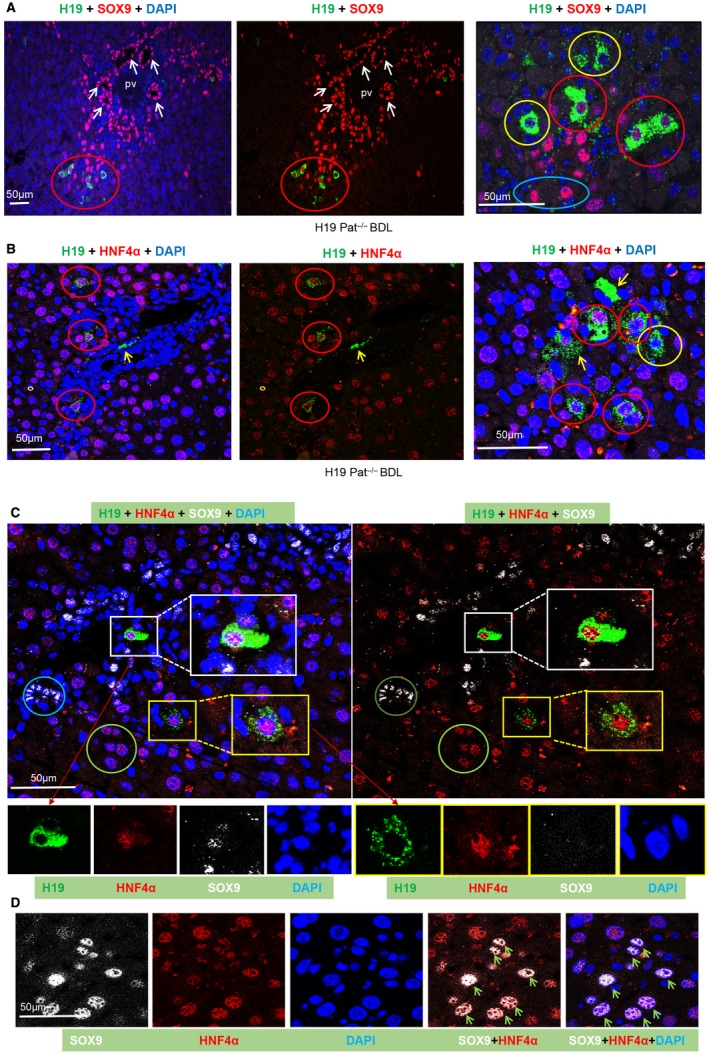
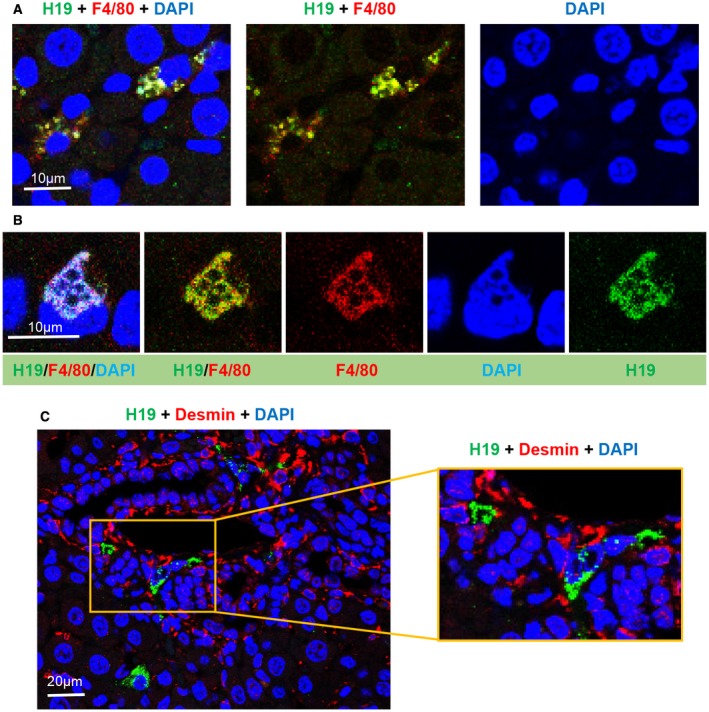
Long noncoding RNA (lncRNA) H19 is abundantly expressed in fetal liver. Its expression is significantly diminished in adult healthy liver but is re-induced in chronic liver diseases, including cholestasis. In this study, we developed a new method with combined hybridization (ISH) and immunofluorescence (IF) colabeling to establish an H19 expression profile with both parenchymal and nonparenchymal cell-specific markers in the livers of cholestatic mouse models and patients with cholestasis. RNA cells showed no colocalization with biliary epithelial cell marker cytokeratin 19 (CK19) cholangiocytes but were immediately adjacent to biliary structures in bile duct ligation (BDL), 3,5-diethoxycarbony1-1,4-dihydrocollidine (DDC), and multidrug-resistant gene 2 knockout ( ) mouse models and in human primary biliary cholangitis (PBC) and primary sclerosing cholangitis (PSC) liver specimens. In contrast, double-positive RNA/sex-determining region Y (SRY)-box 9 (SOX9) ductal progenitor cells, RNA/hepatocyte nuclear factor 4α (HNF4α) hepatocytes, RNA/F4/80 Kupffer cells, HNF4α/SOX9 hybrid hepatocytes, as well as triple-positive RNA/HNF4α/SOX9 periportal hepatocytes were identified. In addition, RNA could not be detected in mesenchymal cell marker desmin cells. Furthermore, RNA was predominately detected in cytoplasm with a small amount at the interspace with neighboring cells. RNA is localized in HNF4α periportal hepatocytes, SOX9 ductal progenitor cells, and F4/80 Kupffer cells but not in CK19 cholangiocytes and desmin stellate cells in cholestatic livers.
长链非编码RNA(lncRNA)H19在胎儿肝脏中大量表达。其表达在成年健康肝脏中显著降低,但在包括胆汁淤积在内的慢性肝病中会再次诱导表达。在本研究中,我们开发了一种结合杂交(ISH)和免疫荧光(IF)共标记的新方法,以在胆汁淤积小鼠模型和胆汁淤积患者的肝脏中建立具有实质细胞和非实质细胞特异性标记物的H19表达谱。RNA细胞与胆管上皮细胞标记物细胞角蛋白19(CK19)胆管细胞没有共定位,但在胆管结扎(BDL)、3,5 - 二乙氧基羰基 - 1,4 - 二氢可力丁(DDC)和多药耐药基因2敲除( )小鼠模型以及人类原发性胆汁性胆管炎(PBC)和原发性硬化性胆管炎(PSC)肝脏标本中与胆管结构紧邻。相比之下,鉴定出了双阳性RNA/性别决定区Y(SRY)-盒9(SOX9)导管祖细胞、RNA/肝细胞核因子4α(HNF4α)肝细胞、RNA/F4/80库普弗细胞、HNF4α/SOX9杂交肝细胞以及三阳性RNA/HNF4α/SOX9门周肝细胞。此外,在间充质细胞标记物结蛋白细胞中未检测到RNA。此外,RNA主要在细胞质中检测到,在与相邻细胞的间隙中有少量。RNA定位于胆汁淤积肝脏中的HNF4α门周肝细胞、SOX9导管祖细胞和F4/80库普弗细胞,但不在CK19胆管细胞和结蛋白星状细胞中。