Laboratório de Cirurgia Cardiovascular e Fisiopatologia da Circulação (LIM-11), Instituto do Coração (InCor), Hospital das Clinicas HCFMUSP, Faculdade de Medicina, Universidade de Sao Paulo, Sao Paulo, SP, Brazil.
University of Groningen, University Medical Center Groningen, Department of Pathology and Medical Biology, Groningen, The Netherlands.
Sci Rep. 2018 Nov 9;8(1):16633. doi: 10.1038/s41598-018-34747-3.
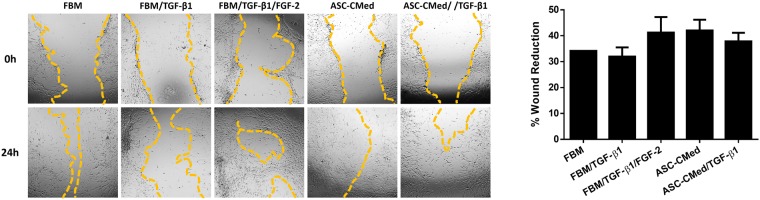
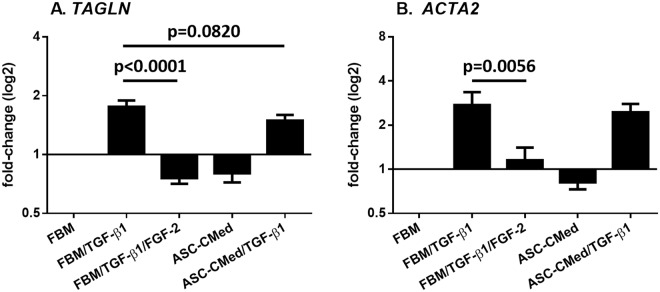
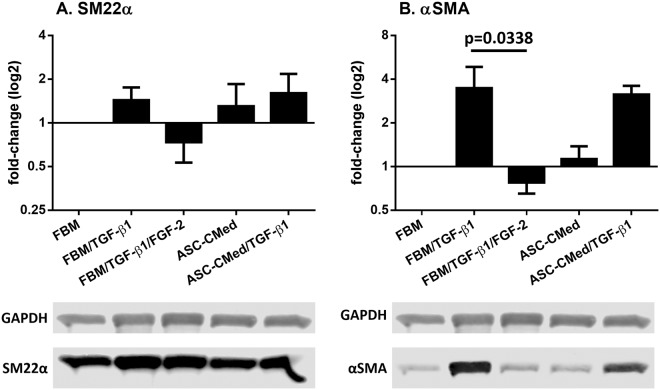
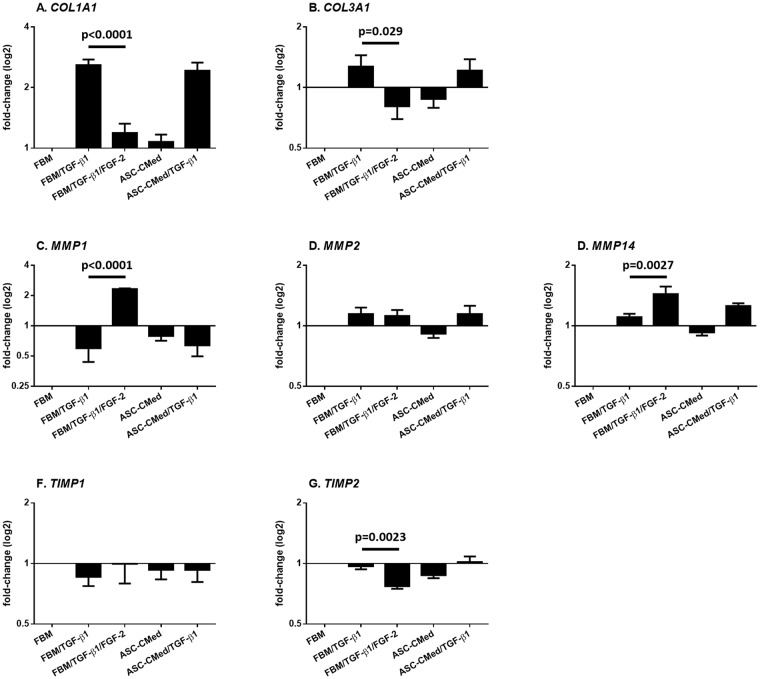
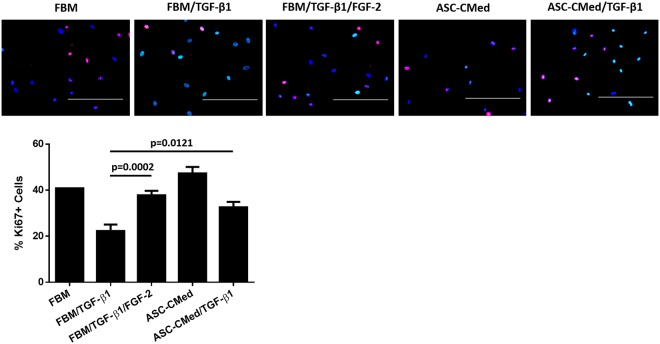
Transforming growth factor-β1 (TGF-β1) is a potent inducer of fibroblast to myofibroblast differentiation and contributes to the pro-fibrotic microenvironment during cardiac remodeling. Fibroblast growth factor-2 (FGF-2) is a growth factor secreted by adipose tissue-derived stromal cells (ASC) which can antagonize TGF-β1 signaling. We hypothesized that TGF-β1-induced cardiac fibroblast to myofibroblast differentiation is abrogated by FGF-2 and ASC conditioned medium (ASC-CMed). Our experiments demonstrated that TGF-β1 treatment-induced cardiac fibroblast differentiation into myofibroblasts, as evidenced by the formation of contractile stress fibers rich in αSMA. FGF-2 blocked the differentiation, as evidenced by the reduction in gene (TAGLN, p < 0.0001; ACTA2, p = 0.0056) and protein (αSMA, p = 0.0338) expression of mesenchymal markers and extracellular matrix components gene expression (COL1A1, p < 0.0001; COL3A1, p = 0.0029). ASC-CMed did not block myofibroblast differentiation. The treatment with FGF-2 increased matrix metalloproteinases gene expression (MMP1, p < 0.0001; MMP14, p = 0.0027) and decreased the expression of tissue inhibitor of metalloproteinase gene TIMP2 (p = 0.0023). ASC-CMed did not influence these genes. The proliferation of TGF-β1-induced human cardiac fibroblasts was restored by both FGF-2 (p = 0.0002) and ASC-CMed (p = 0.0121). The present study supports the anti-fibrotic effects of FGF-2 through the blockage of cardiac fibroblast differentiation into myofibroblasts. ASC-CMed, however, did not replicate the anti-fibrotic effects of FGF-2 in vitro.
转化生长因子-β1(TGF-β1)是一种有效的成纤维细胞向肌成纤维细胞分化诱导剂,并有助于心脏重构过程中的促纤维化微环境形成。成纤维细胞生长因子 2(FGF-2)是脂肪组织来源的基质细胞(ASC)分泌的生长因子,可以拮抗 TGF-β1 信号。我们假设 FGF-2 和 ASC 条件培养基(ASC-CMed)可以阻断 TGF-β1 诱导的心脏成纤维细胞向肌成纤维细胞的分化。我们的实验表明,TGF-β1 处理诱导心脏成纤维细胞分化为肌成纤维细胞,这表现为富含αSMA 的收缩力纤维的形成。FGF-2 阻断了分化,表现为间充质标记物和细胞外基质成分基因表达的基因(TAGLN,p < 0.0001;ACTA2,p = 0.0056)和蛋白(αSMA,p = 0.0338)表达减少。ASC-CMed 不能阻断肌成纤维细胞的分化。FGF-2 的治疗增加了基质金属蛋白酶基因表达(MMP1,p < 0.0001;MMP14,p = 0.0027)并降低了组织金属蛋白酶抑制剂基因 TIMP2 的表达(p = 0.0023)。ASC-CMed 对这些基因没有影响。FGF-2(p = 0.0002)和 ASC-CMed(p = 0.0121)均恢复了 TGF-β1 诱导的人心脏成纤维细胞的增殖。本研究支持 FGF-2 通过阻断心脏成纤维细胞向肌成纤维细胞的分化发挥抗纤维化作用。然而,ASC-CMed 并未在体外复制 FGF-2 的抗纤维化作用。