
Ni₃Si中Σ5(210)晶界张量弹性性质与化学键之间联系的从头算研究。
An Ab Initio Study of Connections between Tensorial Elastic Properties and Chemical Bonds in Σ5(210) Grain Boundaries in Ni₃Si.
作者信息
Friák Martin, Zelený Martin, Všianská Monika, Holec David, Šob Mojmír
机构信息
Institute of Physics of Materials, Academy of Sciences of the Czech Republic, Žižkova 22, CZ-616 62 Brno, Czech Republic.
Institute of Materials Science and Engineering, NETME Centre, Faculty of Mechanical Engineering, Brno University of Technology, Technická 2896/2, CZ-616 69 Brno, Czech Republic.
出版信息
Materials (Basel). 2018 Nov 13;11(11):2263. doi: 10.3390/ma11112263.
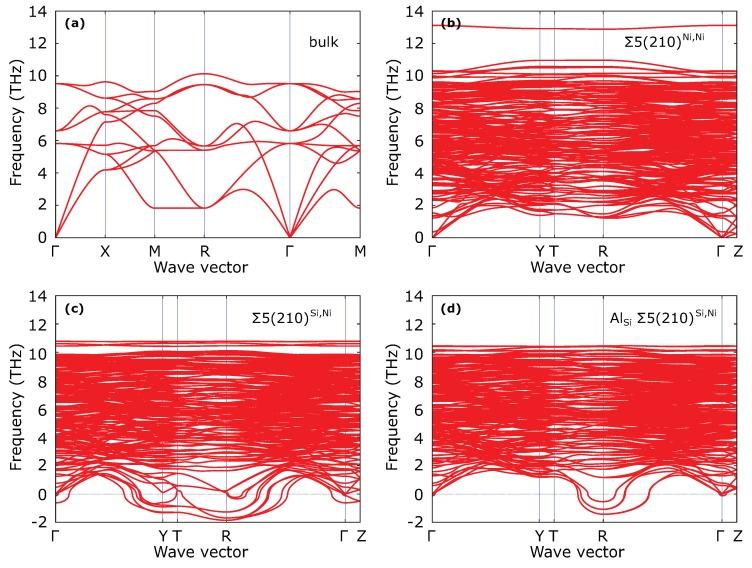
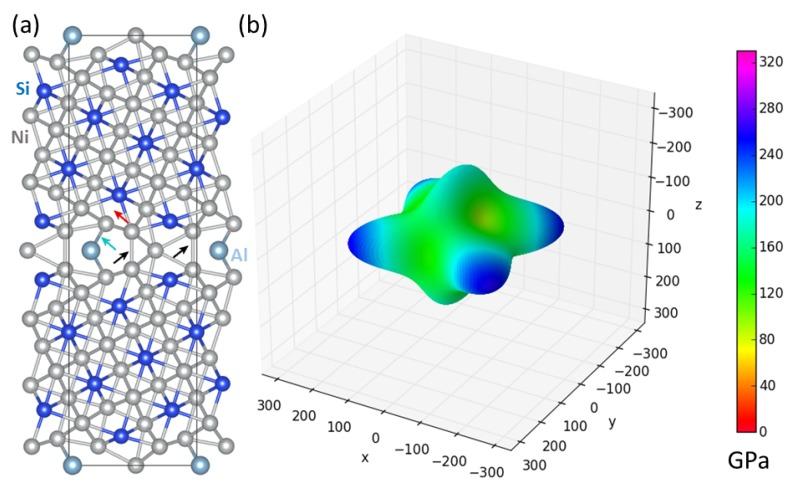
Using quantum-mechanical methods we calculate and analyze (tensorial) anisotropic elastic properties of the ground-state configurations of interface states associated with Σ 5(210) grain boundaries (GBs) in cubic L1 2 -structure Ni 3 Si. We assess the mechanical stability of interface states with two different chemical compositions at the studied GB by checking rigorous elasticity-based Born stability criteria. In particular, we show that a GB variant containing both Ni and Si atoms at the interface is unstable with respect to shear deformation (one of the elastic constants, C 55 , is negative). This instability is found for a rectangular-parallelepiped supercell obtained when applying standard coincidence-lattice construction. Our elastic-constant analysis allowed us to identify a shear-deformation mode reducing the energy and, eventually, to obtain mechanically stable ground-state characterized by a shear-deformed parallelepiped supercell. Alternatively, we tested a stabilization of this GB interface state by Al substituents replacing Si atoms at the GB. We further discuss an atomistic origin of this instability in terms of the crystal orbital Hamilton population (COHP) and phonon dispersion calculations. We find that the unstable GB variant shows a very strong interaction between the Si atoms in the GB plane and Ni atoms in the 3rd plane off the GB interface. However, such bond reinforcement results in weakening of interaction between the Ni atoms in the 3rd plane and the Si atoms in the 5th plane making this GB variant mechanically unstable.
我们使用量子力学方法计算并分析了立方L1₂结构Ni₃Si中与Σ5(210)晶界(GBs)相关的界面态基态构型的(张量)各向异性弹性性质。通过检查基于弹性的严格Born稳定性标准,我们评估了所研究晶界处两种不同化学成分的界面态的力学稳定性。特别地,我们表明,在界面处同时含有Ni和Si原子的一种晶界变体相对于剪切变形是不稳定的(弹性常数之一C₅₅为负)。在应用标准重合点阵构造得到的长方体超胞中发现了这种不稳定性。我们的弹性常数分析使我们能够识别出一种降低能量的剪切变形模式,并最终获得以剪切变形的平行六面体超胞为特征的力学稳定基态。或者,我们测试了通过Al取代基取代晶界处的Si原子来稳定这种晶界界面态。我们进一步根据晶体轨道哈密顿布居(COHP)和声子色散计算讨论了这种不稳定性的原子起源。我们发现,不稳定的晶界变体在晶界平面中的Si原子与离晶界界面第三个平面中的Ni原子之间表现出非常强的相互作用。然而,这种键增强导致第三个平面中的Ni原子与第五个平面中的Si原子之间的相互作用减弱,使得这种晶界变体在力学上不稳定。





 Zotero 插件