Department of Nephrology, Monash Medical Centre, Monash Health, Clayton, VIC, Australia.
Department of Medicine, Monash University, Clayton, VIC, Australia.
BMC Nephrol. 2018 Nov 14;19(1):325. doi: 10.1186/s12882-018-1127-7.
Serum fibroblast growth factor 23 (FGF-23) levels are markedly elevated in haemodialysis patients and have been linked to mortality outcomes. Small studies in health and chronic kidney disease, have demonstrated marked intra- and inter-individual variability in measured FGF-23 levels, and variable degradation in serum as compared to plasma samples. In end-stage kidney disease (ESKD), the intra- and inter-individual variability of FGF-23 levels, and the optimal collection methods remain poorly characterized. In this study we assessed the variability of FGF-23 levels in a cohort of stable haemodialysis patients. Secondly, in a subset of patients, we assessed the effects of different collection methods on measured FGF-23 levels.
To assess the variability of FGF-23, pre-dialysis blood samples were collected over 3 consecutive weeks from 75 haemodialysis patients. The effects of different specimen collection methods were examined in a subset of patients (n = 23), with pre-dialysis blood collected into different tubes: plain (serum), EDTA (plasma) and EDTA with the addition of a protease inhibitor (EDTA-PI). All analyses were performed in the main cohort and repeated in each subgroup. Variability over a 3-week period was assessed using repeated measures ANOVA and random effects linear regression models. Intra-class correlation coefficients were calculated to assess agreement, and coefficients of variation were calculated to assess intra- and inter-individual variability.
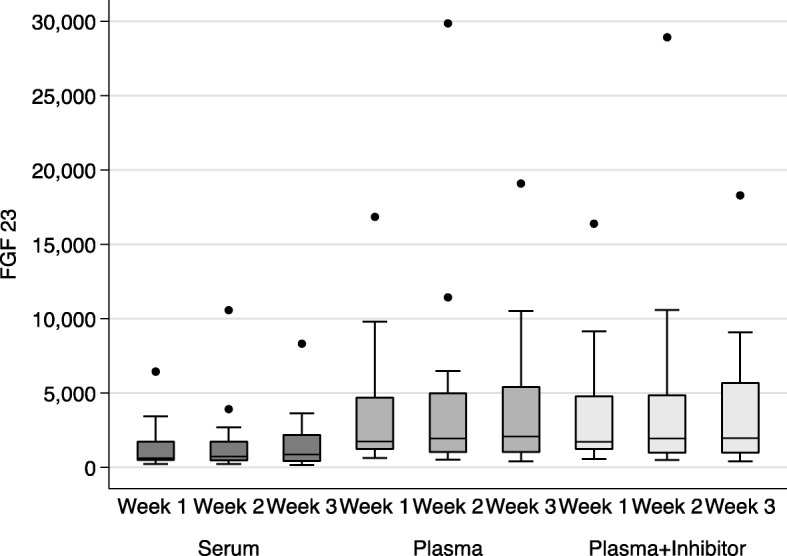
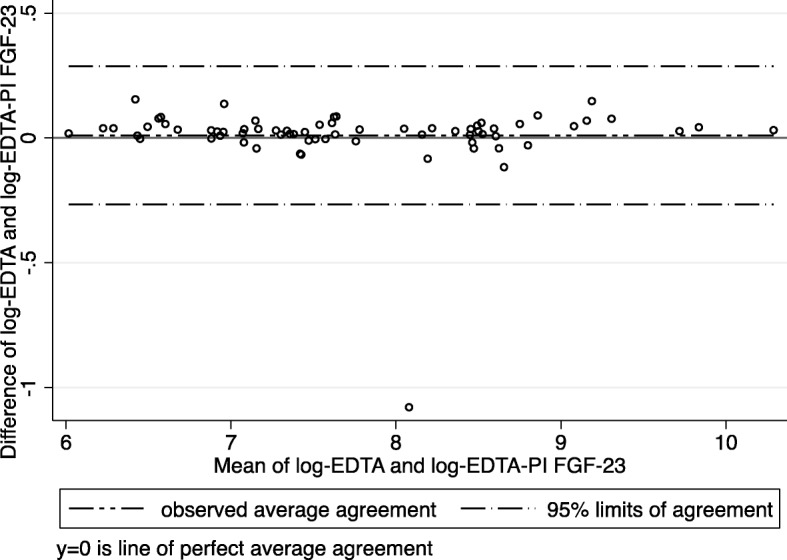
Over the 3-week study period the mean FGF-23 levels were not significantly different in the serum (p = 0.26), EDTA (p = 0.62) and EDTA-PI (p = 0.55) groups. FGF-23 levels demonstrated marked intra- and inter-individual variability with a CV of 36 and 203.2%, respectively. In the subgroup analysis, the mean serum FGF-23 levels were significantly lower than the EDTA (p < 0.001) or EDTA-PI (p < 0.001) groups, however there was no difference in mean FGF-23 levels between EDTA and EDTA-PI (p = 0.54).
The measured FGF-23 levels were significantly lower in serum as compared to plasma, and the addition of a protease inhibitor did not confer an additional benefit. Importantly in this cohort of ESKD patients, FGF-23 levels showed marked intra- and inter-individual variability. The routine measurement of FGF-23 in ESKD remains challenging, however this study suggests the plasma is the optimal collection method for FGF-23 analysis.
血清成纤维细胞生长因子 23(FGF-23)水平在血液透析患者中明显升高,并与死亡率结果相关。在健康和慢性肾脏病的小型研究中,已经证明了测量的 FGF-23 水平存在明显的个体内和个体间变异性,并且与血浆样本相比,血清中的 FGF-23 水平存在可变的降解。在终末期肾病(ESKD)中,FGF-23 水平的个体内和个体间变异性以及最佳采集方法仍未得到很好的描述。在这项研究中,我们评估了稳定血液透析患者队列中 FGF-23 水平的变异性。其次,在一部分患者中,我们评估了不同采集方法对测量的 FGF-23 水平的影响。
为了评估 FGF-23 的变异性,从 75 名血液透析患者中连续 3 周采集了透析前血液样本。在一部分患者(n=23)中,用不同的试管采集了透析前血液:普通(血清)、EDTA(血浆)和 EDTA 加蛋白酶抑制剂(EDTA-PI)。在主队列中进行了所有分析,并在每个亚组中重复进行。使用重复测量方差分析和随机效应线性回归模型评估 3 周期间的变异性。计算了组内相关系数以评估一致性,并计算了变异系数以评估个体内和个体间的变异性。
在 3 周的研究期间,血清(p=0.26)、EDTA(p=0.62)和 EDTA-PI(p=0.55)组的平均 FGF-23 水平没有显著差异。FGF-23 水平表现出明显的个体内和个体间变异性,变异系数分别为 36%和 203.2%。在亚组分析中,血清 FGF-23 水平明显低于 EDTA(p<0.001)或 EDTA-PI(p<0.001)组,但 EDTA 和 EDTA-PI 之间的平均 FGF-23 水平没有差异(p=0.54)。
与血浆相比,血清中测量的 FGF-23 水平明显降低,并且添加蛋白酶抑制剂并没有带来额外的益处。重要的是,在这个 ESKD 患者队列中,FGF-23 水平表现出明显的个体内和个体间变异性。在 ESKD 中常规测量 FGF-23 仍然具有挑战性,但是这项研究表明血浆是 FGF-23 分析的最佳采集方法。