Dolibog Patrycja, Dolibog Paweł T, Franek Andrzej, Brzezińska-Wcisło Ligia, Wróbel Beata, Arasiewicz Hubert, Chmielewska Daria, Ziaja Jacek, Błaszczak Edward
Chair and Department of Medical Biophysics, School of Medicine, Medical University of Silesia, Katowice, Poland.
Department of Dermatology, School of Medicine, Medical University of Silesia, Katowice, Poland.
Postepy Dermatol Alergol. 2018 Oct;35(5):454-461. doi: 10.5114/ada.2018.79191. Epub 2018 Jul 19.
Venous insufficiency and venous leg ulcers each year affect more and more people, especially in developed countries. The challenge of our time is to find an effective method of treating venous leg ulcers, which will further shorten treatment time and reduce the cost of treatment.
To compare the effects of treating venous leg ulcers using ultrasound therapy, radial shock wave therapy and standard care.
Group A consisted of 17 patients. Patients were treated with ultrasound therapy US power density 0.5 W/cm, pulsed wave with a duty cycle of 1/5, and 1 MHz frequency. Group B consisted of 17 patients. Patients were treated with the radial shock wave R-ESWT using surface energy density 0.17 mJ/mm, 100 impulses/cm, frequency of 5 Hz and a pressure of 0.2 MPa. Group C (control group) consisted of 17 patients. Patients in this group received standard care: gauze dressing saturated in 0.9% sodium chloride and elastic bandages changed daily for 4 weeks.
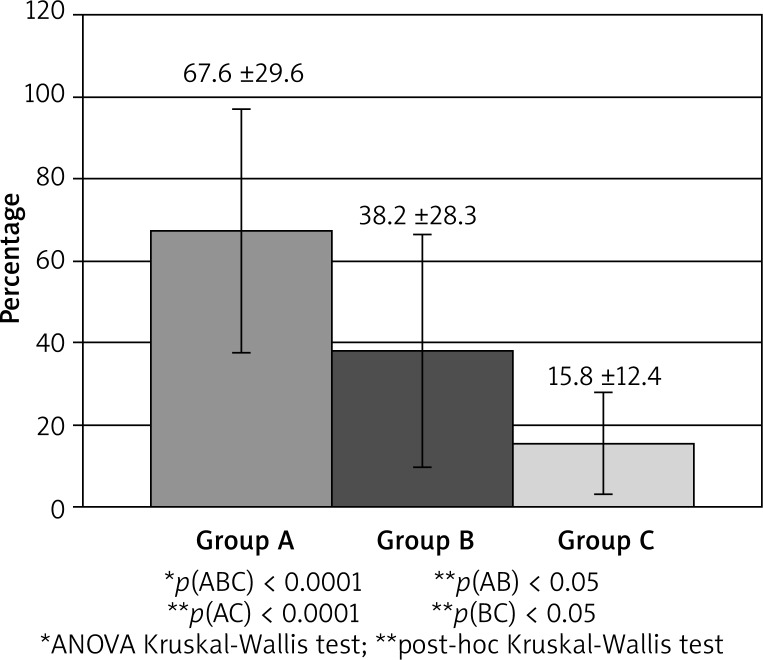
Ultrasound therapy with 1 MHz and energy power density 0.5 W/cm for 4 weeks resulted in an average reduction of 68% of the area of ulceration. We used for venous leg ulcers 4-week treatment with radial shock wave therapy resulting in a 38% mean percentage reduction of the ulceration area. Standard care reduces the area of ulceration by only 16%.
The use of ultrasound therapy for the treatment of venous leg ulcers is more effective than the use of radial shock wave therapy or standard care alone.
静脉功能不全和下肢静脉溃疡每年影响着越来越多的人,尤其是在发达国家。我们这个时代面临的挑战是找到一种有效的治疗下肢静脉溃疡的方法,这将进一步缩短治疗时间并降低治疗成本。
比较超声治疗、径向冲击波治疗和标准护理治疗下肢静脉溃疡的效果。
A组由17名患者组成。患者接受超声治疗,超声功率密度为0.5W/cm²,脉冲波,占空比为1/5,频率为1MHz。B组由17名患者组成。患者接受径向冲击波(R-ESWT)治疗,表面能量密度为0.17mJ/mm²,每厘米100次脉冲,频率为5Hz,压力为0.2MPa。C组(对照组)由17名患者组成。该组患者接受标准护理:用0.9%氯化钠浸湿的纱布敷料和弹性绷带,每天更换,持续4周。
采用1MHz、能量功率密度为0.5W/cm²的超声治疗4周后,溃疡面积平均减少68%。我们对下肢静脉溃疡采用径向冲击波治疗4周,溃疡面积平均减少38%。标准护理仅使溃疡面积减少16%。
使用超声治疗下肢静脉溃疡比单独使用径向冲击波治疗或标准护理更有效。