Qian Chunyan, Zhang Yuefeng, Zhang Xinyan, Yuan Chao, Gao Zhichao, Yuan Hong, Zhong Jiang
Yuhang Branch, The Second Affiliated Hospital of Zhejiang University, Hangzhou 311100, Zhejiang Province, PR China - School of Life Sciences, Fudan University, Shanghai 200433, PR China.
Yuhang Branch, The Second Affiliated Hospital of Zhejiang University, Hangzhou 311100, Zhejiang Province, PR China.
Parasite. 2018;25:54. doi: 10.1051/parasite/2018058. Epub 2018 Nov 16.
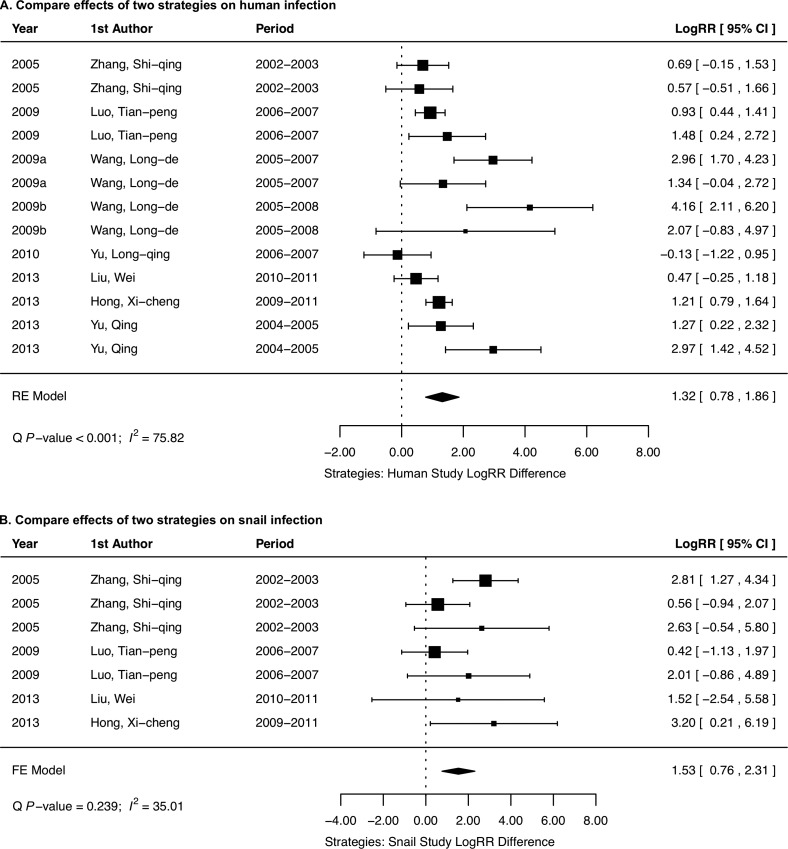
Since 2004, the national schistosomiasis control strategy in China has shifted from the morbidity control strategy (conventional strategy) to an integrated strategy (new strategy). We investigated the effectiveness of the new strategy and compared it against the conventional strategy. We retrieved from electronic databases the literature regarding the new strategy published from 2000 to 2017. The effect of the new or conventional strategy on infection by Schistosoma japonicum of humans and snails (Oncomelania hupensis) was evaluated with pooled log relative risk (logRR). A total of only eight eligible publications were included in the final meta-analysis. The results showed that implementation of the new strategy reduced the infection risk by 3-4 times relative to the conventional strategy. More specifically, the conventional strategy caused a reduction in both human (logRR = 0.56, 95% CI: 0.12-0.99) and snail infections (logRR = 0.34, 95% CI: -0.69-1.37), while the new strategy also significantly reduced both human (logRR = 1.89, 95% CI: 1.33-2.46) and snail infections (logRR = 1.61, 95% CI: 1.06-2.15). In contrast to the conventional strategy, the new strategy appeared more effective to control both human (logRR difference = 1.32, 95% CI: 0.78-1.86) and snail infections (logRR difference = 1.53, 95% CI: 0.76-2.31). Our data demonstrate that the new integrated strategy is highly effective to control the transmission of S. japonicum in China, and this strategy is recommended for schistosomiasis elimination in other affected regions across the world, with adaptation to local conditions.
自2004年起,中国的国家血吸虫病防治策略已从发病控制策略(传统策略)转变为综合策略(新策略)。我们调查了新策略的有效性,并将其与传统策略进行比较。我们从电子数据库中检索了2000年至2017年发表的有关新策略的文献。采用合并对数相对风险(logRR)评估新策略或传统策略对人类和钉螺(湖北钉螺)感染日本血吸虫的影响。最终的荟萃分析仅纳入了8篇符合条件的出版物。结果显示,与传统策略相比,新策略的实施使感染风险降低了3至4倍。更具体地说,传统策略使人类感染(logRR = 0.56,95%可信区间:0.12 - 0.99)和钉螺感染(logRR = 0.34,95%可信区间:-0.69 - 1.37)均有所降低,而新策略也显著降低了人类感染(logRR = 1.89,95%可信区间:1.33 - 2.46)和钉螺感染(logRR = 1.61,95%可信区间:1.06 - 2.15)。与传统策略相比,新策略在控制人类感染(logRR差异 = 1.32,95%可信区间:0.78 - 1.86)和钉螺感染(logRR差异 = 1.53,95%可信区间:0.76 - 2.31)方面似乎更有效。我们的数据表明,新的综合策略在控制中国日本血吸虫传播方面非常有效,建议在世界其他受影响地区因地制宜地采用该策略以消除血吸虫病。