Research Laboratory and Department of Laboratory Medicine, Nordland Hospital Trust, Bodø, Norway.
Department of Clinical Medicine, UiT - The Arctic University of Norway, Tromsø, Norway.
Clin Exp Immunol. 2019 Apr;196(1):97-110. doi: 10.1111/cei.13240. Epub 2018 Dec 19.
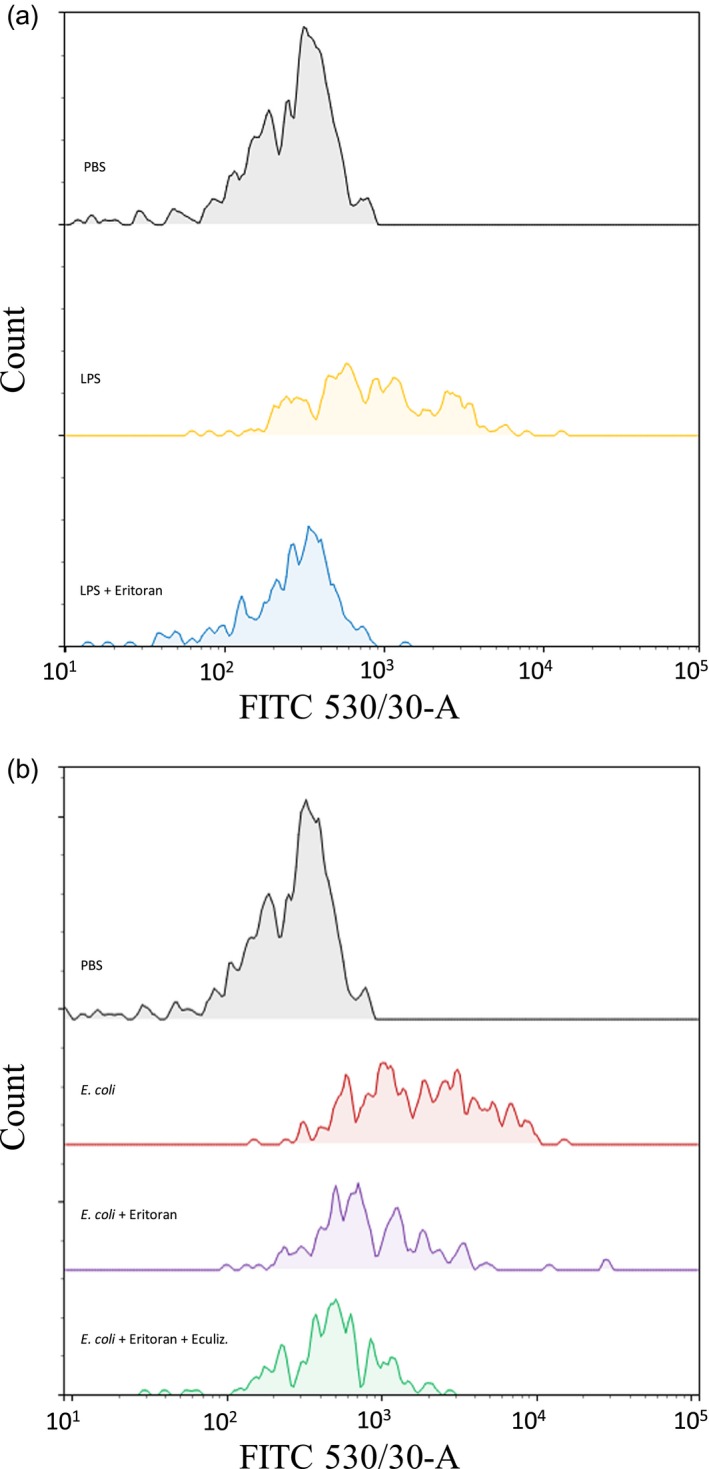
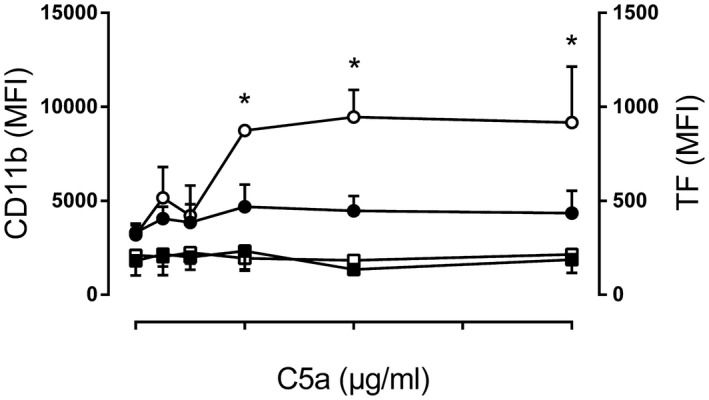
There is a close cross-talk between complement, Toll-like receptors (TLRs) and coagulation. The role of the central complement component 5 (C5) in physiological and pathophysiological hemostasis has not, however, been fully elucidated. This study examined the effects of C5 in normal hemostasis and in Escherichia coli-induced coagulation and tissue factor (TF) up-regulation. Fresh whole blood obtained from six healthy donors and one C5-deficient individual (C5D) was anti-coagulated with the thrombin inhibitor lepirudin. Blood was incubated with or without E. coli in the presence of the C5 inhibitor eculizumab, a blocking anti-CD14 monoclonal antibody (anti-CD14) or the TLR-4 inhibitor eritoran. C5D blood was reconstituted with purified human C5. TF mRNA was measured by quantitative polymerase chain reaction (qPCR) and monocyte TF and CD11b surface expression by flow cytometry. Prothrombin fragment 1+2 (PTF1·2) in plasma and microparticles exposing TF (TF-MP) was measured by enzyme-linked immunosorbent assay (ELISA). Coagulation kinetics were analyzed by rotational thromboelastometry and platelet function by PFA-200. Normal blood with eculizumab as well as C5D blood with or without reconstitution with C5 displayed completely normal biochemical hemostatic patterns. In contrast, E. coli-induced TF mRNA and TF-MP were significantly reduced by C5 inhibition. C5 inhibition combined with anti-CD14 or eritoran completely inhibited the E. coli-induced monocyte TF, TF-MP and plasma PTF1·2. Addition of C5a alone did not induce TF expression on monocytes. In conclusion, C5 showed no impact on physiological hemostasis, but substantially contributed to E. coli-induced procoagulant events, which were abolished by the combined inhibition of C5 and CD14 or TLR-4.
补体、Toll 样受体 (TLR) 和凝血之间存在密切的相互作用。然而,中心补体成分 5 (C5) 在生理和病理生理止血中的作用尚未完全阐明。本研究检测了 C5 在正常止血以及大肠杆菌诱导的凝血和组织因子 (TF) 上调中的作用。从六名健康供体和一名 C5 缺陷个体 (C5D) 中获得新鲜全血,用凝血酶抑制剂 lepirudin 抗凝。在存在 C5 抑制剂 eculizumab、阻断性抗 CD14 单克隆抗体 (抗 CD14) 或 TLR-4 抑制剂 eritoran 的情况下,用或不用大肠杆菌孵育血液。用纯化的人 C5 重建 C5D 血液。通过定量聚合酶链反应 (qPCR) 测量 TF mRNA,通过流式细胞术测量单核细胞 TF 和 CD11b 表面表达。通过酶联免疫吸附试验 (ELISA) 测量血浆中凝血酶原片段 1+2 (PTF1·2) 和暴露 TF 的微粒 (TF-MP)。通过旋转血栓弹性测定法分析凝血动力学,通过 PFA-200 分析血小板功能。用 eculizumab 的正常血液以及用或不用 C5 重建的 C5D 血液显示出完全正常的生化止血模式。相比之下,C5 抑制显著降低了大肠杆菌诱导的 TF mRNA 和 TF-MP。C5 抑制与抗 CD14 或 eritoran 联合完全抑制了大肠杆菌诱导的单核细胞 TF、TF-MP 和血浆 PTF1·2。单独添加 C5a 不会诱导单核细胞表达 TF。总之,C5 对生理止血没有影响,但对大肠杆菌诱导的促凝事件有很大贡献,这些事件通过 C5 和 CD14 或 TLR-4 的联合抑制而被消除。