Department of Ophthalmology, University of Cologne, Kerpener Strasse 62, 50924, Cologne, Germany.
Department of Dermatology, University of Dusseldorf, Düsseldorf, Germany.
Eur J Med Res. 2018 Nov 16;23(1):58. doi: 10.1186/s40001-018-0355-4.
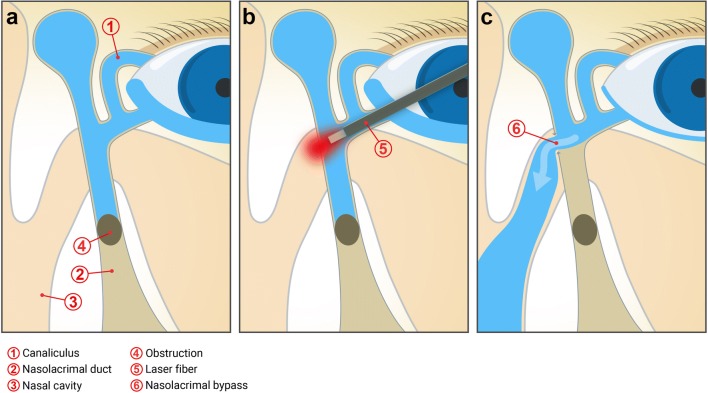
External dacryocystorhinostomy (DCR) is considered as the gold standard in the treatment of acquired nasolacrimal duct obstruction. However, many advances have been made towards the development of modern minimally invasive therapies. These new techniques were proven less harmful to the patients' skin and medial palpebral structures with their palpebral-canalicular pump mechanism. Options include endonasal and transcanalicular procedures. Here, we report on our 2-year experience with the surgical technique, results and complications of transcanalicular laser-assisted DCR.
This is a retrospective study. A total of 104 patients with acquired nasolacrimal duct obstruction underwent transcanalicular laser-assisted DCR combined with bicanalicular silicon intubation. We then analyzed intra-/post-operative complications and subjective and objective success rates. The institutional ethics committee ruled that approval was not necessary. The trial was registered with the German Clinical Trials Register (DRKS00012879).
Transcanalicular laser-assisted DCR in combination with bicanalicular silicon intubation could be performed surgically successfully in 101 patients (97%). In three cases (3%) using the superior canalicular approach, positioning of the laser instrument at the anteroinferior rim of the middle turbinate failed. Complications included thermal injury to the canaliculus (one), canalicular infection (two) and silicon tube prolapse (ten). Functional success (resolution of preoperative symptoms) was achieved in 80 cases (77%), functional failure occured in 24 cases with all patients reporting persisting epiphora, 15 reporting failure to irrigate the nasolacrimal duct and 15 requiring secondary external DCR.
Laser-assisted DCR shows promising results with few complications. It seems well suited as a second-step procedure after failed recanalization and before external DCR.
外路泪囊鼻腔吻合术(DCR)被认为是治疗后天性鼻泪管阻塞的金标准。然而,许多先进的微创治疗技术已经得到了发展。这些新技术对患者的皮肤和内眦结构以及其睑管泵机制的损伤较小。选择包括经鼻和经泪小管途径。在此,我们报告了我们在经泪小管激光辅助 DCR 手术技术、结果和并发症方面的 2 年经验。
这是一项回顾性研究。共有 104 例后天性鼻泪管阻塞患者接受了经泪小管激光辅助 DCR 联合双泪小管硅管插管。然后,我们分析了术中/术后并发症以及主观和客观成功率。机构伦理委员会裁定无需批准。该试验已在德国临床试验注册处(DRKS00012879)注册。
101 例(97%)患者成功进行了经泪小管激光辅助 DCR 联合双泪小管硅管插管手术。在 3 例(3%)采用上泪小管入路的患者中,激光器械定位在中鼻甲的前下边缘失败。并发症包括:泪小管热损伤(1 例)、泪小管感染(2 例)和硅管脱出(10 例)。80 例(77%)患者达到功能成功(术前症状缓解),24 例患者出现功能失败,所有患者均报告持续溢泪,15 例报告无法冲洗鼻泪管,15 例需要再次进行外路 DCR。
激光辅助 DCR 并发症少,效果有一定前景。它似乎非常适合作为失败再通后的第二步治疗方法,也是外路 DCR 之前的选择。