Luirink J, Hayashi S, Wu H C, Kater M M, de Graaf F K, Oudega B
Department of Molecular Microbiology, Vrije Universiteit, Amsterdam, The Netherlands.
J Bacteriol. 1988 Sep;170(9):4153-60. doi: 10.1128/jb.170.9.4153-4160.1988.
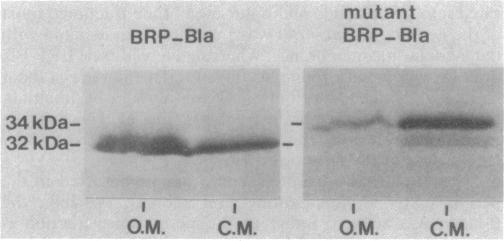
The pCloDF13-encoded bacteriocin release protein (BRP; Mr 2,871) is essential for the translocation of cloacin DF13 across the cell envelope of producing Escherichia coli cells. Overproduction of this BRP provokes lysis (quasilysis) of cells. Construction and analysis of a hybrid BRP-beta-lactamase protein (BRP-Bla) demonstrated that the BRP contains a lipid modified cysteine residue at its amino terminus and is mainly located in the outer membrane. The significance of lipid modification for the localization and functioning of the BRP was investigated. Site-directed mutagenesis was used to substitute the cysteine residue for a glycine residue in the lipobox of the BRP and the BRP-Bla protein. The mutated BRP was unable to bring about the release of cloacin DF13 and could not provide the lysis (quasilysis) of host cells. However, the mutated BRP strongly inhibited the colony-forming ability of the cells, indicating that induction of the mutated protein still affected cell viability. In contrast to the wild-type BRP-Bla protein, the mutated BRP-Bla protein was mainly located in the cytoplasmic membrane, indicating that the mutation prevented the proper localization of the protein. The results indicated that lipid modification of the BRP is required for its localization and release of cloacin DF13, but not for its lethality to host cells.
pCloDF13编码的细菌素释放蛋白(BRP;分子量2871)对于细菌素DF13穿过产细菌素的大肠杆菌细胞包膜进行转运至关重要。过量表达这种BRP会引发细胞裂解(准裂解)。构建并分析一种杂交BRP-β-内酰胺酶蛋白(BRP-Bla)表明,BRP在其氨基末端含有一个脂质修饰的半胱氨酸残基,且主要位于外膜。研究了脂质修饰对于BRP定位和功能的重要性。利用定点诱变将BRP和BRP-Bla蛋白脂质盒中的半胱氨酸残基替换为甘氨酸残基。突变后的BRP无法促使细菌素DF13释放,也不能引起宿主细胞裂解(准裂解)。然而,突变后的BRP强烈抑制细胞的集落形成能力,这表明突变蛋白的诱导仍会影响细胞活力。与野生型BRP-Bla蛋白不同,突变后的BRP-Bla蛋白主要位于细胞质膜,这表明该突变阻止了该蛋白的正确定位。结果表明,BRP的脂质修饰对于其定位和细菌素DF13的释放是必需的,但对于其对宿主细胞的致死性并非必需。