Aliaga Arantxa, Cunillera Oriol, Amador María Del Carmen, Aliaga Mercedes, Arquerons Martí, Almeda Jesús
Equip d'Atenció Primària el Castell, SAP Baix Llobregat Litoral, Insitut Català de la Salut (ICS) Castelldefels, Spain.
Unitat de Suport a la Recerca Costa de Ponent, Institut Universitari d'Investigació en Atenció Primària Jordi Gol (IDIAP Jordi Gol), Cornellà de Llobregat, Spain; Universitat Autònoma de Barcelona, Bellaterra (Cerdanyola del Vallès), Spain.
Aten Primaria. 2019 Dec;51(10):626-636. doi: 10.1016/j.aprim.2018.06.009. Epub 2018 Nov 16.
To study the relationship between maternal affective disorders (AD) before and during pregnancy, and pre-term birth.
Retrospective observational study.
Sexual and reproductive health units at the Institut Català de la Salut (ICS) in Catalonia, Spain.
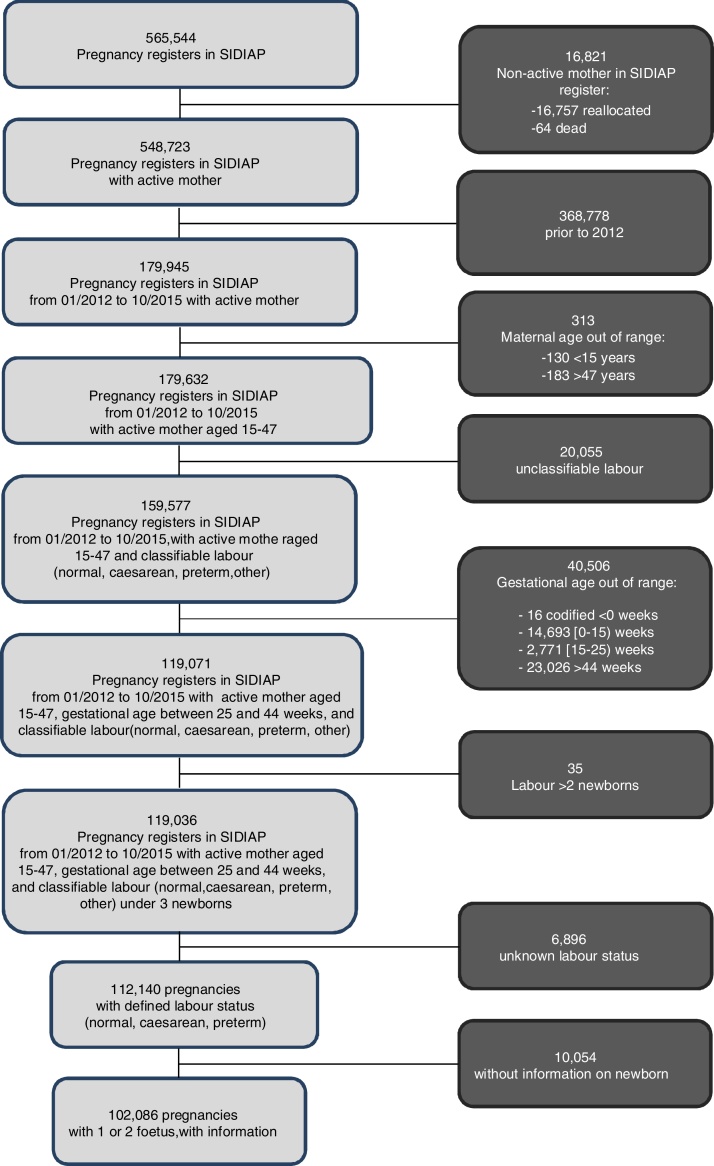
Pregnant women with a result of live-born child from 1/1/2012 to 30/10/2015.
Data were obtained from the ICS Primary Care electronic medical record.
Diagnosis of AD before and during pregnancy, months of pregnancy, and possible confusion factors were collected. Descriptive statistical analysis (median, interquartile range, and absolute and relative frequency), bivariate analysis (Wilcoxon test and Chi-square test), and multivariate analysis (logistic regression) were performed.
102,086 women presented valid information for the study. Prevalence of AD during pregnancy was 3.5% (4.29% in pre-term and 3.46% in term births; p<0.004). Pregnant women with pre-term births presented a higher age, smoking habit, lower inter-pregnancy interval, and a lower socio-economic status. Pre-term birth was significantly associated to previous history of stress and dissociative disorder (SDD), anxiety, obsessive-compulsive disorder (OCD) and eating disorders (ED), and use of antidepressants. It was also associated to abuse of alcohol, smoking, and use of psychoactive substances, as well as SDD, ED, use of antipsychotics, and divorce during pregnancy. Multivariate analysis confirmed the relationship between pre-term birth and history of AD, SDD, ED, and smoking, but not with AD during pregnancy.
Examining the previous history of SDD and ED in pregnant women, and SDD, and ED during pregnancy is highly relevant to avoid pre-term birth.
研究孕期前后孕产妇情感障碍(AD)与早产之间的关系。
回顾性观察研究。
西班牙加泰罗尼亚加泰罗尼亚卫生研究所(ICS)的性与生殖健康单位。
2012年1月1日至2015年10月30日期间有活产儿的孕妇。
数据来自ICS初级保健电子病历。
收集孕期前后的AD诊断、孕周以及可能的混淆因素。进行描述性统计分析(中位数、四分位数间距、绝对和相对频率)、双变量分析(Wilcoxon检验和卡方检验)以及多变量分析(逻辑回归)。
102,086名女性提供了该研究的有效信息。孕期AD患病率为3.5%(早产中为4.29%,足月产中为3.46%;p<0.004)。早产孕妇年龄较大、有吸烟习惯、妊娠间隔较短且社会经济地位较低。早产与既往应激和分离性障碍(SDD)、焦虑、强迫症(OCD)及进食障碍(ED)病史以及使用抗抑郁药显著相关。还与孕期酗酒、吸烟、使用精神活性物质以及SDD、ED、使用抗精神病药和离婚有关。多变量分析证实早产与AD、SDD、ED病史及吸烟之间存在关联,但与孕期AD无关。
检查孕妇既往SDD和ED病史以及孕期的SDD和ED对于避免早产至关重要。