Wing Kristof, Low Gwyn, Sharma Manoj, De Jesus Frenky, Jeronimo Belmerio, Verma Nitin
College of Health and Medicine, University of Tasmania, 17 Liverpool St, Hobart, Tasmania 7000, Australia.
Royal Australasian College of Surgeons, Melbourne, Australia.
Bull World Health Organ. 2018 Oct 1;96(10):716-722. doi: 10.2471/BLT.18.212506. Epub 2018 Aug 27.
Violent conflict left Timor-Leste with a dismantled health-care workforce and infrastructure after 2001. The absence of existing health and tertiary education sectors compounded the challenges of instituting a national eye-care system.
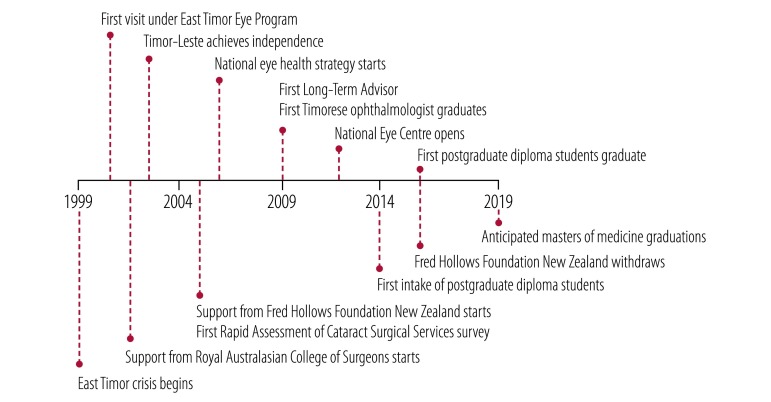
From 2001, the East Timor Eye Program coordinated donations and initially provided eye care through visiting teams. From 2005, the programme reoriented to undertake concerted workforce and infrastructure development. In 2008 full-time surgical services started in a purpose-built facility in the capital city. In 2014 we developed a clinical training pipeline for local medical graduates to become ophthalmic surgeons, comprising a local postgraduate diploma, with donor funding supporting master's degree studies abroad.
In the population of 1.26 million, an estimated 35 300 Timorese are blind and an additional 123 500 have moderate to severe visual impairment, overwhelmingly due to cataract and uncorrected refractive error.
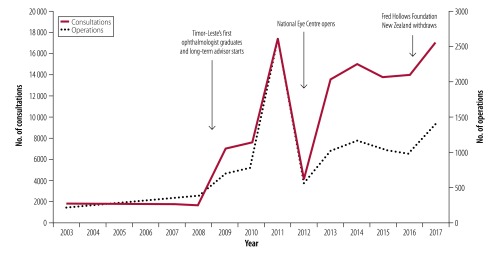
By April 2018, six Timorese doctors had completed the domestic postgraduate diploma, three of whom had enrolled in master's degree programmes. Currently, one consultant ophthalmologist, seven ophthalmic registrars, two optometrists, three refractionists and four nursing staff form a tertiary resident ophthalmic workforce, supported by an international advisor ophthalmologist and secondary eye-care workers. A recorded 12 282 ophthalmic operations and 117 590 consultations have been completed since 2001.
International organizations played a pivotal role in supporting the Timorese eye health system, in an initially vulnerable setting. We highlight how transition to domestic funding can be achieved through the creation of a domestic training pipeline and integration with national institutions.
2001年后,暴力冲突致使东帝汶的医疗保健人员队伍和解体,基础设施遭到破坏。由于缺乏现有的卫生和高等教育部门,建立国家眼科保健系统的挑战更加严峻。
自2001年起,东帝汶眼科项目协调捐赠事宜,并最初通过巡回医疗队提供眼科护理。从2005年起,该项目重新调整方向,致力于协调一致的人员队伍和基础设施建设。2008年,在首都一座专门建造的设施中开始提供全职手术服务。2014年,我们为当地医学毕业生制定了一条临床培训途径,使其成为眼科外科医生,包括一个当地研究生文凭,由捐助资金支持其在国外攻读硕士学位。
在126万人口中,估计有35300名东帝汶人失明,另有123500人患有中度至重度视力障碍,绝大多数是由白内障和未矫正的屈光不正所致。
截至2018年4月,六名东帝汶医生完成了国内研究生文凭课程,其中三人已报名参加硕士学位课程。目前,一名眼科顾问医生、七名眼科住院医生、两名验光师、三名验光配镜师和四名护理人员组成了一支三级眼科住院医护队伍,由一名国际顾问眼科医生和二级眼科护理人员提供支持。自2001年以来,已记录完成了12282例眼科手术和117590次会诊。
在最初脆弱的环境中,国际组织在支持东帝汶眼科卫生系统方面发挥了关键作用。我们强调了如何通过建立国内培训途径并与国家机构整合来实现向国内资金的过渡。