Holden Emily C, Lai Erica, Morelli Sara S, Alderson Donald, Schulkin Jay, Castleberry Neko M, McGovern Peter G
1Obstetrics, Gynecology and Women's Health, Rutgers-New Jersey Medical School, 185 South Orange Avenue, E-level, Newark, NJ 07103 USA.
2Reproductive Endocrinology and Infertility, University Reproductive Associates, 214 Terrace Avenue, Hasbrouck Heights, NJ 07604 USA.
Contracept Reprod Med. 2018 Nov 8;3:23. doi: 10.1186/s40834-018-0078-5. eCollection 2018.
Postpartum women are at risk for unintended pregnancy. Access to immediate long-acting reversible contraception (LARC) may help decrease this risk, but it is unclear how many providers in the United States routinely offer this to their patients and what obstacles they face. Our primary objective was to determine the proportion of United States obstetric providers that offer immediate postpartum LARC to their obstetric patients.
We surveyed practicing Fellows and Junior Fellows of the American College of Obstetricians and Gynecologists (ACOG) about their use of immediate postpartum LARC. These members are demographically representative of ACOG members as a whole and represent all of the ACOG districts. Half of these Fellows were also part of the Collaborative Ambulatory Research Network (CARN), a group of ACOG members who voluntarily participate in research. We asked about their experience with and barriers to immediate placement of intrauterine devices and contraceptive implants after delivery.
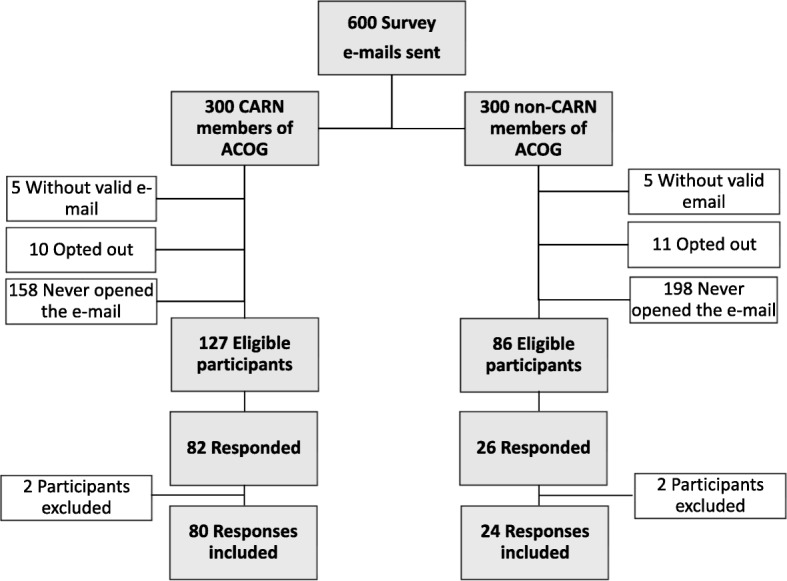
There were a total of 108 out of 600 responses (18%). Participants practiced in a total of 36 states and/or US territories and their median age was 52 years. Only 26.9% of providers surveyed offered their patients immediate postpartum LARC, and of these providers, 60.7% work in a university-based practice. There was a statistically significant association between offering immediate postpartum LARC and practice type, with the majority of providers working at a university-based practice ( < 0.001). Multiple obstacles were identified, including cost or reimbursement, device availability, and provider training on device placement in the immediate postpartum period.
The majority of obstetricians surveyed do not offer immediate postpartum long-acting reversible contraception to patients in the United States. This is secondary to multiple obstacles faced by providers.
产后女性存在意外怀孕的风险。获得即时长效可逆避孕方法(LARC)可能有助于降低这种风险,但尚不清楚美国有多少医疗服务提供者会定期向患者提供此类服务以及他们面临哪些障碍。我们的主要目标是确定美国产科医疗服务提供者向其产科患者提供即时产后LARC的比例。
我们对美国妇产科医师学会(ACOG)的在职会员和初级会员就他们对即时产后LARC的使用情况进行了调查。这些会员在人口统计学上代表了ACOG全体会员,且涵盖了ACOG的所有地区。其中一半的会员还是协作门诊研究网络(CARN)的成员,该网络由自愿参与研究的ACOG会员组成。我们询问了他们在产后即时放置宫内节育器和避孕植入物的经验及障碍。
600份回复中共有108份有效回复(18%)。参与者在总共36个州和/或美国领地执业,他们的年龄中位数为52岁。接受调查的医疗服务提供者中只有26.9%向患者提供即时产后LARC,在这些提供者中,60.7%在大学附属医院执业。提供即时产后LARC与执业类型之间存在统计学上的显著关联,大多数提供者在大学附属医院工作(P<0.001)。研究确定了多个障碍,包括成本或报销、器械供应以及提供者在产后即时放置器械方面的培训。
在美国,接受调查的大多数产科医生不会向患者提供即时产后长效可逆避孕方法。这是由于提供者面临多种障碍所致。