Department of Chemical Engineering, University of Michigan, Ann Arbor, MI, USA.
Institute of Cellular Therapeutics, Department of Microbiology and Immunology, University of Louisville School of Medicine, Louisville, KY, USA.
Biomaterials. 2019 Feb;192:271-281. doi: 10.1016/j.biomaterials.2018.11.015. Epub 2018 Nov 13.
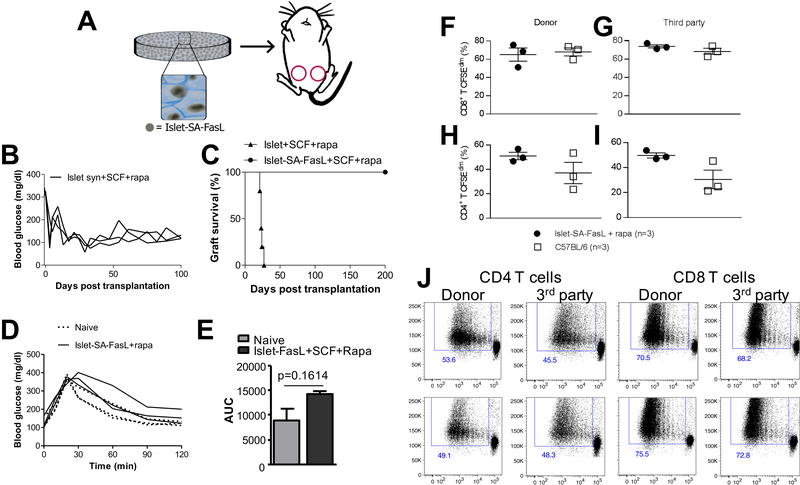
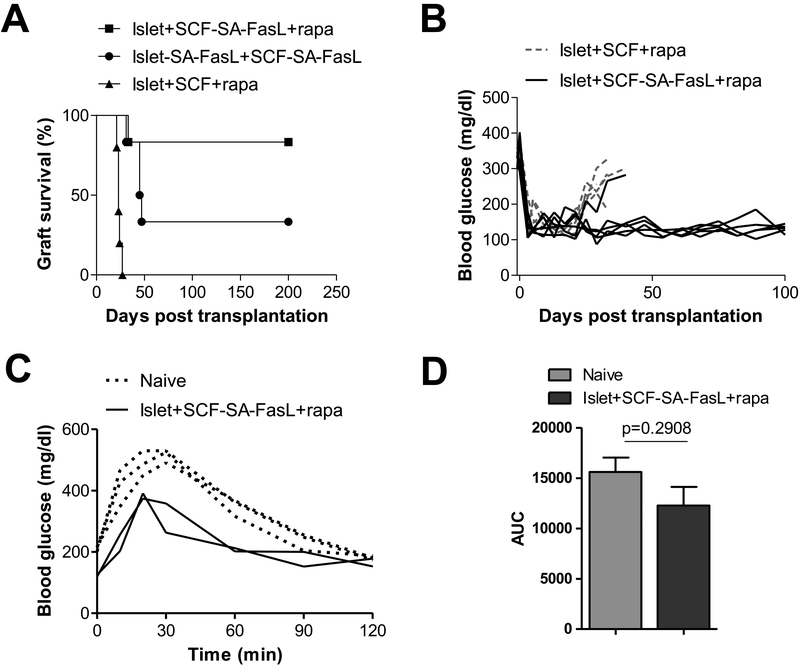
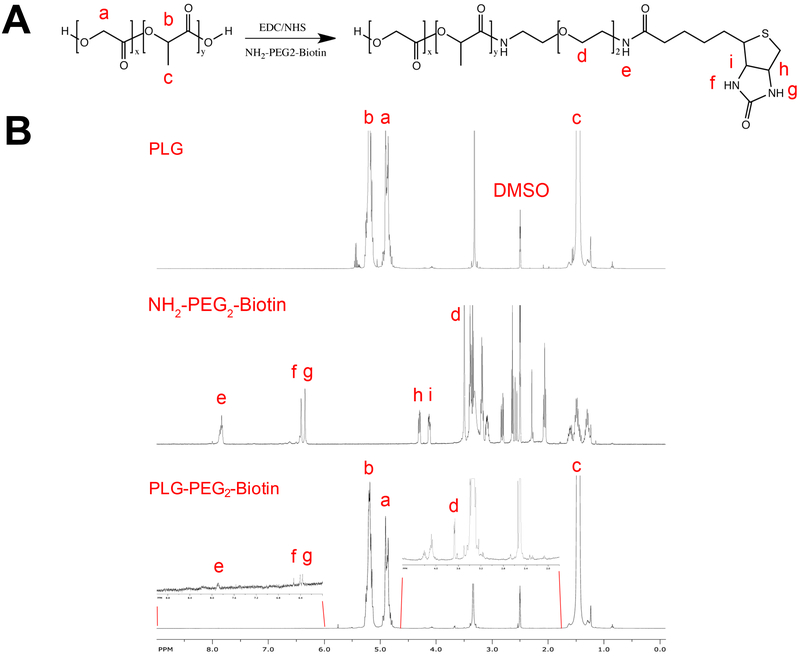
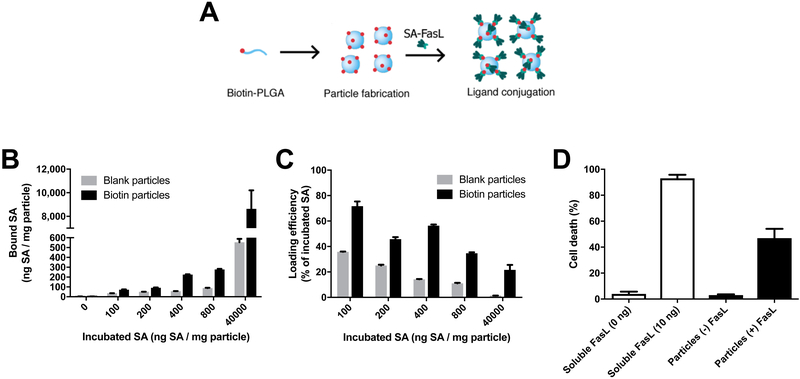
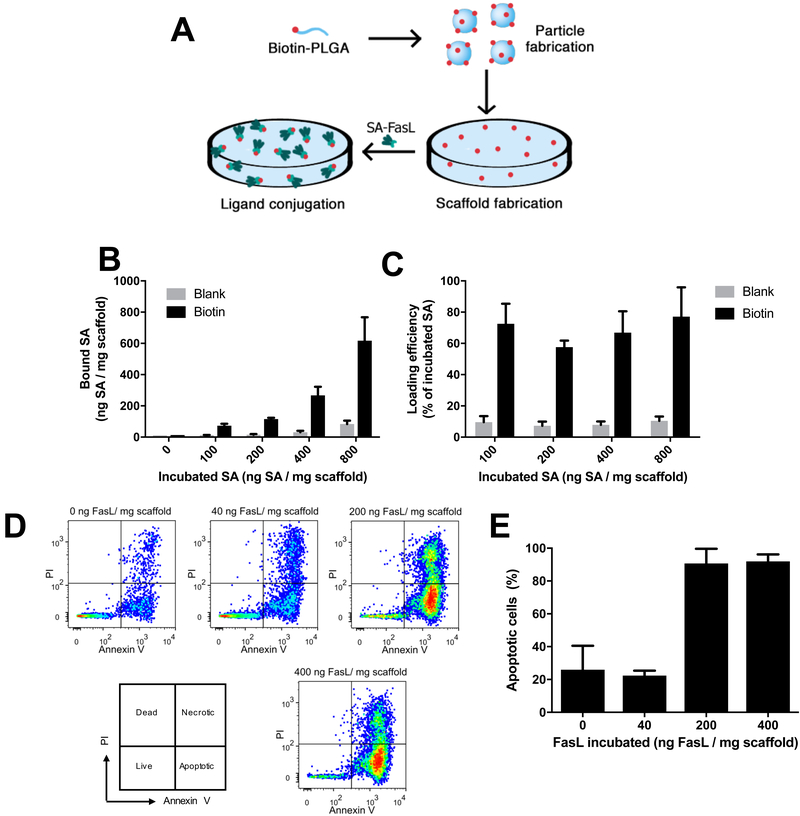
Intraportal allogeneic islet transplantation has been demonstrated as a potential therapy for type 1 diabetes (T1D). The placement of islets into the liver and chronic immunosuppression to control rejection are two major limitations of islet transplantation. We hypothesize that localized immunomodulation with a novel form of FasL chimeric with streptavidin, SA-FasL, can provide protection and long-term function of islets at an extrahepatic site in the absence of chronic immunosuppression. Allogeneic islets modified with biotin and engineered to transiently display SA-FasL on their surface showed sustained survival following transplantation on microporous scaffolds into the peritoneal fat in combination with a short course (15 days) of rapamycin treatment. The challenges with modifying islets for clinical translation motivated the modification of scaffolds with SA-FasL as an off-the-shelf product. Poly (lactide-co-glycolide) (PLG) was conjugated with biotin and fabricated into particles and subsequently formed into microporous scaffolds to allow for rapid and efficient conjugation with SA-FasL. Biotinylated particles and scaffolds efficiently bound SA-FasL and induced apoptosis in cells expressing Fas receptor (FasR). Scaffolds functionalized with SA-FasL were subsequently seeded with allogeneic islets and transplanted into the peritoneal fat under the short-course of rapamycin treatment. Scaffolds modified with SA-FasL had robust engraftment of the transplanted islets that restored normoglycemia for 200 days. Transplantation without rapamycin or without SA-FasL did not support long-term survival and function. This work demonstrates that scaffolds functionalized with SA-FasL support allogeneic islet engraftment and long-term survival and function in an extrahepatic site in the absence of chronic immunosuppression with significant potential for clinical translation.
门静脉内同种异体胰岛移植已被证明是治疗 1 型糖尿病(T1D)的一种潜在疗法。胰岛移植的两个主要限制是将胰岛植入肝脏和慢性免疫抑制以控制排斥反应。我们假设,用一种新型的与链霉亲和素融合的 FasL 形式进行局部免疫调节,SA-FasL,可以在没有慢性免疫抑制的情况下,在肝外部位为胰岛提供保护和长期功能。用生物素修饰并设计为在表面短暂表达 SA-FasL 的同种异体胰岛,在与短期(15 天)雷帕霉素治疗相结合的情况下,移植到微孔支架到腹膜脂肪中后,显示出持续的存活。将胰岛修饰用于临床转化的挑战促使我们用 SA-FasL 修饰支架作为现成产品。聚(乳酸-共-乙醇酸)(PLG)与生物素缀合并制成颗粒,然后形成微孔支架,以允许与 SA-FasL 快速高效地缀合。生物素化颗粒和支架有效地结合了 SA-FasL,并诱导表达 Fas 受体(FasR)的细胞凋亡。随后用 SA-FasL 功能化的支架接种同种异体胰岛,并在短期雷帕霉素治疗下移植到腹膜脂肪中。用 SA-FasL 修饰的支架具有强大的移植胰岛的植入能力,可恢复正常血糖 200 天。没有雷帕霉素或没有 SA-FasL 的移植不能支持长期存活和功能。这项工作表明,用 SA-FasL 功能化的支架在没有慢性免疫抑制的情况下支持肝外部位的同种异体胰岛植入和长期存活和功能,具有重要的临床转化潜力。