Noh Yoo-Hun, Lee Jaehyouk, Seo Seong Joon, Myung Soon Chul
Agricultrual Research Center, Dankook University, Yongin, Republic of Korea.
Bio-Integration Research Center for Nutra-Pharmaceutical Epigenetics, Department of Urology, Chung-Ang University College of Medicine, Seoul, Republic of Korea.
Anim Cells Syst (Seoul). 2018 May 24;22(3):172-177. doi: 10.1080/19768354.2018.1458652. eCollection 2018.
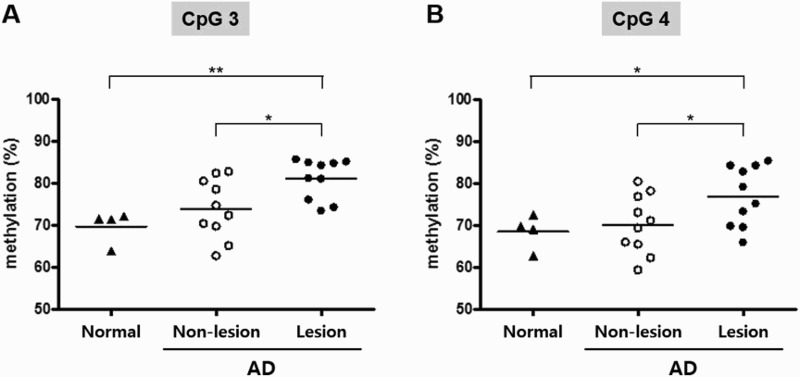
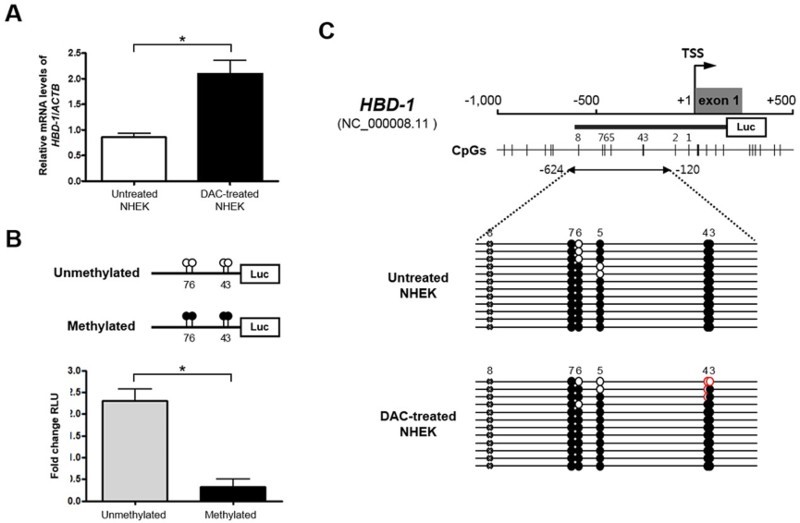
Atopic dermatitis (AD) is a chronic inflammatory skin disease caused by epidermal barrier dysfunction and dysregulation of innate and adaptive immunity. Epigenetic regulation of human -defensin-1 (HBD-1) might be associated with a variety of defects in the innate immune system during AD pathogenesis. We investigated the possible mechanism of decreased gene expression in AD and demonstrated the restoration of HBD-1 transcription in undifferentiated normal human epidermal keratinocyte cells after treatment with a DNA methyltransferase inhibitor. We also conducted an methylated reporter assay using a reporter containing 14 CpG sites. Methylation of the 14 CpG sites within the HBD-1 5' region resulted in an approximately 86% reduction in promoter activity and affected HBD-1 transcriptional regulation. We then compared methylation frequencies at CpG 3 and CpG 4 between non-lesional and lesional epidermis samples of patients with severe AD and between these paired tissues and healthy control epidermis from normal volunteers without AD history. Bisulfite pyrosequencing data showed significantly higher methylation frequencies at the CpG 3 and 4 sites in AD lesional samples than in non-lesional AD skin and normal skin samples ( < 0.05). These results suggest that the DNA methylation signature of HBD-1 is a novel diagnostic/prognostic marker and a promising therapeutic target for the compromised stratum corneum barrier attributed to HBD-1 deficiency.
特应性皮炎(AD)是一种由表皮屏障功能障碍以及先天性和适应性免疫失调引起的慢性炎症性皮肤病。人类防御素-1(HBD-1)的表观遗传调控可能与AD发病机制中先天性免疫系统的多种缺陷相关。我们研究了AD中HBD-1基因表达降低的可能机制,并证明了用DNA甲基转移酶抑制剂处理后,未分化的正常人表皮角质形成细胞中HBD-1转录得以恢复。我们还使用了一个包含14个CpG位点的报告基因进行了甲基化报告基因检测。HBD-1 5'区域内14个CpG位点的甲基化导致启动子活性降低约86%,并影响HBD-1的转录调控。然后,我们比较了重度AD患者非皮损和皮损表皮样本之间以及这些配对组织与无AD病史的正常志愿者的健康对照表皮之间CpG 3和CpG 4位点的甲基化频率。亚硫酸氢盐焦磷酸测序数据显示,AD皮损样本中CpG 3和4位点的甲基化频率显著高于非皮损AD皮肤和正常皮肤样本(P<0.05)。这些结果表明,HBD-1的DNA甲基化特征是一种新型的诊断/预后标志物,也是因HBD-1缺乏导致角质层屏障受损的一个有前景的治疗靶点。