Lybeck Charlotte, Brenndörfer Erwin D, Sällberg Matti, Montgomery Scott M, Aleman Soo, Duberg Ann-Sofi
Department of Infectious Diseases, Faculty of Medicine and Health.
Department of Laboratory Medicine, Division of Clinical Microbiology.
Eur J Gastroenterol Hepatol. 2019 Apr;31(4):506-513. doi: 10.1097/MEG.0000000000001316.
Curing of hepatitis C virus (HCV) infection primarily aims to prevent severe liver complications. Our objectives were to investigate the long-term presence and impact of occult HCV infection (OCI) and to study the outcomes in terms of liver disease after virological cure.
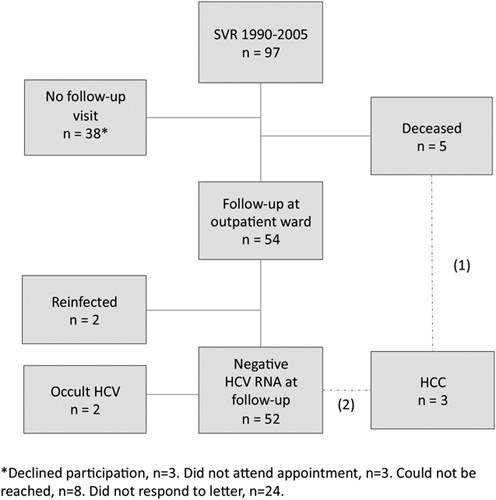
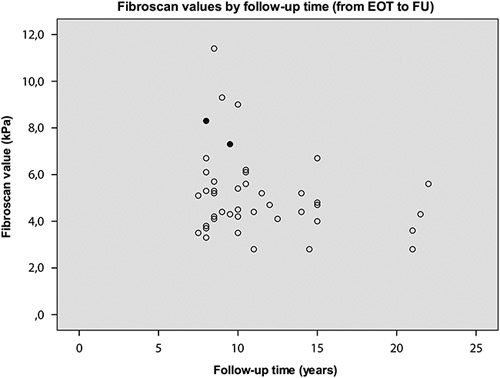
A total of 97 patients with achieved sustained virological response (SVR) during 1990-2005 were followed either by a clinical follow-up (FU) visit with blood sampling and liver elastography (n=54) or through national registries for outcomes (n=43). To diagnose OCI among patients with SVR, a highly sensitive method was used to detect HCV-RNA traces in whole blood. The FU duration was a median of 10.5 years, with samples up to 21.5 years after the end of treatment (EOT).
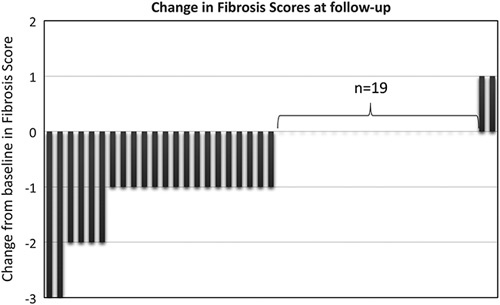
The majority of patients [52 (96%)] were HCV-RNA negative at FU, and regression of fibrosis was statistically significant. OCI was found in two (4%) of them at 8 and 9 years after EOT. These patients had F1 and F2 fibrosis before treatment and F2 at FU, but no other abnormal findings. Three previously noncirrhotic men were diagnosed with hepatocellular carcinoma 8-11 years after EOT.
Occult infection could be detected many years after the achievement of SVR but was not associated with serious liver disease. The majority had persistent viral eradication and regression of fibrosis after SVR. However, an increased risk of hepatocellular carcinoma may persist in the long term after SVR even in noncirrhotic patients. Further studies with FU after direct-acting antiviral therapy and on the long-term impact after cure are needed.
丙型肝炎病毒(HCV)感染的治愈主要旨在预防严重的肝脏并发症。我们的目的是调查隐匿性HCV感染(OCI)的长期存在情况及其影响,并研究病毒学治愈后肝脏疾病的转归。
对1990年至2005年间实现持续病毒学应答(SVR)的97例患者进行随访,其中54例通过临床随访(FU)就诊并进行血液采样和肝脏弹性成像检查,43例通过国家登记系统获取转归信息。为了诊断SVR患者中的OCI,采用了一种高灵敏度方法来检测全血中的HCV-RNA痕迹。FU持续时间中位数为10.5年,样本采集时间距治疗结束(EOT)最长达21.5年。
大多数患者[52例(96%)]在FU时HCV-RNA呈阴性,纤维化程度的改善具有统计学意义。在EOT后8年和9年时,其中2例(4%)被发现存在OCI。这2例患者治疗前为F1和F2级纤维化,FU时为F2级,但无其他异常发现。3例既往非肝硬化男性在EOT后8至11年被诊断为肝细胞癌。
在实现SVR多年后仍可检测到隐匿感染,但与严重肝脏疾病无关。大多数患者在SVR后病毒持续清除,纤维化程度改善。然而,即使是非肝硬化患者,SVR后长期肝细胞癌风险可能仍会增加。需要对直接抗病毒治疗后的FU以及治愈后的长期影响进行进一步研究。