School of Life Sciences, Yunnan University, Kunming, Yunnan, China.
CAS Key Laboratory of Tropical Plant Resources and Sustainable Use, Xishuangbanna Tropical Botanical Garden, Chinese Academy of Sciences, Kunming, Yunnan, China.
J Exp Bot. 2019 Feb 5;70(3):897-908. doi: 10.1093/jxb/ery413.
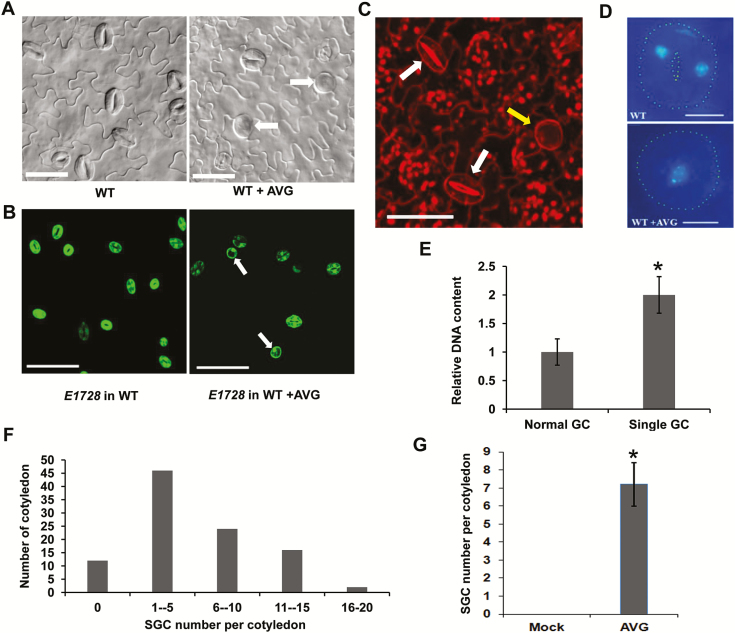
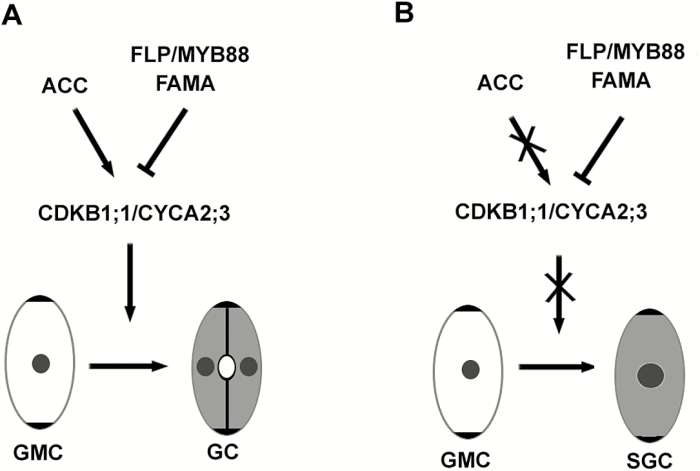
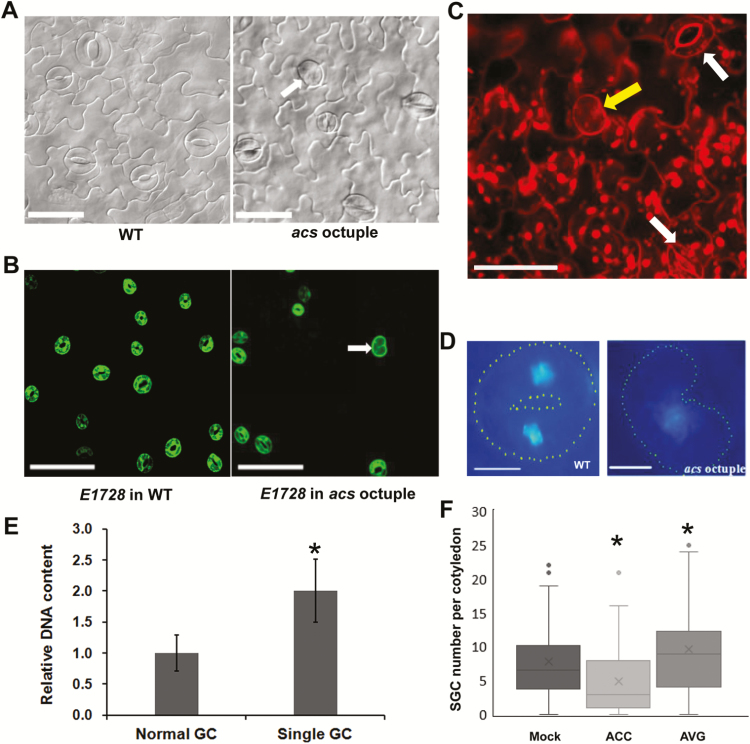
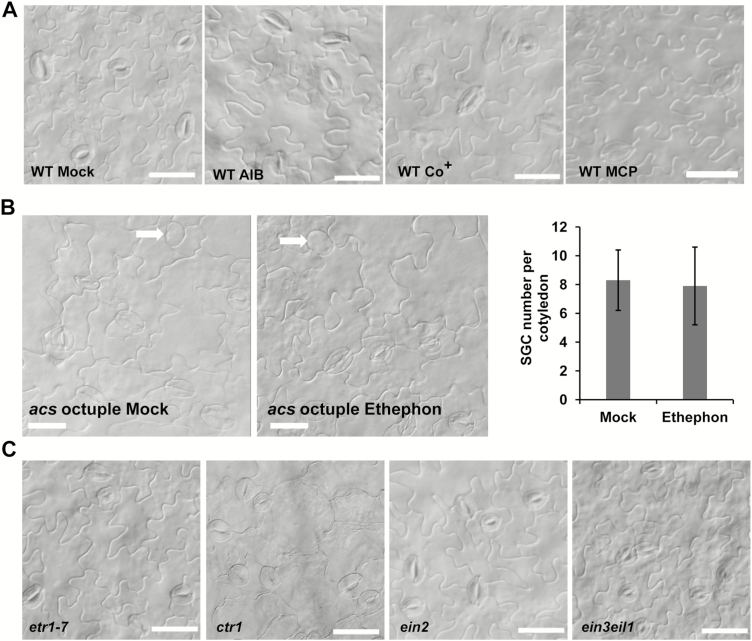
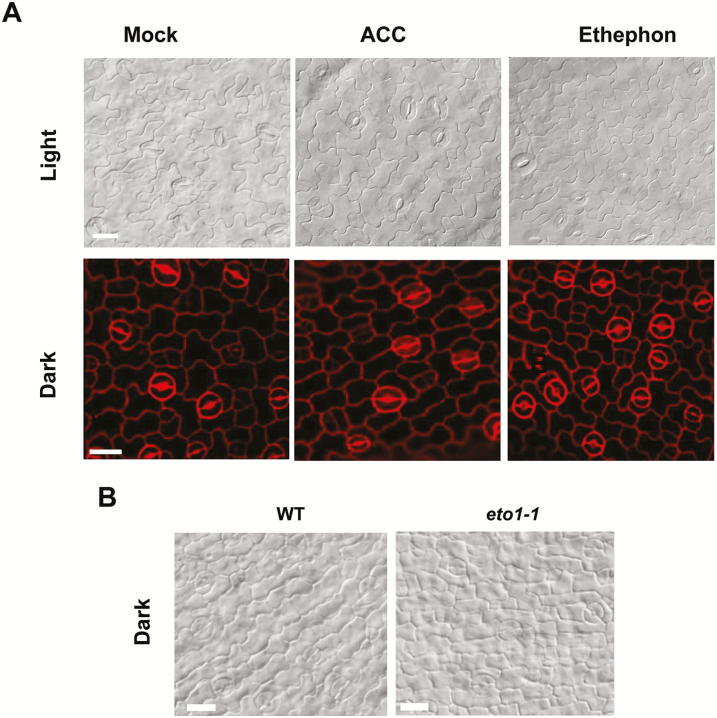
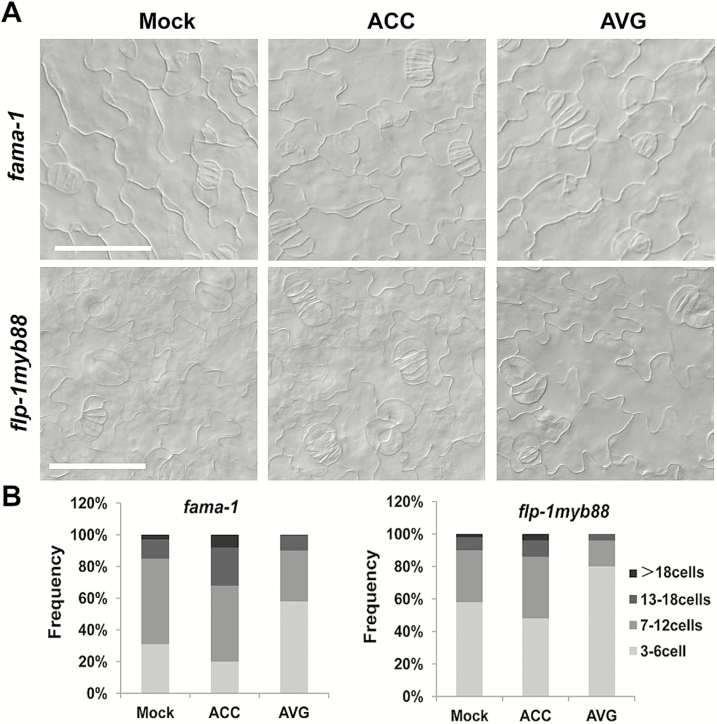
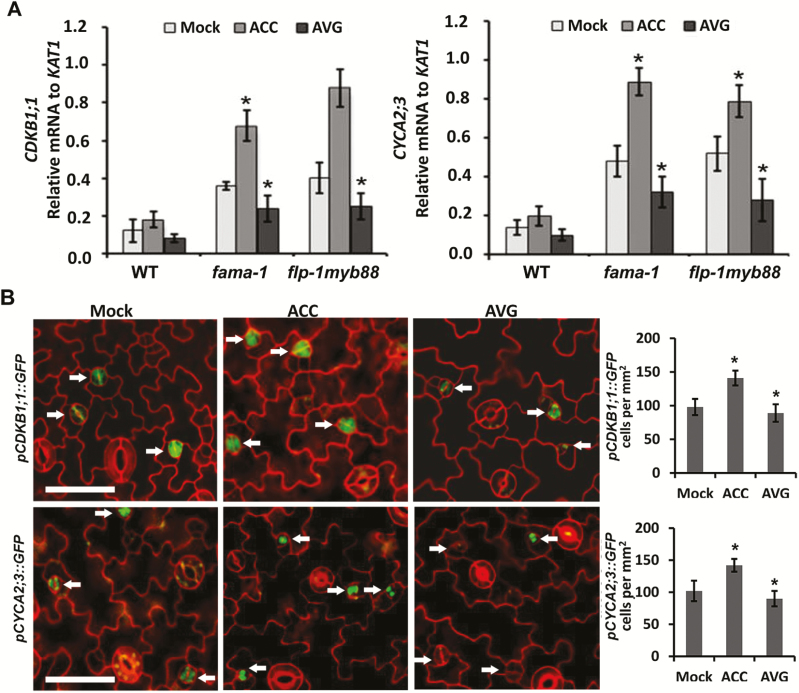
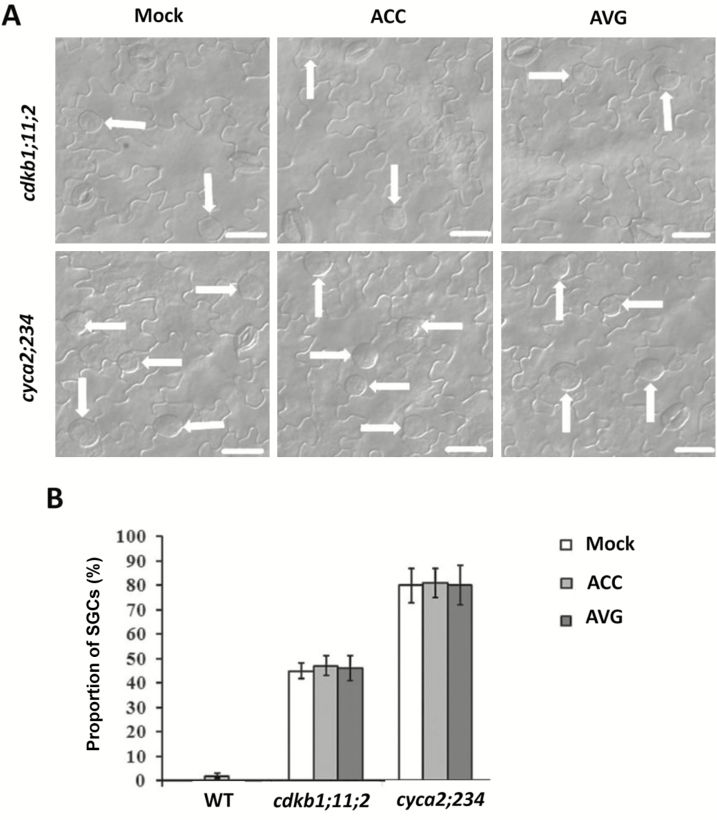
Stomata have a critical function in the exchange of gases and water vapor between plants and their environment. Stomatal development is under the rigorous control of many regulators. The last step of development is the terminal division of guard mother cells (GMC) into two guard cells (GC). It is still unclear how the symmetric division of GMCs is regulated. Here, we show that the ethylene precursor aminocyclopropane-1-carboxylic acid (ACC) is required for the symmetric division of GMCs into GCs in Arabidopsis. Exogenous application of the ACC biosynthesis inhibitor aminoethoxyvinylglycine (AVG) induced the formation of single guard cells (SGCs). Correspondingly, an acs octuple-mutant with extremely low endogenous ACC also developed SGCs, and exogenous ACC dramatically decreased the number of SGCs in this mutant whereas exogenous ethephon (which is gradually converted into ethylene) had no effect. Furthermore, neither blocking of endogenous ethylene synthesis nor disruption of ethylene signaling transduction could induce the production of SGCs. Further investigation indicated that ACC promoted the division of GMCs in fama-1 and flp-1myb88 mutants whereas AVG inhibited it. Moreover, ACC positively regulated the expression of CDKB1;1 and CYCA2;3 in the fama-1 and flp-1myb88 mutants. The SGC number was not affected by ACC or AVG in cdkb1;11;2 and cyca2;234 mutants. Taken together, the results demonstrate that ACC itself, but not ethylene, positively modulates the symmetric division of GMCs in a manner that is dependent on CDKB1s and CYCA2s.
气孔在植物与其环境之间的气体和水蒸气交换中具有关键功能。气孔的发育受到许多调节剂的严格控制。发育的最后一步是保卫母细胞(GMC)的终末分裂为两个保卫细胞(GC)。目前尚不清楚 GMC 的对称分裂是如何被调控的。在这里,我们表明乙烯前体 1-氨基环丙烷-1-羧酸(ACC)是拟南芥 GMC 对称分裂为 GC 所必需的。ACC 生物合成抑制剂氨基氧乙烯基甘氨酸(AVG)的外源应用诱导了单个保卫细胞(SGC)的形成。相应地,acs 八倍突变体具有极低的内源 ACC,也发育出 SGC,而外源 ACC 显著减少了该突变体中 SGC 的数量,而外源性乙烯磷(逐渐转化为乙烯)则没有影响。此外,阻断内源性乙烯合成或破坏乙烯信号转导都不能诱导 SGC 的产生。进一步的研究表明,ACC 促进了 fama-1 和 flp-1myb88 突变体中 GMC 的分裂,而 AVG 则抑制了它。此外,ACC 正向调节了 fama-1 和 flp-1myb88 突变体中 CDKB1;1 和 CYCA2;3 的表达。在 cdkb1;11;2 和 cyca2;234 突变体中,ACC 或 AVG 对 SGC 数量没有影响。综上所述,这些结果表明,ACC 本身,而不是乙烯,以依赖于 CDKB1s 和 CYCA2s 的方式正向调节 GMC 的对称分裂。