Fyfe Emily R, Matz Lauren Eisenband, Hunt Kayla M, Alibali Martha W
Indiana University, United States.
University of Wisconsin-Madison, United States.
J Commun Disord. 2019 Jan-Feb;77:17-30. doi: 10.1016/j.jcomdis.2018.11.001. Epub 2018 Nov 15.
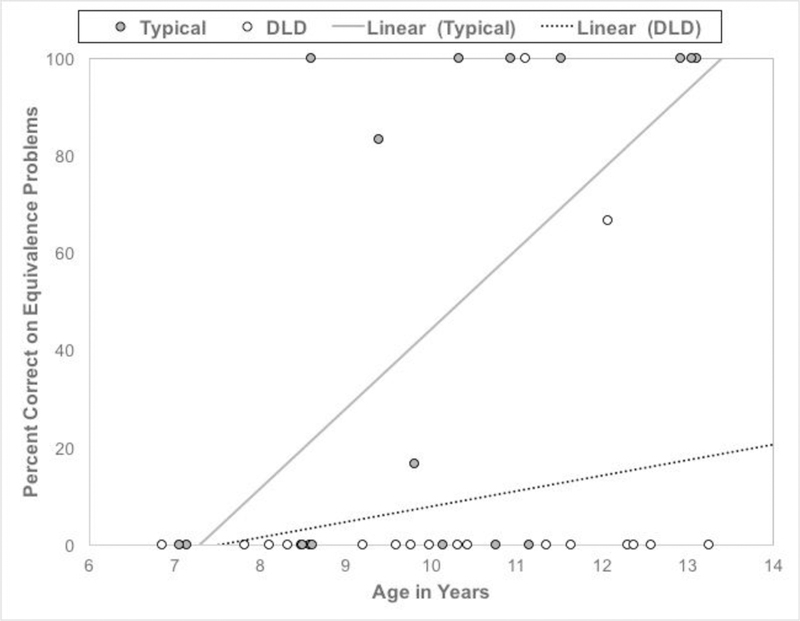
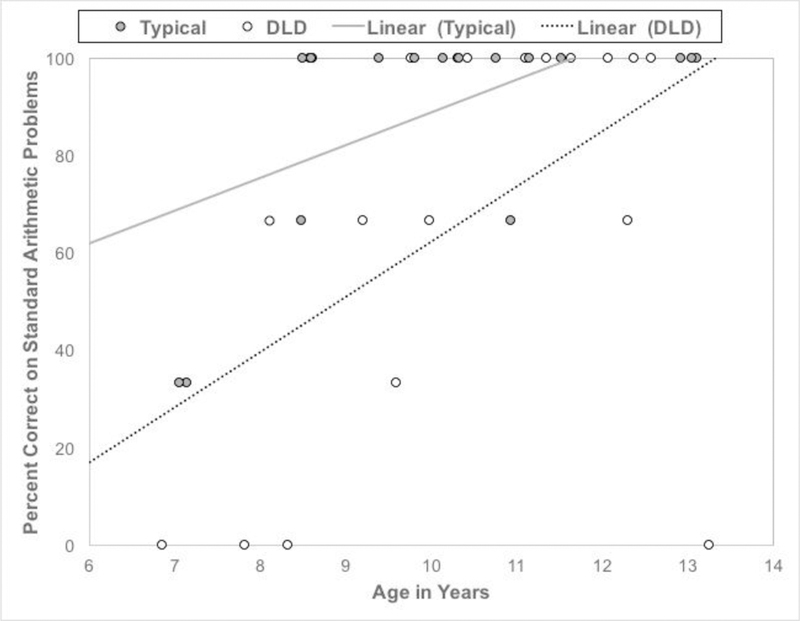
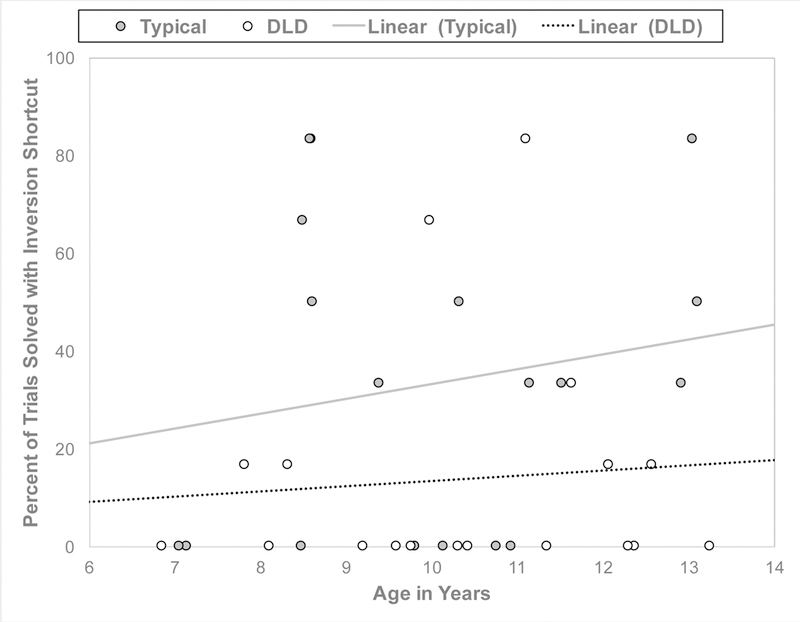
Previous research suggests that children with language disorders often have difficulties in mathematical tasks. In the current study, we investigated two relevant factors - working memory and pattern skills - that may underlie children's poor mathematics performance. Children with developmental language disorder (DLD, n = 18, ages 6-13) and age-matched typically-developing children (n = 18) completed three math tasks that tapped calculation skill and knowledge of concepts. Children also completed a visual pattern extension task and a verbal working memory task. There were four key findings: (1) children with DLD exhibited poorer mathematical knowledge than typically-developing children, both in calculation and on key math concepts, (2) children with DLD performed similarly to typically-developing children on the visual pattern extension task, (3) children with DLD had lower verbal working memory scores than typically-developing children, and these differences in working memory accounted in part for their poorer calculation performance, and (4) children's pattern extension scores predicted their arithmetic calculation scores, but not their concept scores.
先前的研究表明,患有语言障碍的儿童在数学任务方面往往存在困难。在当前的研究中,我们调查了两个相关因素——工作记忆和模式技能,它们可能是儿童数学成绩不佳的潜在原因。患有发育性语言障碍(DLD,n = 18,年龄6至13岁)的儿童和年龄匹配的发育正常儿童(n = 18)完成了三项数学任务,这些任务考察了计算技能和概念知识。儿童还完成了一项视觉模式扩展任务和一项言语工作记忆任务。有四项主要发现:(1)患有DLD的儿童在计算和关键数学概念方面表现出比发育正常儿童更差的数学知识,(2)患有DLD的儿童在视觉模式扩展任务上的表现与发育正常儿童相似,(3)患有DLD的儿童的言语工作记忆得分低于发育正常儿童,并且工作记忆中的这些差异部分解释了他们较差的计算表现,(4)儿童的模式扩展得分预测了他们的算术计算得分,但不能预测他们的概念得分。