Fukutani Kiyoshi F, Nascimento-Carvalho Cristiana M, Bouzas Maiara L, Oliveira Juliana R, Barral Aldina, Dierckx Tim, Khouri Ricardo, Nakaya Helder I, Andrade Bruno B, Van Weyenbergh Johan, de Oliveira Camila I
Instituto Gonçalo Moniz-FIOCRUZ, Salvador, Brazil.
School of Medicine, Federal University of Bahia, Salvador, Brazil.
Front Microbiol. 2018 Nov 9;9:2475. doi: 10.3389/fmicb.2018.02475. eCollection 2018.
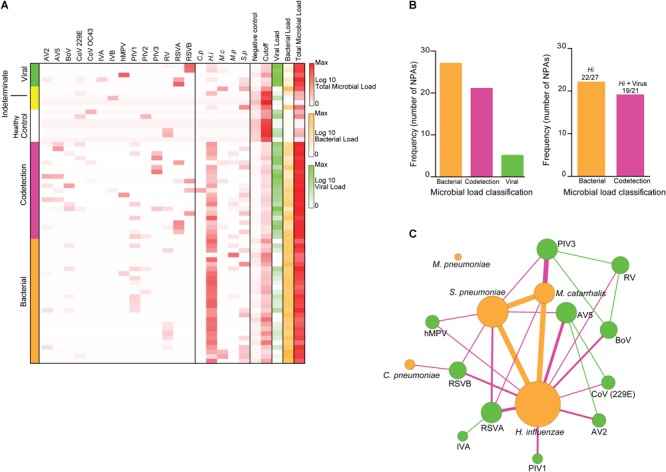
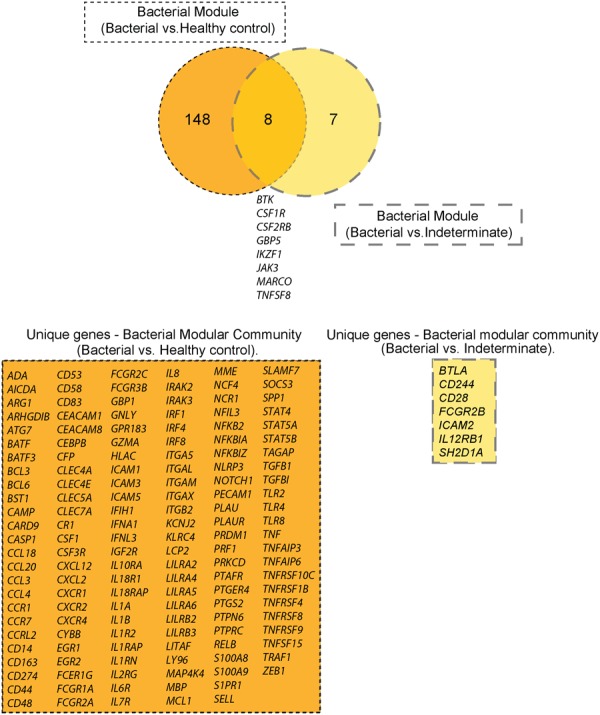
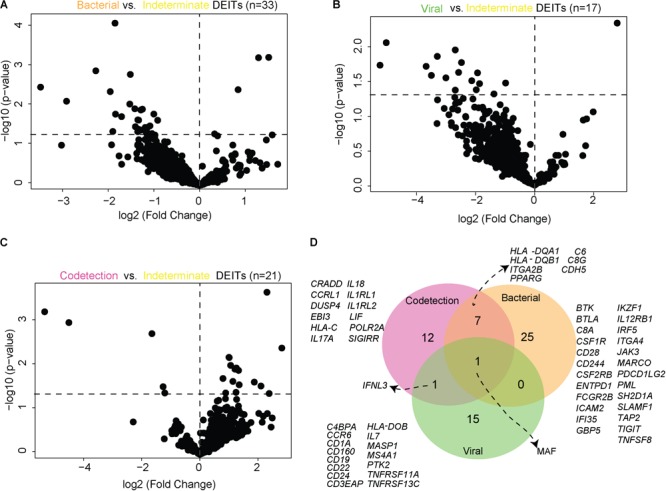
Acute respiratory infection (ARI) is the most frequent cause for hospitalization in infants and young children. Using multiplexed nCounter technology to digitally quantify 600 human mRNAs in parallel with 14 virus- and 5 bacterium-specific RNAs, we characterized viral and bacterial presence in nasopharyngeal aspirates (NPA) of 58 children with ARI and determined the corresponding immune profiles. NPA contained different groups of organisms and these were classified into bacterial ( = 27), viral ( = 5), codetection [containing both viral and bacterial transcripts ( = 21), or indeterminate intermediate where microbial load is below threshold ( = 5)]. We then identified differentially expressed immune transcripts (DEITs) comparing NPAs from symptomatic children vs. healthy controls, and comparing children presenting NPAs with detectable microbial load vs. indeterminate. We observed a strong innate immune response in NPAs, due to the presence of evolutionarily conserved type I Interferon (IFN)-stimulated genes (ISG), which was correlated with total bacterial and/or viral load. In comparison with indeterminate NPAs, adaptive immunity transcripts discriminated among viral, bacterial, and codetected microbial profiles. In viral NPAs, B cell transcripts were significantly enriched among DEITs, while only type III IFN was correlated with viral load. In bacterial NPAs, myeloid cells and coinhibitory transcripts were enriched and significantly correlated with bacterial load. In conclusion, digital nCounter transcriptomics provide a microbial and immunological "snapshot" of the nasopharyngeal interface in children with ARI. This enabled discrimination among viral, bacterial, codetection, and indeterminate transcripts in the samples using non-invasive sampling.
急性呼吸道感染(ARI)是婴幼儿住院治疗最常见的原因。我们运用多重nCounter技术对600种人类mRNA以及14种病毒特异性RNA和5种细菌特异性RNA进行数字化定量分析,对58例患ARI儿童的鼻咽抽吸物(NPA)中的病毒和细菌存在情况进行了特征分析,并确定了相应的免疫图谱。NPA含有不同种类的生物体,这些生物体被分为细菌感染组(n = 27)、病毒感染组(n = 5)、联合检测组[同时含有病毒和细菌转录本(n = 21)]或不确定中间组(微生物负荷低于阈值,n = 5)。然后,我们比较了有症状儿童与健康对照的NPA,以及微生物负荷可检测的儿童与不确定儿童的NPA,从而鉴定出差异表达的免疫转录本(DEITs)。由于存在进化上保守的I型干扰素(IFN)刺激基因(ISG),我们在NPA中观察到了强烈的先天免疫反应,这与细菌和/或病毒总负荷相关。与不确定的NPA相比,适应性免疫转录本在病毒、细菌和联合检测的微生物图谱之间存在差异。在病毒感染的NPA中,B细胞转录本在DEITs中显著富集,而只有III型IFN与病毒负荷相关。在细菌感染的NPA中,髓样细胞和共抑制转录本富集,并与细菌负荷显著相关。总之,数字nCounter转录组学提供了ARI儿童鼻咽界面的微生物和免疫学“快照”。这使得使用非侵入性采样能够区分样本中的病毒、细菌、联合检测和不确定转录本。