Donders Institute for Brain, Cognition and Behaviour, Radboud University Nijmegen, Nijmegen, The Netherlands.
Eur J Neurosci. 2019 Jun;49(11):1477-1490. doi: 10.1111/ejn.14292. Epub 2018 Dec 11.
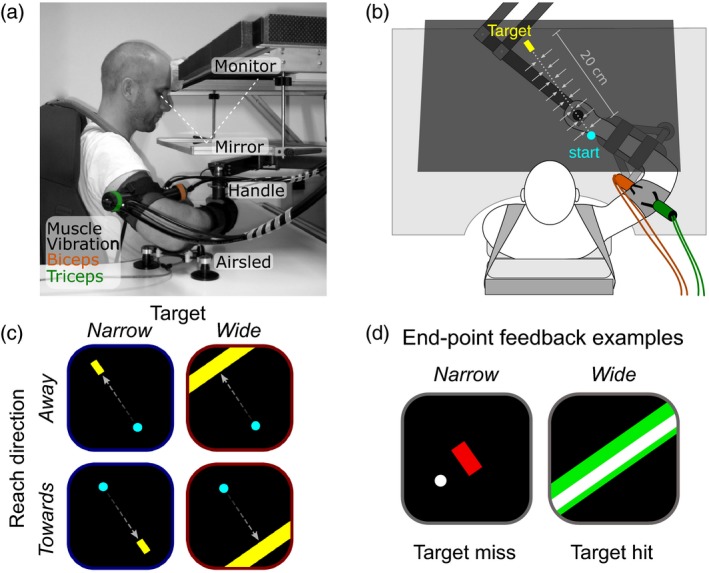
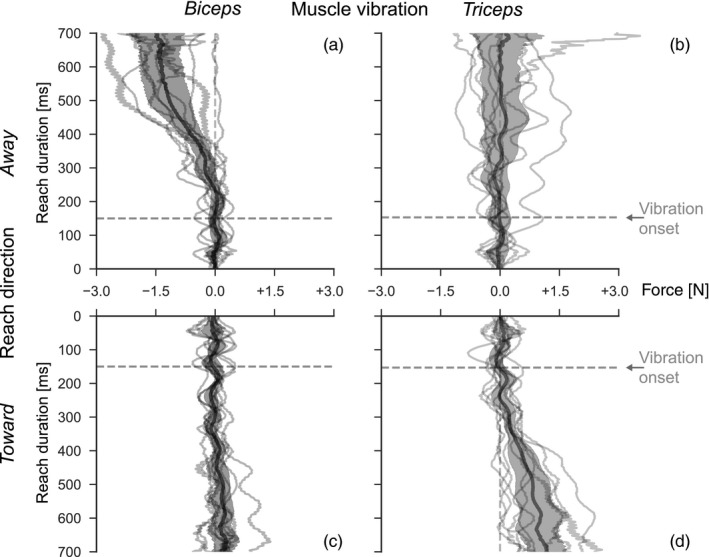
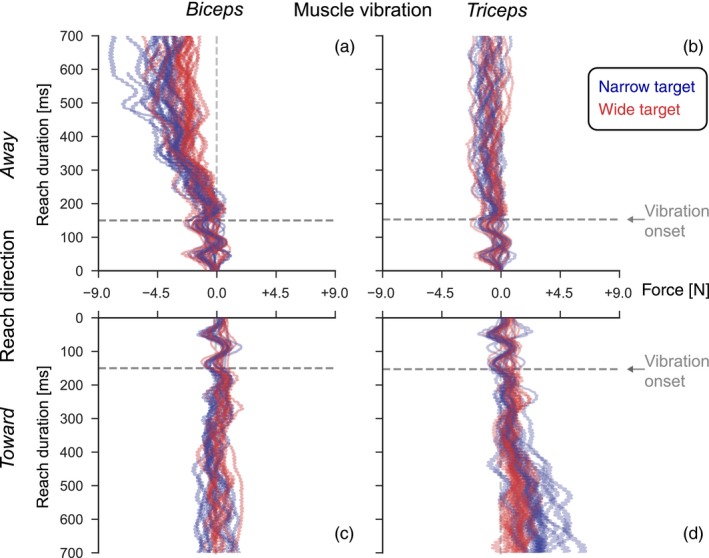
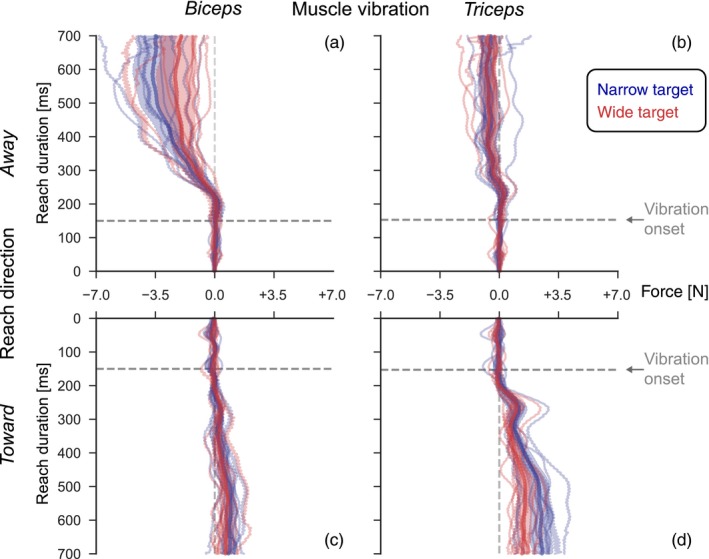
Feedback corrections in reaching have been shown to be task-dependent for proprioceptive, visual and vestibular perturbations, in line with predictions from optimal feedback control theory. Mechanical perturbations have been used to elicit proprioceptive errors, but have the drawback to actively alter the limb's trajectory, making it nontrivial to dissociate the subject's compensatory response from the perturbation itself. In contrast, muscle vibration provides an alternative tool to perturb the muscle afferents without changing the hands trajectory, inducing only changes in the estimated, but not the actual, limb position and velocity. Here, we investigate whether upper-arm muscle vibration is sufficient to evoke task-dependent feedback corrections during goal-directed reaching to a narrow versus a wide target. Our main result is that for vibration of biceps and triceps, compensatory responses were down-regulated for the wide compared to the narrow target. The earliest detectable difference between these target-specific corrections is at about 100 ms, likely reflecting a task-dependent feedback control policy rather than a voluntary response.
在与最佳反馈控制理论的预测一致的情况下,针对本体感觉、视觉和前庭感觉的干扰,已证明在进行目标导向的手臂伸展任务时,反馈校正具有任务依赖性。人们已经使用机械干扰来产生本体感觉错误,但存在的缺点是会主动改变肢体的轨迹,从而难以将主体的补偿反应与干扰本身区分开来。相比之下,肌肉振动为干扰肌肉传入神经提供了一种替代工具,而不会改变手部的轨迹,只会引起估计的但不是实际的肢体位置和速度的变化。在这里,我们研究了在上臂肌肉振动的情况下,在指向狭窄与宽阔目标的目标导向手臂伸展过程中,是否足以引起任务依赖性的反馈校正。我们的主要结果是,对于肱二头肌和肱三头肌的振动,与狭窄目标相比,宽目标的补偿反应被下调。在这些特定于目标的校正之间最早可以检测到的差异约为 100 毫秒,这可能反映了一种任务依赖性的反馈控制策略,而不是一种自愿反应。