Department of Physiology, Emory University School of Medicine, Atlanta, Georgia.
Department of Biomedicine, Danish Research Institute of Translational Neuroscience - DANDRITE, Nordic-EMBL Partnership for Molecular Medicine, & AU IDEAS center NEURODIN, Aarhus University, Aarhus C, Denmark.
Eur J Neurosci. 2019 Feb;49(3):364-383. doi: 10.1111/ejn.14290. Epub 2018 Dec 10.
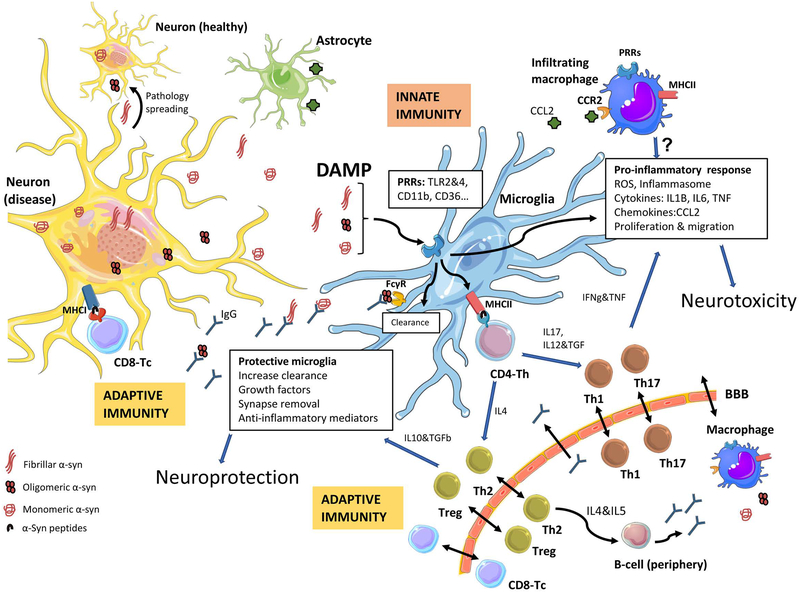
The neuropathological hallmarks of Parkinson's disease (PD) are the degeneration and death of dopamine-producing neurons in the ventral midbrain, the widespread intraneuronal aggregation of alpha-synuclein (α) in Lewy bodies and neurites, neuroinflammation, and gliosis. Signs of microglia activation in the PD brain postmortem as well as during disease development revealed by neuroimaging, implicate immune responses in the pathophysiology of the disease. Intensive research during the last two decades has advanced our understanding of the role of these responses in the disease process, yet many questions remain unanswered. A transformative finding in the field has been the confirmation that in vivo microglia are able to respond directly to pathological a-syn aggregates but also to neuronal dysfunction due to intraneuronal a-syn toxicity well in advance of neuronal death. In addition, clinical research and disease models have revealed the involvement of both the innate and adaptive immune systems. Indeed, the data suggest that PD leads not only to a microglia response, but also to a cellular and humoral peripheral immune response. Together, these findings compel us to consider a more holistic view of the immunological processes associated with the disease. Central and peripheral immune responses aimed at maintaining neuronal health will ultimately have consequences on neuronal survival. We will review here the most significant findings that have contributed to the current understanding of the immune response in PD, which is proposed to occur early, involve peripheral and brain immune cells, evolve as neuronal dysfunction progresses, and is likely to influence disease progression.
帕金森病 (PD) 的神经病理学特征是中脑腹侧多巴胺能神经元的退化和死亡,α-突触核蛋白 (α) 在路易体和神经突中的广泛细胞内聚集,神经炎症和神经胶质增生。PD 大脑死后以及神经影像学显示疾病发展过程中微胶质细胞激活的迹象表明,免疫反应参与了疾病的病理生理学。在过去的二十年中,对这些反应在疾病过程中的作用的深入研究已经提高了我们的认识,但仍有许多问题尚未得到解答。该领域的一个变革性发现是证实,体内的小胶质细胞能够直接对病理性 α-突触核蛋白聚集物做出反应,而且还能够对由于神经元内 α-突触核蛋白毒性引起的神经元功能障碍做出反应,而这种反应远早于神经元死亡。此外,临床研究和疾病模型揭示了固有免疫和适应性免疫系统的参与。事实上,这些数据表明,PD 不仅导致小胶质细胞反应,还导致细胞和体液外周免疫反应。这些发现促使我们考虑与疾病相关的免疫过程的更全面观点。旨在维持神经元健康的中枢和外周免疫反应最终将对神经元存活产生影响。我们将在这里回顾对目前对 PD 免疫反应的理解做出重要贡献的发现,这些发现表明免疫反应发生得很早,涉及外周和大脑免疫细胞,随着神经元功能障碍的进展而演变,并且可能影响疾病进展。