Department of Urology, College of Medicine, The Catholic University of Korea, Seoul 06591, Korea.
Catholic Integrative Medicine Research Institute, The Catholic University of Korea, Seoul 06591, Korea.
Int J Mol Sci. 2018 Nov 23;19(12):3730. doi: 10.3390/ijms19123730.
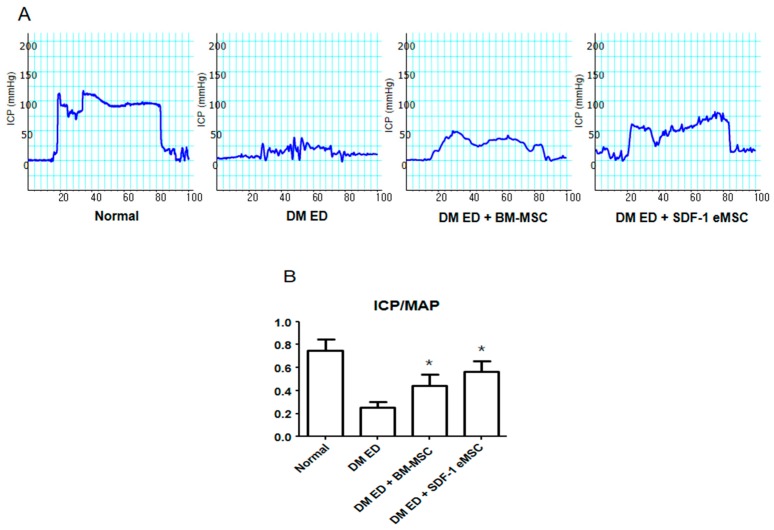
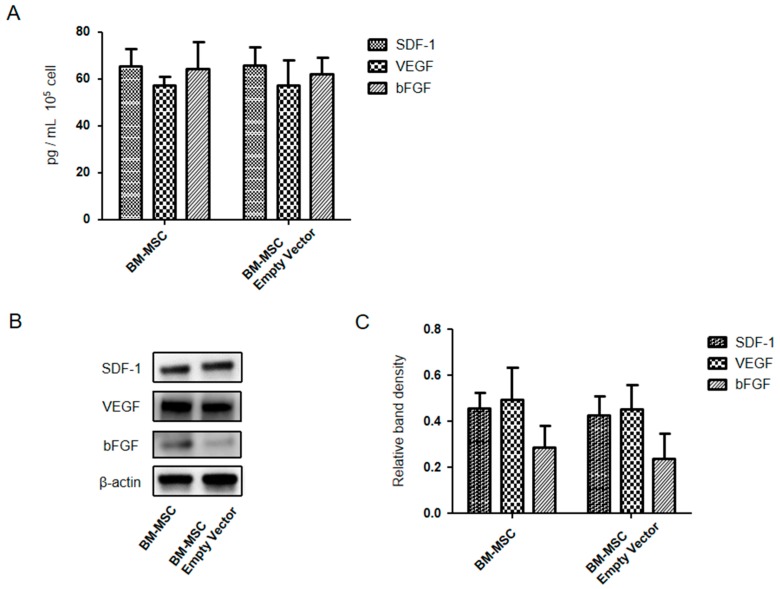
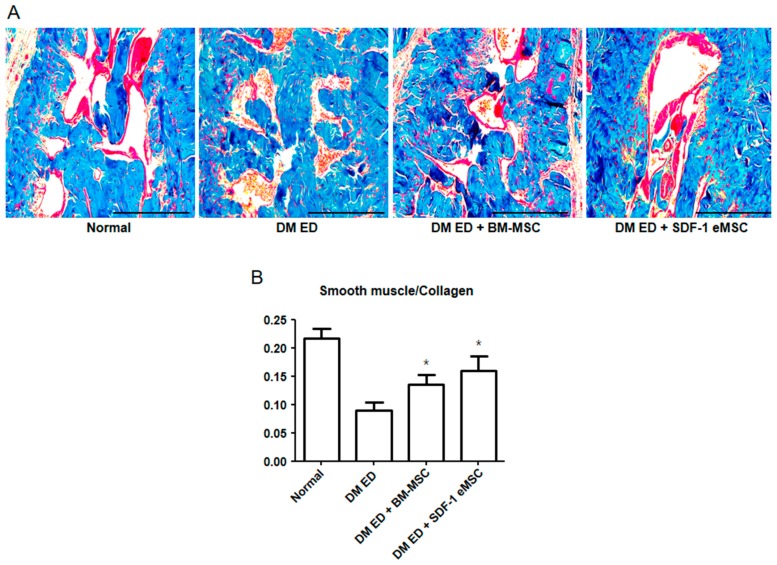
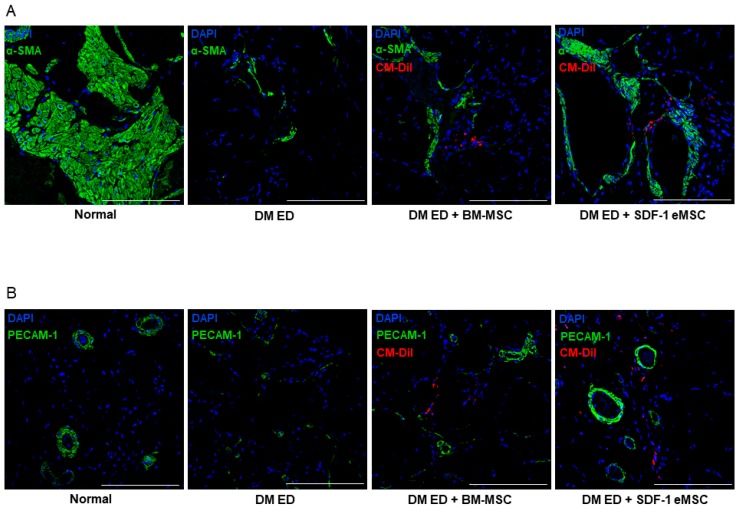
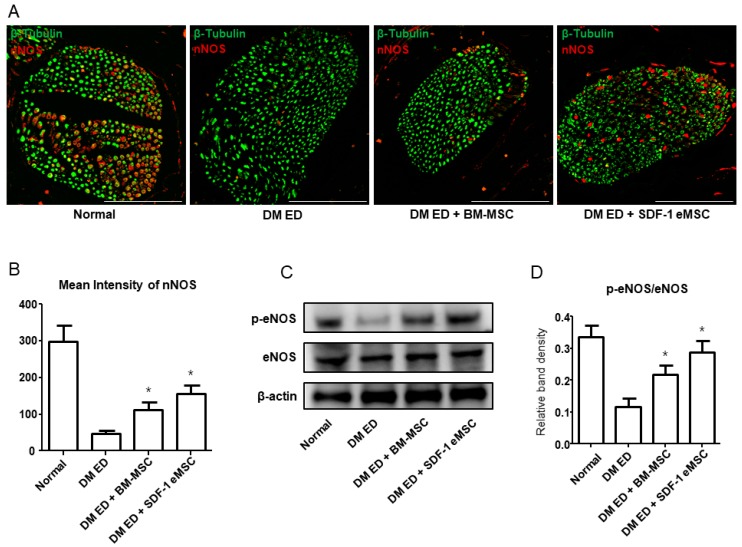
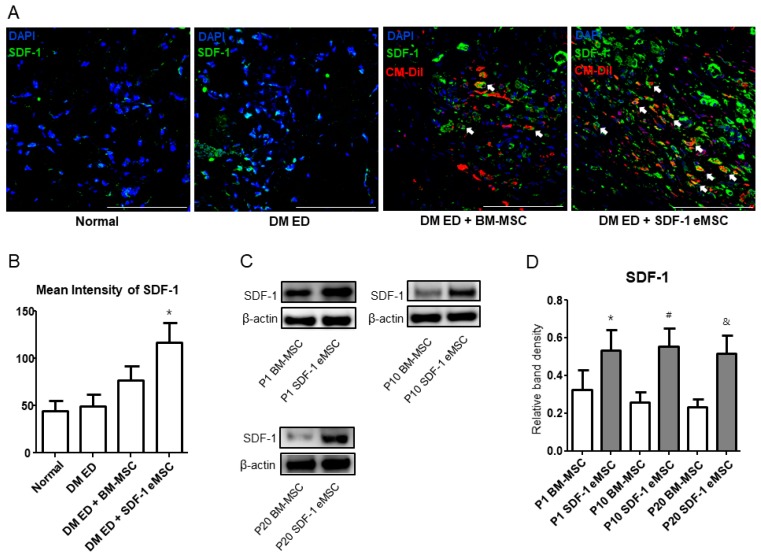
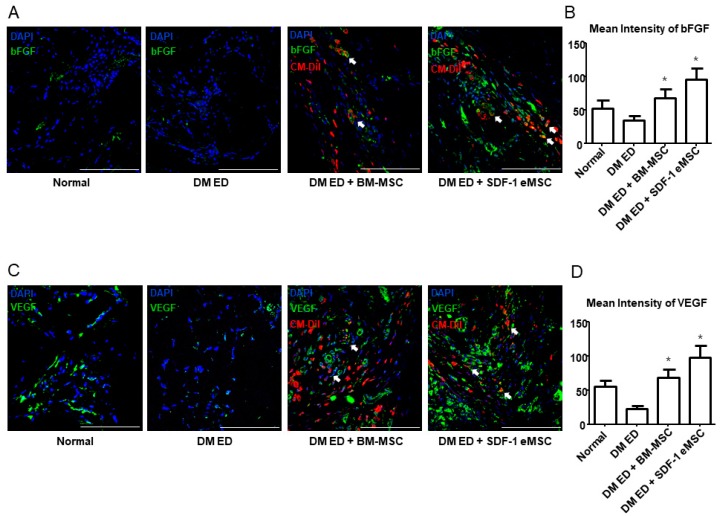
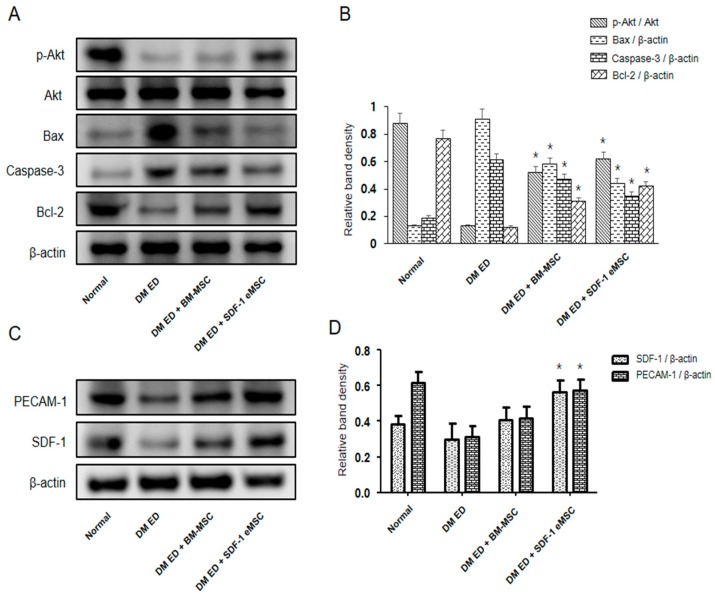
Effective therapies for erectile dysfunction (ED) associated with diabetes mellitus (DM) are needed. In this study, the effects of stromal cell-derived factor-1 (SDF-1)-expressing engineered mesenchymal stem cells (SDF-1 eMSCs) and the relevant mechanisms in the corpus cavernosum of a streptozotocin (STZ)-induced DM ED rat model were evaluated. In a randomized controlled trial, Sprague⁻Dawley (SD) rats ( = 48) were divided into four groups ( = 12/group): Normal (control), DM ED (diabetes induced by STZ), DM ED + BM-MSC (treated with bone marrow [BM]-derived MSCs), and DM ED + SDF-1 eMSC (treated with SDF-1-expressing BM-MSCs). After four weeks, intracavernosal pressure (ICP), an indicator of erectile function, was 0.75 ± 0.07 in the normal group, 0.27 ± 0.08 in the DM ED group, 0.42 ± 0.11 in the DM ED + BM-MSC group, and 0.58 ± 0.11 in the DM ED + SDF-1 eMSC group. BM-MSCs, especially SDF-1 eMSCs, improved ED ( < 0.05). SDF-1 eMSC treatment improved the smooth muscle content in the corpus cavernosum ( < 0.05). As SDF-1 expression increased, ED recovery improved. In the SDF-1 eMSC group, levels of neuronal nitric oxide synthase (nNOS) and phosphorylated endothelial NOS (p-eNOS) were higher than those in other groups ( < 0.05). In addition, high stromal cell-derived factor-1 (SDF-1) expression was associated with increased vascular endothelial growth factor (VEGF) and basic fibroblast growth factor (bFGF) in DM ED rats ( < 0.05). Higher levels of phosphorylated protein kinase B (p-AKT)/protein kinase B (AKT) ( < 0.05) and B-cell lymphoma-2 (Bcl-2) and lower levels of the apoptosis factors Bcl2-associated x (Bax) and caspase-3 were observed in the MSC-treated group than in the DM ED group ( < 0.05). SDF-1 eMSCs showed beneficial effects on recovery from erectile function.
需要有效的治疗方法来治疗与糖尿病(DM)相关的勃起功能障碍(ED)。在这项研究中,评估了基质细胞衍生因子-1(SDF-1)表达工程间充质干细胞(SDF-1 eMSCs)在链脲佐菌素(STZ)诱导的 DM ED 大鼠模型海绵体中的作用及其相关机制。在一项随机对照试验中,将 Sprague-Dawley(SD)大鼠(n = 48)分为四组(n = 12/组):正常(对照组)、DM ED(STZ 诱导的糖尿病)、DM ED + BM-MSC(骨髓 [BM]-衍生 MSC 治疗)和 DM ED + SDF-1 eMSC(表达 SDF-1 的 BM-MSC 治疗)。四周后,正常组的海绵体内压(ICP),勃起功能的指标为 0.75 ± 0.07,DM ED 组为 0.27 ± 0.08,DM ED + BM-MSC 组为 0.42 ± 0.11,DM ED + SDF-1 eMSC 组为 0.58 ± 0.11。BM-MSCs,特别是 SDF-1 eMSCs,改善了 ED(<0.05)。SDF-1 eMSC 治疗增加了海绵体平滑肌含量(<0.05)。随着 SDF-1 表达的增加,ED 恢复得到改善。在 SDF-1 eMSC 组中,神经元型一氧化氮合酶(nNOS)和磷酸化内皮型一氧化氮合酶(p-eNOS)的水平高于其他组(<0.05)。此外,在 DM ED 大鼠中,高基质细胞衍生因子-1(SDF-1)表达与血管内皮生长因子(VEGF)和碱性成纤维细胞生长因子(bFGF)的增加有关(<0.05)。在 MSC 治疗组中,磷酸化蛋白激酶 B(p-AKT)/蛋白激酶 B(AKT)(<0.05)和 B 细胞淋巴瘤-2(Bcl-2)水平升高,凋亡因子 Bcl2 相关 X(Bax)和 caspase-3 水平降低与 DM ED 组相比(<0.05)。SDF-1 eMSCs 对恢复勃起功能具有有益作用。