Śmielak Beata, Klimek Leszek, Świniarski Jacek
Department of Dental Prosthetics, Medical University of Lodz, ul. Pomorska 251, 92-213 Lodz, Poland.
Department of Materials Research, Institute of Materials Science and Engineering, University of Technology, ul. Stefanowskiego 1/15, 90-924 Lodz, Poland.
Materials (Basel). 2018 Nov 23;11(12):2360. doi: 10.3390/ma11122360.
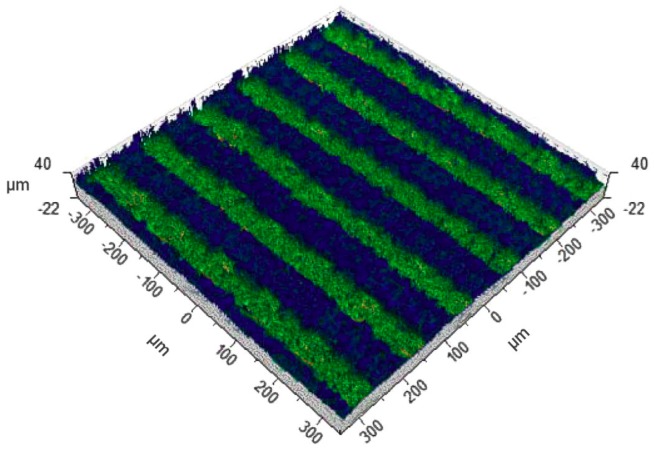
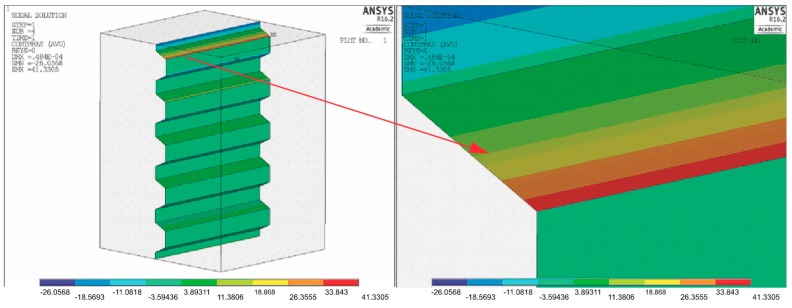
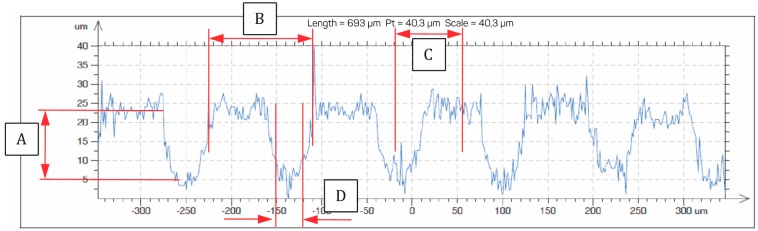
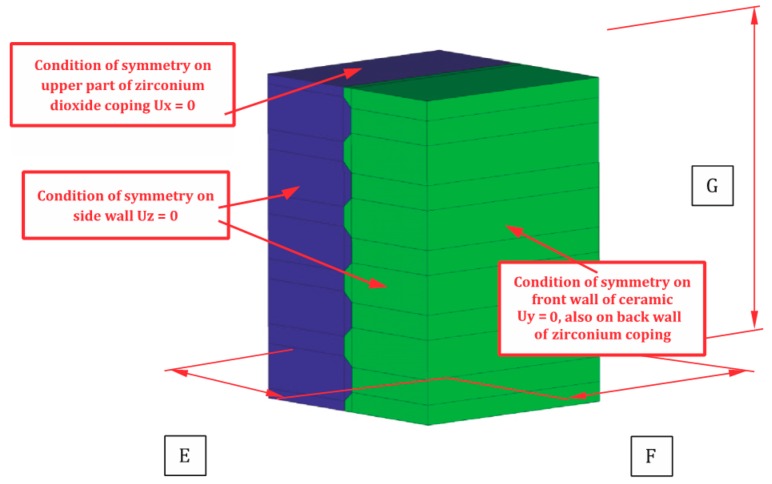
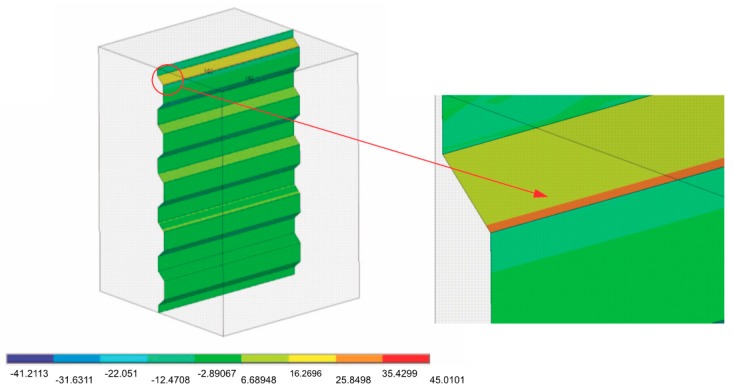
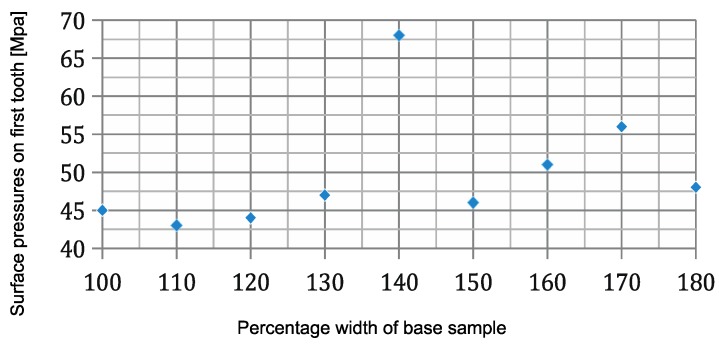
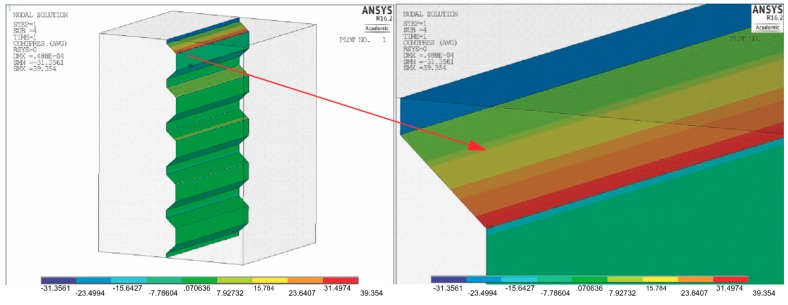
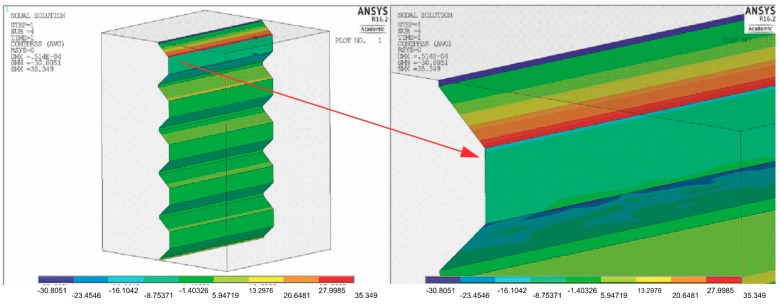
To examine the influence of coping notches with varying groove widths and depths on the quality of the connection with ceramic. Ten rectangular sintered zirconia (3Y-TZP) samples were etched with a neodymium-yag laser Nd:YAG. Then, a profilometer was used to test the depths and spacing of the grooves. A notch profile was used to design the shapes and spacing of the grooves based on a finite element method (FEM) simulating zirconia. The following situations were simulated: an increase in groove width from 100% to 180% and depth from 40% and 80%; and a 40% depth and width. An increase of 10% in the baseline width caused an insignificant reduction of the strain in the connection. A further increase in this dimension led to a 50% increase in strain with a 40% increase in width. An increase in the groove depth by 40% reduced the strain level by 13%, while an increase in the groove depth by 80% reduced the strain level by 22%. Simultaneous deepening and widening of the groove by 40% had no significant impact on the strain level. Maintaining the width of the groove bottom while increasing the depth offers fewer advantages than deepening and narrowing the groove bottom.
为研究不同槽宽和深度的应对缺口对与陶瓷连接质量的影响。用钕钇铝石榴石激光(Nd:YAG)对十个矩形烧结氧化锆(3Y-TZP)样品进行蚀刻。然后,使用轮廓仪测试凹槽的深度和间距。基于模拟氧化锆的有限元方法(FEM),用缺口轮廓设计凹槽的形状和间距。模拟了以下情况:槽宽从100%增加到180%,深度从40%增加到80%;以及40%的深度和宽度。基线宽度增加10%导致连接处应变的降低不显著。该尺寸的进一步增加导致宽度增加40%时应变增加50%。槽深增加40%使应变水平降低13%,而槽深增加80%使应变水平降低22%。槽同时加深和加宽40%对应变水平没有显著影响。在增加深度的同时保持槽底宽度比加深并变窄槽底提供的优势更少。