1Institute for Infection Prevention and Hospital Epidemiology, Medical Center - University of Freiburg, Faculty of Medicine, Freiburg, Germany.
2Institute of Hygiene and Environmental Medicine, Charité - Universitätsmedizin, Berlin, Germany.
Antimicrob Resist Infect Control. 2018 Nov 21;7:141. doi: 10.1186/s13756-018-0432-z. eCollection 2018.
Blood cultures (BCs) are the gold standard for diagnosing sepsis and are prerequisite for a targeted antibiotic treatment and essential for patient outcomes. Aim of the study was to analyze the frequency of BCs, the rate of central line-associated bloodstream infections (CLABSIs) and to study the association between both parameters on intensive care units in Germany over time.
Cross-sectional studies at two points in time (2006, 2015) on ICUs participating in the German hospital infection surveillance system. CLABSIs were defined according to the Center for Disease Control and Prevention (CDC). Univariable and multivariable analyses were performed using generalized linear models.
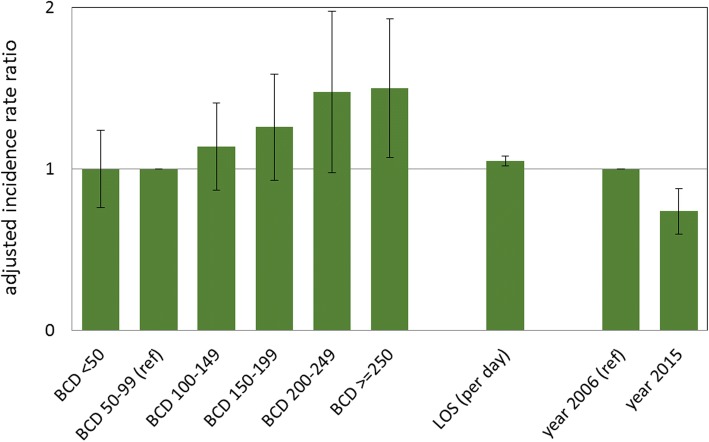
A total of 639 ICUs participated in 2006 or 2015 and 90 ICUs ("") in both years. Overall, 2,427,921 patient days from 644,575 patients were analyzed. In the ICU core group the frequency of BCs per 1000 patient days doubled from 57.8 (interquartile range [IQR] 29.8-101.2; 2006) to 128.2 (IQR 71.6-183.2; 2015). In the same time, the pooled median CLABSI rate decreased from 0.8 (IQR 0-1.9; 2006) per 1000 central-line catheter days to 0.2 (IQR 0-0.9; 2015).
From 2006 to 2015 the frequency of BCs increased on ICUs in Germany and is now within the recommended 100 to 200 BCs sets per 1000 patient days.
血培养(BCs)是诊断败血症的金标准,是靶向抗生素治疗的前提,也是患者预后的关键。本研究旨在分析德国重症监护病房(ICUs)中 BCs 的频率、中心静脉导管相关血流感染(CLABSIs)的发生率,并研究这两个参数之间的相关性。
在参与德国医院感染监测系统的 ICU 中,于两个时间点(2006 年和 2015 年)进行横断面研究。CLABSIs 根据疾病控制与预防中心(CDC)的标准定义。使用广义线性模型进行单变量和多变量分析。
共有 639 家 ICU 参与了 2006 年或 2015 年的研究,其中 90 家 ICU(“核心 ICU”)参与了这两年的研究。总共分析了 644575 名患者的 2427921 个患者日。在 ICU 核心组中,每 1000 个患者日的 BCs 频率从 2006 年的 57.8(四分位距 [IQR] 29.8-101.2)增加到 2015 年的 128.2(IQR 71.6-183.2)。在此期间,集束化导管相关血流感染的累积中位数率从每 1000 个中心静脉导管日的 0.8(IQR 0-1.9)下降到 0.2(IQR 0-0.9)。
从 2006 年到 2015 年,德国 ICU 中 BCs 的使用频率增加,现在达到了每 1000 个患者日推荐的 100 至 200 次 BCs。