Department of Otolaryngology-Head and Neck Surgery, Chungnam National University College of Medicine, Daejeon, 35015, Korea.
Department of Otorhinolaryngology-Head and Neck Surgery, Seoul National University Bundang Hospital, Seoul National University College of Medicine, 300 Gumi-dong, Bundang-gu, Seongnam, 13620, Republic of South Korea.
J Transl Med. 2018 Nov 27;16(1):330. doi: 10.1186/s12967-018-1708-z.
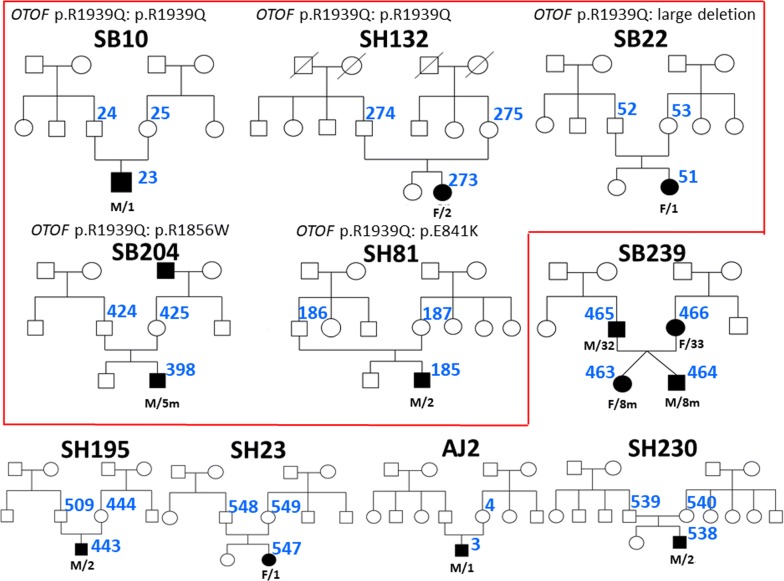
While auditory neuropathy spectrum disorder (ANSD) is a heterogeneous disorder and its management quite varies depending upon the etiology, even including self-resolution, OTOF is an important molecular etiology of prelingual ANSD and has emerged as an attractive target for implementation of precision medicine in terms of timing and prognosis prediction of auditory rehabilitation. However, to date, the literature is lacking in the genotype-phenotype relationship of this gene as well as efficient molecular testing strategy in the clinic in many populations and to make things more complicated in Koreans, the most prevalent variant p.Arg1939Gln among Korean ANSD children frequently evaded detection by next generation sequencing (NGS), resulting in delayed genetic diagnosis and late cochlear implantation (CI). The aims of this study are to document the mutational and phenotypic spectrum of OTOF-related ANSD (DFNB9) in the Korean population, further establishing genotype-phenotype correlation and proposing a set of the most commonly found OTOF variants to be screened first.
Genetic diagnosis through the NGS-based sequencing was made on patients with ANSD in two tertiary hospitals. Genotype and phenotypes of eleven DFNB9 patients were reviewed. For data analysis, Mann-Whitney test and Fisher's exact test were applied.
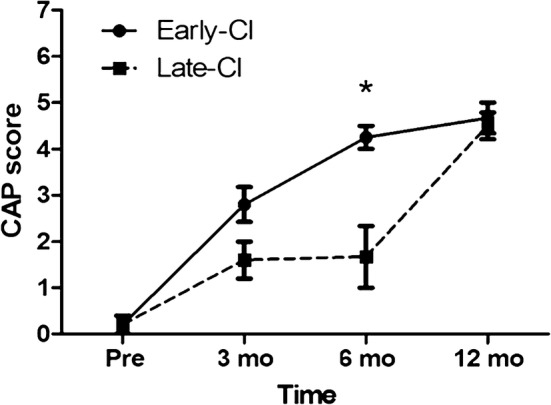
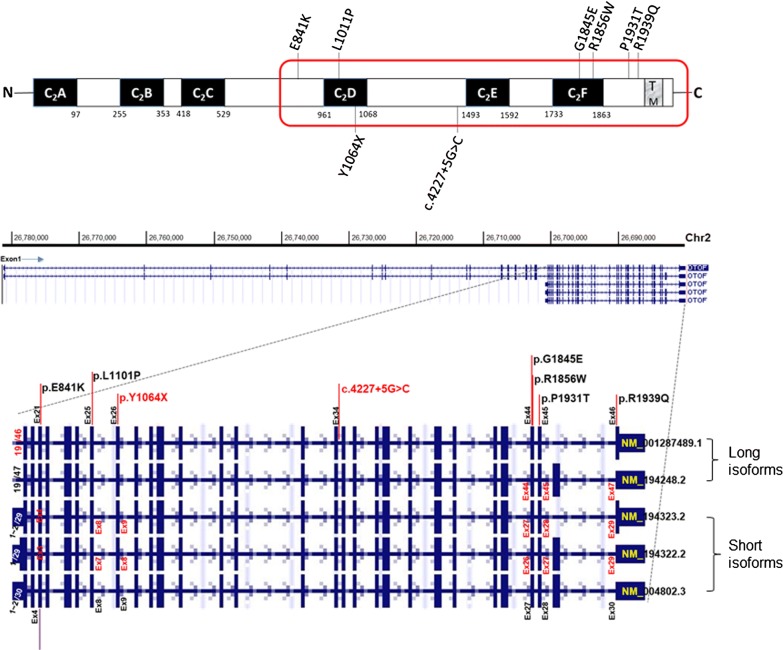
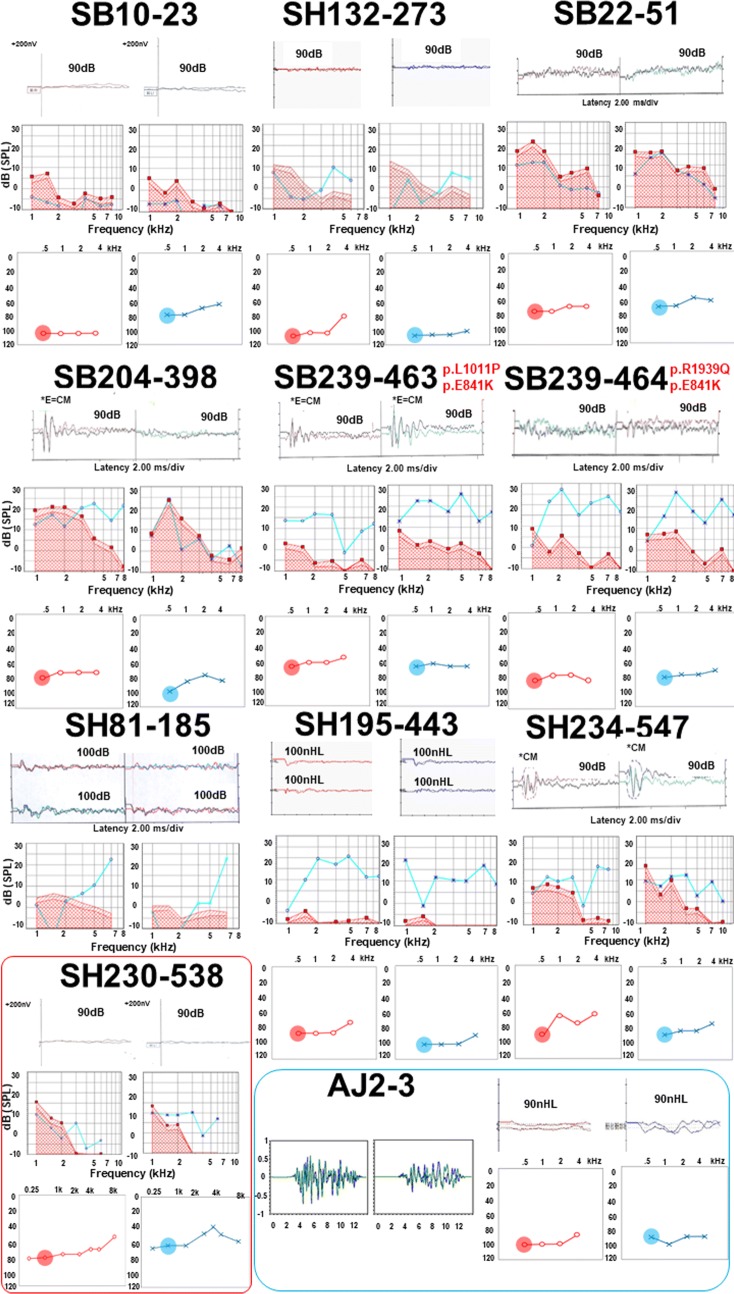
This study disclosed four prevalent variants in Koreans: p.Arg1939Gln with an allele frequency of 40.9%, p.Glu841Lys (13.6%), p.Leu1011Pro and p.Arg1856Trp (9.1%). Three novel variants (c.4227 + 5G > C, p.Gly1845Glu, and p.Pro1931Thr) were identified. Interestingly, a significant association of p.Arg1939Gln with worse ASSR thresholds was observed despite consistently no ABR response. Ten of 11 DFNB9 patients received CI for auditory rehabilitation, showing favorable outcomes with more rapid improvement on early-CI group (age at CI ≤ 18 mo.) than late-CI group.
This study included the largest Korean DFNB9 cohort to date and proposed a set of the most frequent four OTOF variants, allowing the potential prioritization of exons during Sanger sequencing. Further, a significant association of p.Arg1939Gln homozygotes with poor residual hearing was observed. We may have to suspect p.Arg1939Gln homozygosity in cases of poor auditory thresholds in ANSD children with putative negative OTOF variants solely screened by NGS. Reciprocal feedback between bench and clinics regarding DFNB9 would complement each other.
尽管听觉神经病谱系障碍(ANSD)是一种异质性疾病,其治疗方法因病因而异,甚至包括自行缓解,但 OTOF 是导致语前 ANSD 的重要分子病因,并已成为实施精准医学的有吸引力的目标,可预测听觉康复的时机和预后。然而,迄今为止,在许多人群中,该基因的基因型-表型关系以及临床中有效的分子检测策略在文献中仍然缺乏,而在韩国,情况更为复杂,最常见的韩国 ANSD 儿童变异型 p.Arg1939Gln 经常逃避下一代测序(NGS)的检测,导致遗传诊断延迟和人工耳蜗植入(CI)延迟。本研究的目的是记录 OTOF 相关 ANSD(DFNB9)在韩国人群中的突变和表型谱,进一步建立基因型-表型相关性,并提出一套最常见的 OTOF 变体进行优先筛选。
通过两家三级医院的基于 NGS 的测序对 ANSD 患者进行基因诊断。回顾了 11 名 DFNB9 患者的基因型和表型。数据分析采用 Mann-Whitney 检验和 Fisher 确切检验。
本研究在韩国人群中发现了四个常见的变体:等位基因频率为 40.9%的 p.Arg1939Gln、p.Glu841Lys(13.6%)、p.Leu1011Pro 和 p.Arg1856Trp(9.1%)。鉴定出三个新变体(c.4227 + 5G > C、p.Gly1845Glu 和 p.Pro1931Thr)。有趣的是,尽管始终没有 ABR 反应,但观察到 p.Arg1939Gln 与 ASSR 阈值较差显著相关。11 名 DFNB9 患者中有 10 名接受了听觉康复的 CI,早期 CI 组(CI 年龄≤18 个月)的听力改善速度明显快于晚期 CI 组,表明预后良好。
本研究纳入了迄今为止最大的韩国 DFNB9 队列,并提出了一套最常见的四个 OTOF 变体,允许在 Sanger 测序期间对exon 进行优先级排序。此外,还观察到 p.Arg1939Gln 纯合子与残余听力较差显著相关。在仅通过 NGS 筛选推定阴性 OTOF 变体的 ANSD 儿童中,出现较差的听觉阈值时,我们可能不得不怀疑 p.Arg1939Gln 纯合子。DFNB9 的实验室和临床之间的相互反馈将相互补充。