WHO Collaborating Centre for Leishmaniasis, National Centre for Microbiology, Instituto de Salud Carlos III, Madrid, Spain.
Hospital Universitario de Fuenlabrada, Fuenlabrada, Madrid, Spain.
Front Cell Infect Microbiol. 2018 Nov 13;8:381. doi: 10.3389/fcimb.2018.00381. eCollection 2018.
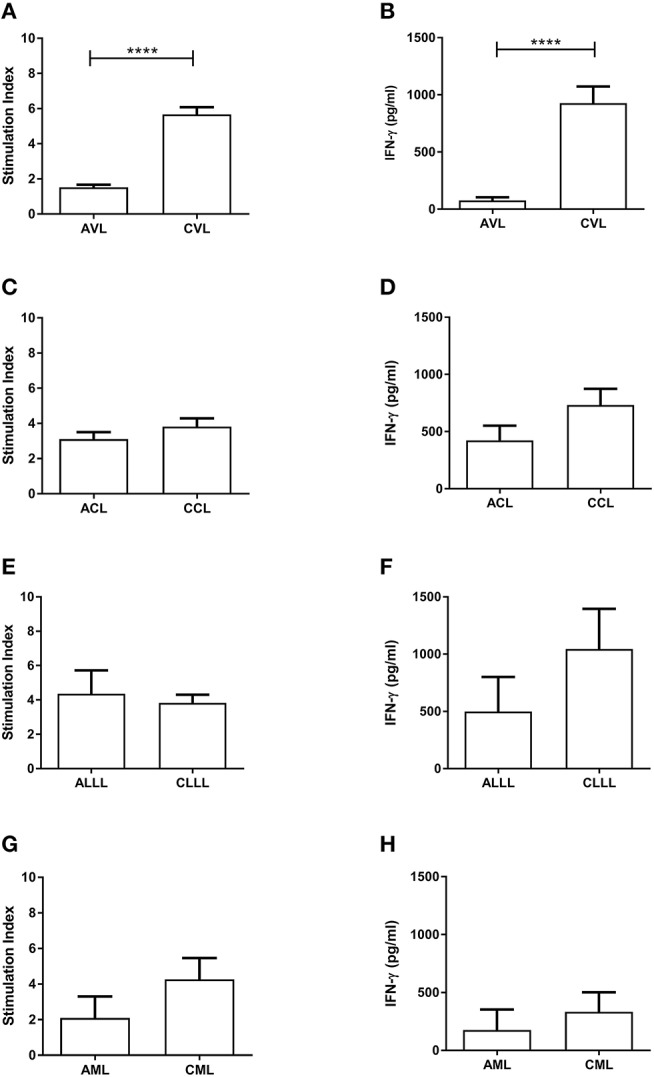
Increased numbers of peripheral blood mononucleocytes (PBMC) and increased IFN-γ secretion following challenge of blood samples with soluble antigen (SLA), have been proposed as biomarkers of specific cell-mediated immunity, indicating that treatment of visceral leishmaniasis (VL) has been successful. However, infection may manifest as cutaneous leishmaniasis (CL), and less commonly as localized leishmanial lymphadenopathy (LLL) or mucosal leishmaniasis (ML). The present work examines the value of these biomarkers as indicators of cured leishmaniasis presenting in these different forms. Blood samples were collected before and after treatment from patients living in Fuenlabrada (Madrid, Spain), an endemic area recently the center of a leishmaniasis outbreak. All samples were subjected to -specific PCR, serological tests (IFAT and rK39-ICT), and the SLA-cell proliferation assay (SLA-CPA), recording PBMC proliferation and the associated changes in IFN-γ production. Differences in the results recorded for the active and cured conditions were only significant for VL. PCR returned positive results in 67% of patients with active VL and in 3% of those with cured leishmaniasis. Similarly, rK39-ICT returned a positive result in 77% of active VL samples . 52% in cured VL samples, and IFAT in 90% . 56%; in the SLA-CPA, PBMC proliferation was seen in 16% . 90%, and an associated increase in IFN-γ production of 14 and 84%, respectively. The present findings reinforce the idea that PBMC proliferation and increased IFN-γ production in SLA-stimulated PBMC provide biomarkers of clinical cure in VL. Other tests are urgently needed to distinguish between the cured and active forms of the other types of clinical leishmaniasis caused by .
外周血单核细胞(PBMC)数量增加和 IFN-γ 分泌增加,在挑战血液样本中的可溶性抗原(SLA)后被提出作为特异性细胞介导免疫的生物标志物,表明内脏利什曼病(VL)的治疗已经成功。然而,感染可能表现为皮肤利什曼病(CL),并且不太常见的是局部利什曼性淋巴结病(LLL)或粘膜利什曼病(ML)。本工作检查了这些生物标志物作为不同形式治愈利什曼病的指标的价值。从生活在富恩拉夫拉达(马德里,西班牙)的患者中采集治疗前后的血液样本,富恩拉夫拉达是最近利什曼病爆发的中心的一个地方。所有样本均进行 -特异性 PCR、血清学测试(IFAT 和 rK39-ICT)和 SLA 细胞增殖测定(SLA-CPA),记录 PBMC 增殖及其相关 IFN-γ 产生的变化。仅在 VL 中,活跃和治愈条件下记录的结果差异才有统计学意义。PCR 在 67%的活动性 VL 患者和 3%的治愈性利什曼病患者中呈阳性结果。同样,rK39-ICT 在 77%的活动性 VL 样本中呈阳性结果,52%在治愈性 VL 样本中呈阳性结果,IFAT 在 90%中呈阳性结果。56%;在 SLA-CPA 中,16%观察到 PBMC 增殖,分别为 90%和相关 IFN-γ 产生分别增加 14%和 84%。本研究结果进一步证明了 PBMC 增殖和 SLA 刺激的 PBMC 中 IFN-γ 产生增加是 VL 临床治愈的生物标志物。迫切需要其他测试来区分由 引起的其他类型的临床利什曼病的治愈和活动形式。