Lee Kyeong-Seok
Department of Neurosurgery, Soonchunhyang University Chonan Hospital, Chonan, Korea.
J Korean Neurosurg Soc. 2019 Mar;62(2):144-152. doi: 10.3340/jkns.2018.0156. Epub 2018 Nov 30.
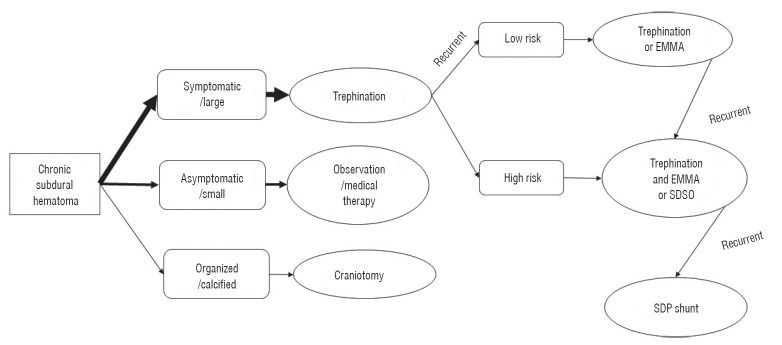
Treatment of chronic subdural hematoma (CSDH) is relatively straightforward, however, there is still some debate regarding the best strategy for treatment. The most practical recommendations of up to date were identified by a review of literature. The author reviewed the literature on CSDH management from the past to now to identify the best methods. Till 1970s, craniotomy was the most commonly used method. Burr hole (BH) became the most preferred method from 1980s. In 1977, twist drill (TD) craniostomy was introduced. Closed system drainage after a BH or a TD became the most frequently used surgical method. Although nonsurgical treatment is often successful, trephination has more advantages, such as rapid resolution of the symptoms and short period of hospitalization. Nonsurgical treatment is possible in asymptomatic patients with a small CSDH. For the symptomatic patients with CSDH, trephination is the treatment of choice, either by BH or TD. In gray zone between surgery and medical treatment, shared decision making can be an ideal approach. For the recurrent CSDHs, repeated trephination is still effective for patients with a low risk of recurrence. If the risk of recurrence is high, additional management would be helpful. For the refractory CSDHs, it is necessary to obliterate the subdural space.
慢性硬膜下血肿(CSDH)的治疗相对简单直接,然而,关于最佳治疗策略仍存在一些争议。通过文献综述确定了最新的最实用建议。作者回顾了过去到现在关于CSDH管理的文献,以确定最佳方法。直到20世纪70年代,开颅手术是最常用的方法。20世纪80年代起,钻孔引流术(BH)成为最常用的方法。1977年,引入了 twist drill(TD)颅骨钻孔术。在BH或TD后进行闭式引流成为最常用的手术方法。尽管非手术治疗通常很成功,但钻孔引流术有更多优点,如症状快速缓解和住院时间短。对于无症状的小CSDH患者,非手术治疗是可行的。对于有症状的CSDH患者,钻孔引流术是首选治疗方法,可通过BH或TD进行。在手术和药物治疗的灰色地带,共同决策可能是一种理想的方法。对于复发性CSDH,对于复发风险低的患者,重复钻孔引流术仍然有效。如果复发风险高,额外的处理会有帮助。对于难治性CSDH,有必要消除硬膜下间隙。