Department of Plant Pathology, The Ohio State University, 201 Kottman Hall, 2021 Coffey Road, 43210, Columbus, Ohio, United States.
Warnell School of Forestry & Natural Resources, University of Georgia, 180 E Green Street, 30602, Athens, Georgia, United States.
Sci Rep. 2018 Nov 28;8(1):17448. doi: 10.1038/s41598-018-35770-0.
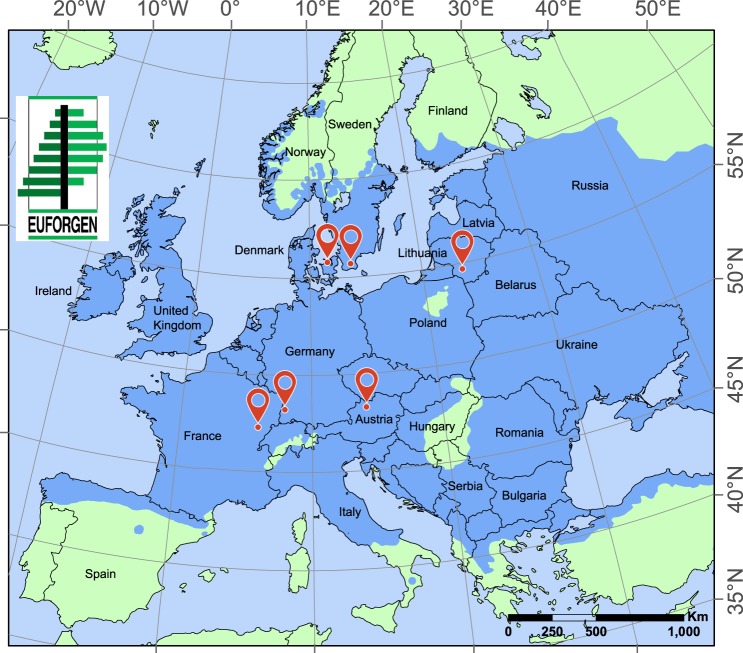
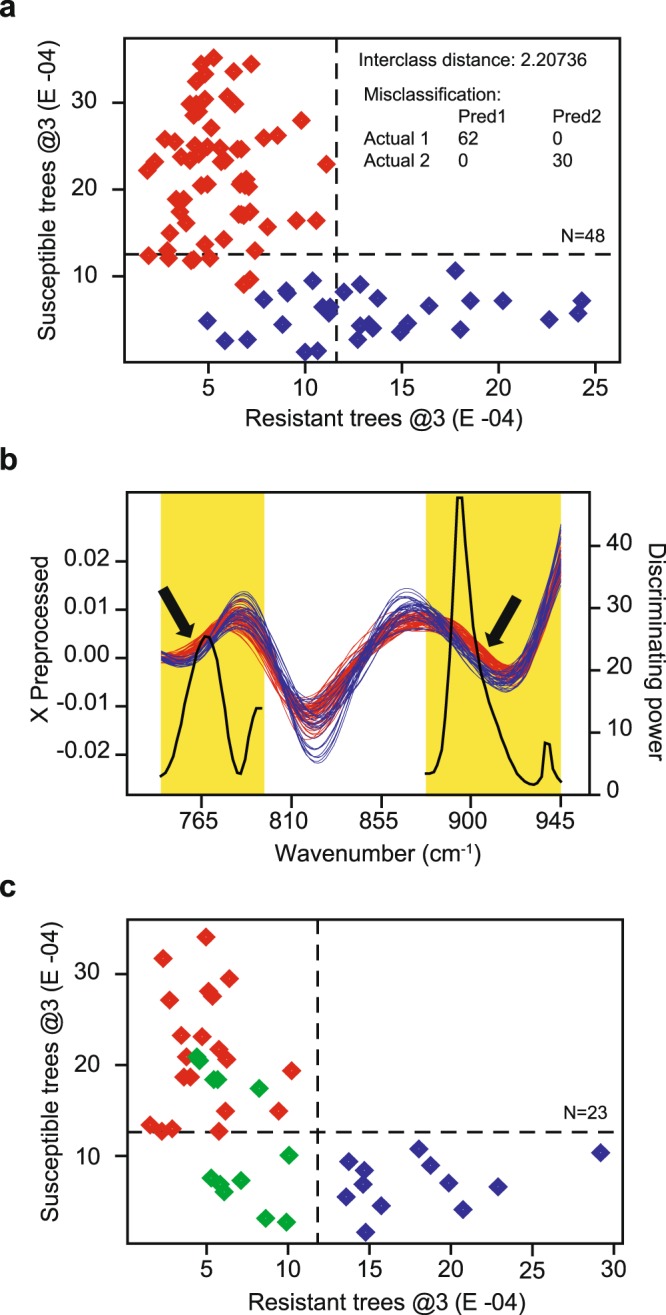
Natural and urban forests worldwide are increasingly threatened by global change resulting from human-mediated factors, including invasions by lethal exotic pathogens. Ash dieback (ADB), incited by the alien invasive fungus Hymenoscyphus fraxineus, has caused large-scale population decline of European ash (Fraxinus excelsior) across Europe, and is threatening to functionally extirpate this tree species. Genetically controlled host resistance is a key element to ensure European ash survival and to restore this keystone species where it has been decimated. We know that a low proportion of the natural population of European ash expresses heritable, quantitative resistance that is stable across environments. To exploit this resource for breeding and restoration efforts, tools that allow for effective and efficient, rapid identification and deployment of superior genotypes are now sorely needed. Here we show that Fourier-transform infrared (FT-IR) spectroscopy of phenolic extracts from uninfected bark tissue, coupled with a model based on soft independent modelling of class analogy (SIMCA), can robustly discriminate between ADB-resistant and susceptible European ash. The model was validated with populations of European ash grown across six European countries. Our work demonstrates that this approach can efficiently advance the effort to save such fundamental forest resource in Europe and elsewhere.
全世界的天然林和城市林正日益受到人为因素引起的全球变化的威胁,包括致命的外来病原体的入侵。由外来入侵真菌 Hymenoscyphus fraxineus 引发的灰树枯萎病(ADB)已导致欧洲各地的欧洲白蜡(Fraxinus excelsior)大量减少,并有可能使其功能性灭绝。受遗传控制的宿主抗性是确保欧洲白蜡存活并在其被大量砍伐的地方恢复这种关键物种的关键因素。我们知道,欧洲白蜡自然种群中只有一小部分表现出可遗传的、稳定的数量抗性。为了利用这一资源进行繁殖和恢复工作,现在迫切需要能够有效和高效地快速识别和部署优良基因型的工具。在这里,我们表明,来自未感染树皮组织的酚类提取物的傅里叶变换红外(FT-IR)光谱,结合基于软独立建模分类分析(SIMCA)的模型,可以可靠地区分 ADB 抗性和易感的欧洲白蜡。该模型在六个欧洲国家生长的欧洲白蜡种群中得到了验证。我们的工作表明,这种方法可以有效地推动拯救欧洲和其他地区这种基本森林资源的工作。