Diaz Julia M, Plummer Sydney, Tomas Carmelo, Alves-de-Souza Catharina
Skidaway Institute of Oceanography, Department of Marine Sciences, University of Georgia, Savannah, GA, USA.
Algal Resources Collection, MARBIONC at CREST Research Park, University of North Carolina Wilmington, Wilmington, NC, USA.
J Plankton Res. 2018 Nov;40(6):667-677. doi: 10.1093/plankt/fby043. Epub 2018 Nov 2.
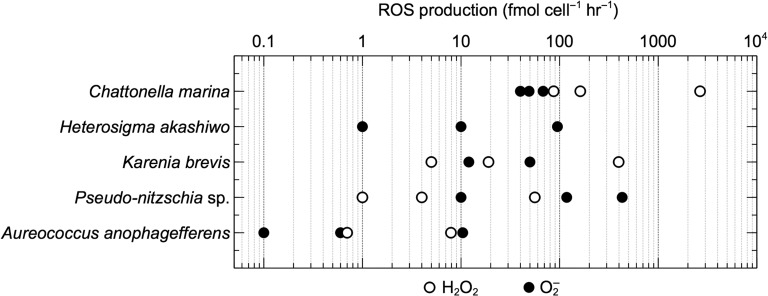
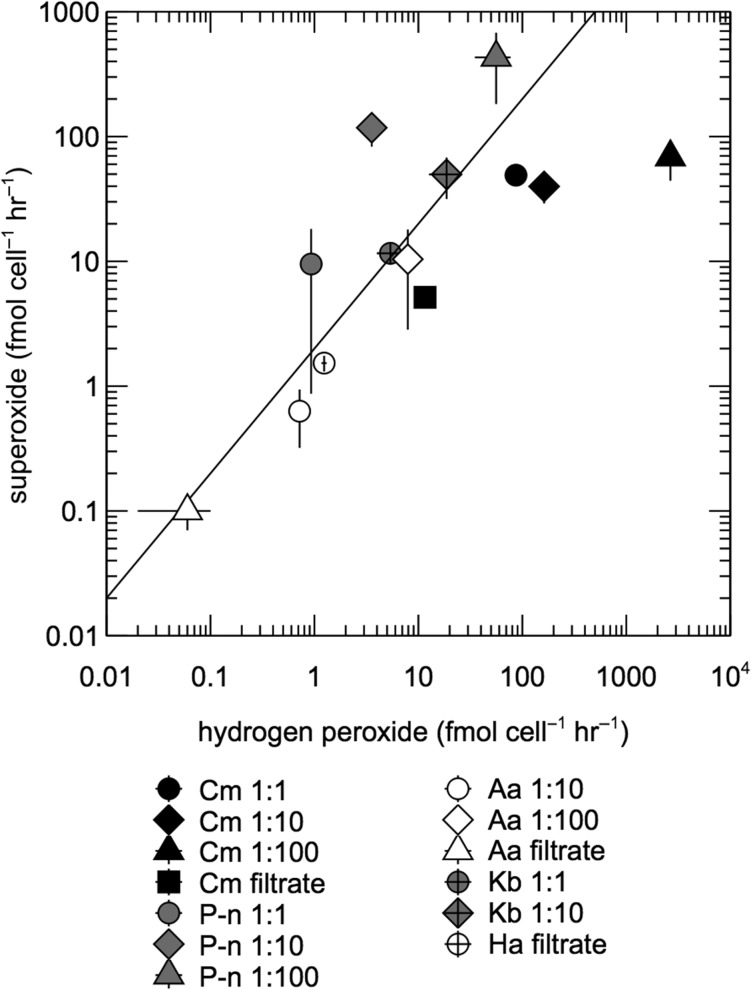
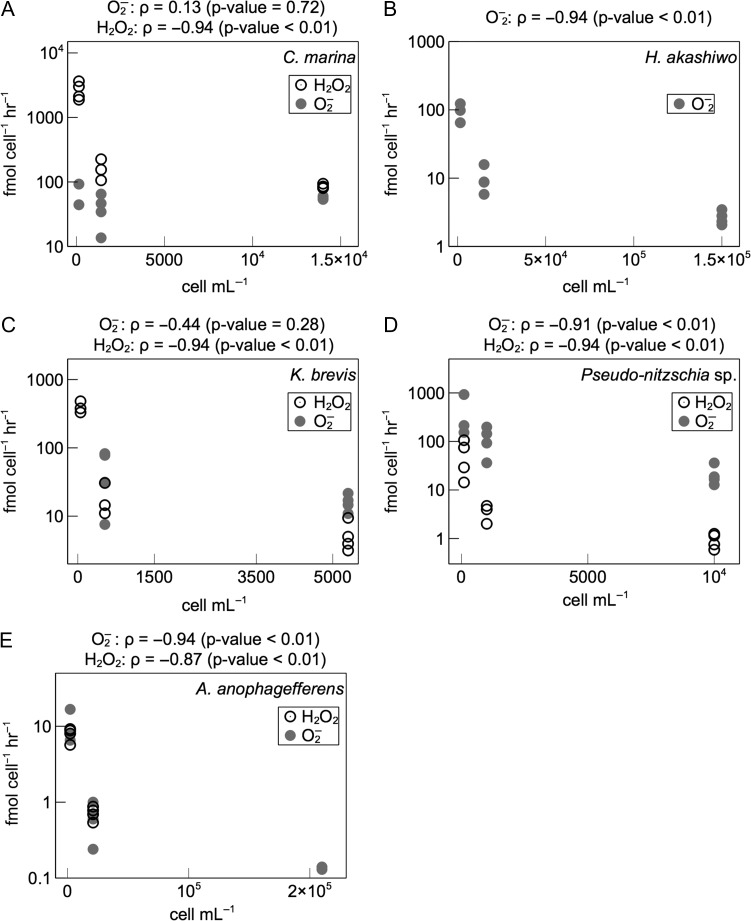
Harmful bloom-forming algae include some of the most prolific microbial producers of extracellular reactive oxygen species (ROS). However, the taxonomic diversity of ROS production, the underlying physiological mechanisms and ecophysiological roles of ROS cycling are not completely characterized among phytoplankton taxa that form harmful algal blooms (HABs). This study examines the extracellular production of the ROS superoxide and hydrogen peroxide by five marine HAB species: , , , sp. and . All species produced extracellular superoxide and hydrogen peroxide. Rates of ROS production per cell spanned several orders of magnitude and varied inversely with cell density, suggesting a potential signaling role for extracellular ROS. ROS production was also detected in the spent media of all cultures except , indicating the presence of cell-free ROS-generating constituents, such as enzymes or metabolites, which could be further investigated as molecular targets for tracking ROS production in laboratory and field settings. Finally, ratios of superoxide to hydrogen peroxide production could not be accounted for by superoxide dismutation alone, except in the case of , indicating a diversity of ROS production and degradation pathways that may ultimately help illuminate the functions of HAB-derived ROS.
有害的形成水华的藻类包括一些细胞外活性氧(ROS)产量最高的微生物生产者。然而,在形成有害藻华(HABs)的浮游植物类群中,ROS产生的分类多样性、潜在的生理机制以及ROS循环的生态生理作用尚未完全明确。本研究检测了五种海洋有害藻华物种(分别为[此处原文缺失具体物种名称]、[此处原文缺失具体物种名称]、[此处原文缺失具体物种名称]、[此处原文缺失具体物种名称]和[此处原文缺失具体物种名称])细胞外超氧化物和过氧化氢的产生情况。所有物种均产生细胞外超氧化物和过氧化氢。每个细胞的ROS产生速率跨越几个数量级,且与细胞密度呈反比,这表明细胞外ROS可能具有信号传导作用。除了[此处原文缺失具体物种名称]外,在所有培养物的用过的培养基中也检测到了ROS的产生,这表明存在无细胞的ROS产生成分,如酶或代谢物,可将其作为实验室和野外环境中追踪ROS产生的分子靶点进行进一步研究。最后,除了[此处原文缺失具体物种名称]的情况外,仅通过超氧化物歧化无法解释超氧化物与过氧化氢产生的比例,这表明ROS产生和降解途径具有多样性,最终可能有助于阐明有害藻华衍生的ROS的功能。