Department of Gastroenterology and Hepatology, Institute of Clinical Medicine, Graduate School of Comprehensive Human Sciences, University of Tsukuba, Tsukuba, Japan.
Department of Gastroenterology, Kasumigaura Medical Center, Tsuchiura, Japan.
Cancer Sci. 2019 Feb;110(2):639-649. doi: 10.1111/cas.13893. Epub 2019 Jan 16.
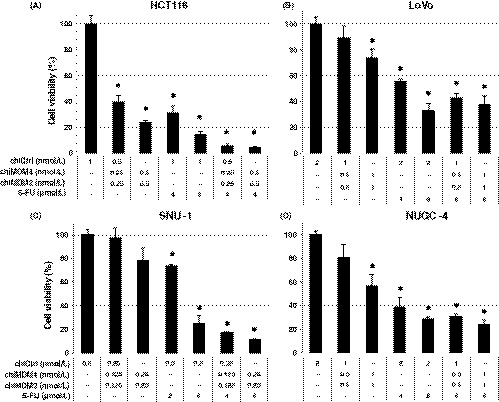
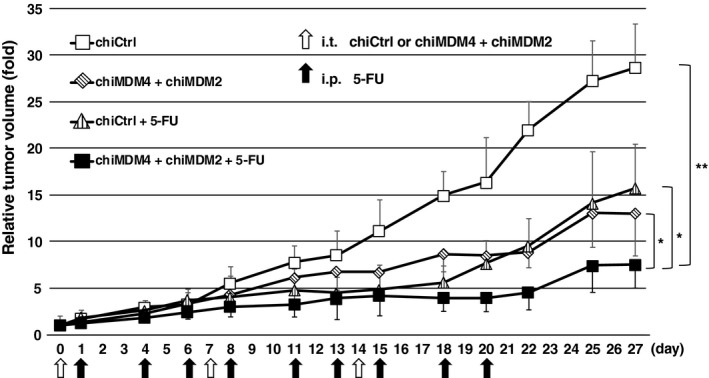
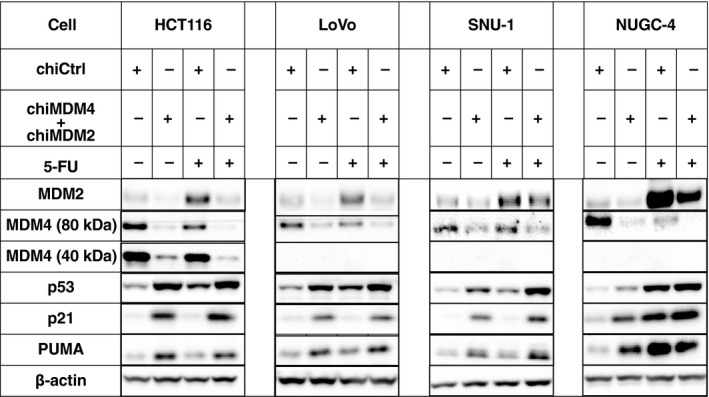
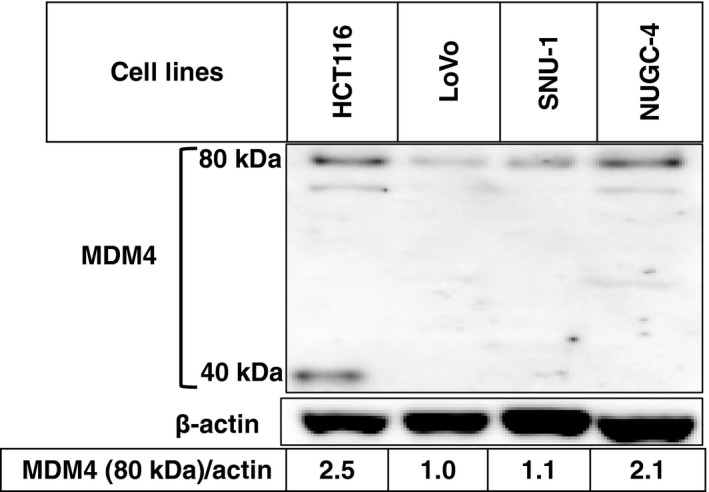
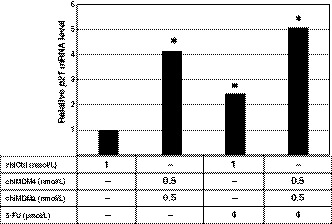
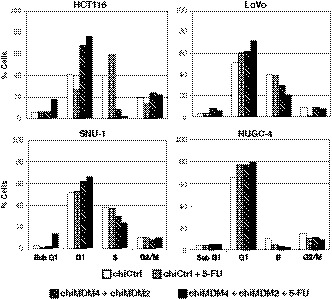
Inactivation of the TP53 tumor suppressor gene is essential during cancer development and progression. Mutations of TP53 are often missense and occur in various human cancers. In some fraction of wild-type (wt) TP53 tumors, p53 is inactivated by upregulated murine double minute homolog 2 (MDM2) and MDM4. We previously reported that simultaneous knockdown of MDM4 and MDM2 using synthetic DNA-modified siRNAs revived p53 activity and synergistically inhibited in vitro cell growth in cancer cells with wt TP53 and high MDM4 expression (wtTP53/highMDM4). In the present study, MDM4/MDM2 double knockdown with the siRNAs enhanced 5-fluorouracil (5-FU)-induced p53 activation, arrested the cell cycle at G phase, and potentiated the antitumor effect of 5-FU in wtTP53/highMDM4 human colon (HCT116 and LoVo) and gastric (SNU-1 and NUGC-4) cancer cells. Exposure to 5-FU alone induced MDM2 as well as p21 and PUMA by p53 activation. As p53-MDM2 forms a negative feedback loop, enhancement of the antitumor effect of 5-FU by MDM4/MDM2 double knockdown could be attributed to blocking of the feedback mechanism in addition to direct suppression of these p53 antagonists. Intratumor injection of the MDM4/MDM2 siRNAs suppressed in vivo tumor growth and boosted the antitumor effect of 5-FU in an athymic mouse xenograft model using HCT116 cells. These results suggest that a combination of MDM4/MDM2 knockdown and conventional cytotoxic drugs could be a promising treatment strategy for wtTP53/highMDM4 gastrointestinal cancers.
TP53 肿瘤抑制基因的失活是癌症发生和发展过程中的关键。TP53 的突变通常是错义突变,并发生在各种人类癌症中。在一部分野生型(wt)TP53 肿瘤中,p53 被上调的鼠双微基因 2(MDM2)和 MDM4 失活。我们之前报道过,使用合成 DNA 修饰的 siRNA 同时敲低 MDM4 和 MDM2,可以恢复 p53 的活性,并在 wtTP53 和高 MDM4 表达(wtTP53/highMDM4)的癌细胞中协同抑制体外细胞生长。在本研究中,siRNA 对 MDM4/MDM2 的双重敲低增强了 5-氟尿嘧啶(5-FU)诱导的 p53 激活,使细胞周期停滞在 G1 期,并增强了 wtTP53/highMDM4 人结肠(HCT116 和 LoVo)和胃(SNU-1 和 NUGC-4)癌细胞中 5-FU 的抗肿瘤作用。单独暴露于 5-FU 会通过 p53 激活诱导 MDM2 以及 p21 和 PUMA。由于 p53-MDM2 形成负反馈回路,因此 MDM4/MDM2 双重敲低增强 5-FU 的抗肿瘤作用可能归因于阻断反馈机制,除了直接抑制这些 p53 拮抗剂。在 HCT116 细胞的裸鼠异种移植模型中,肿瘤内注射 MDM4/MDM2 siRNA 抑制体内肿瘤生长,并增强了 5-FU 的抗肿瘤作用。这些结果表明,MDM4/MDM2 敲低与传统细胞毒性药物的联合使用可能是 wtTP53/highMDM4 胃肠道癌症的一种有前途的治疗策略。