Swetzig Wendy M, Wang Jianmin, Das Gokul M
Department of Pharmacology and Therapeutics, Roswell Park Cancer Institute, Buffalo, NY, USA.
Department of Molecular Pharmacology and Cancer Therapeutics, The University at Buffalo, State University of New York, Buffalo, NY, USA.
Oncotarget. 2016 Mar 29;7(13):16049-69. doi: 10.18632/oncotarget.7533.
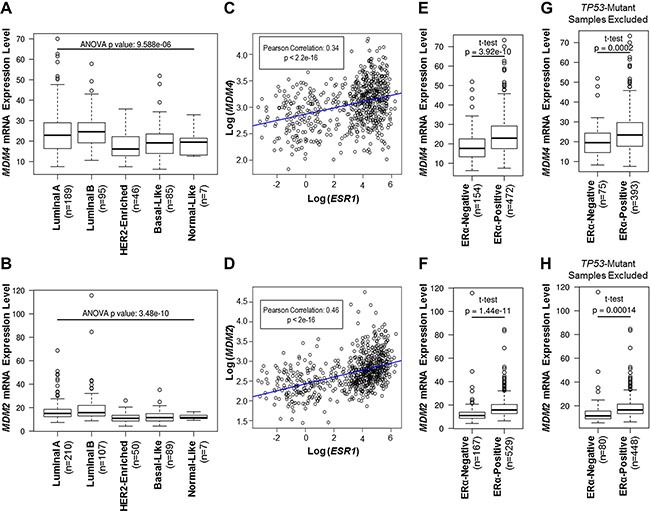
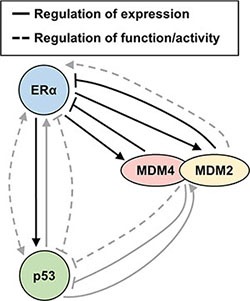
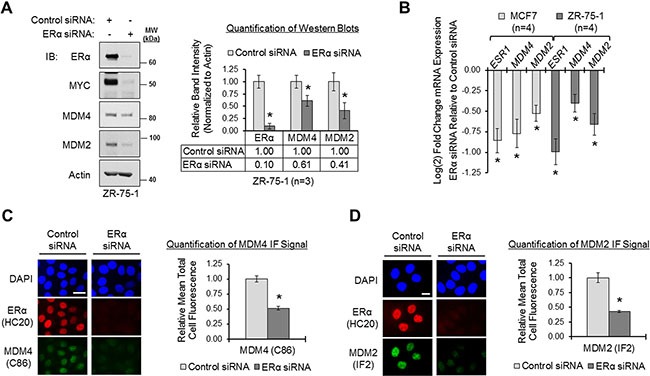
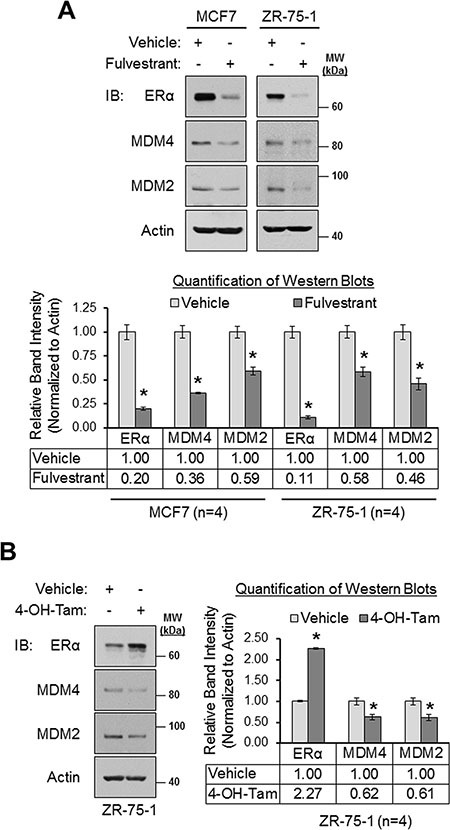
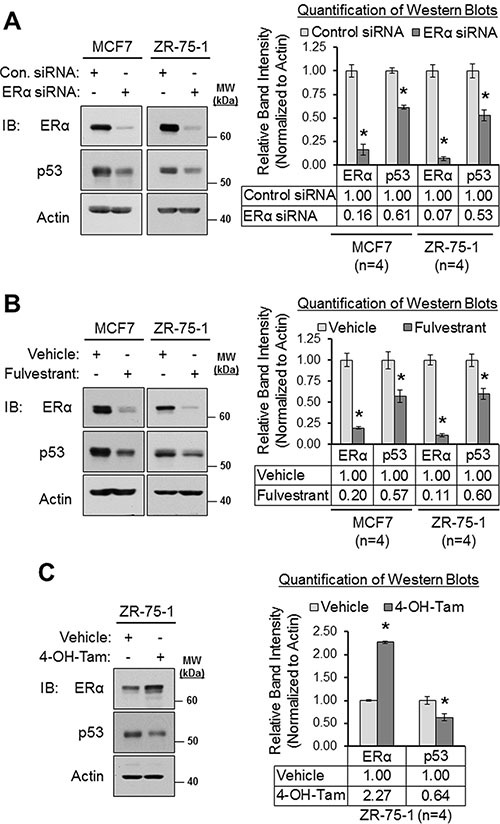
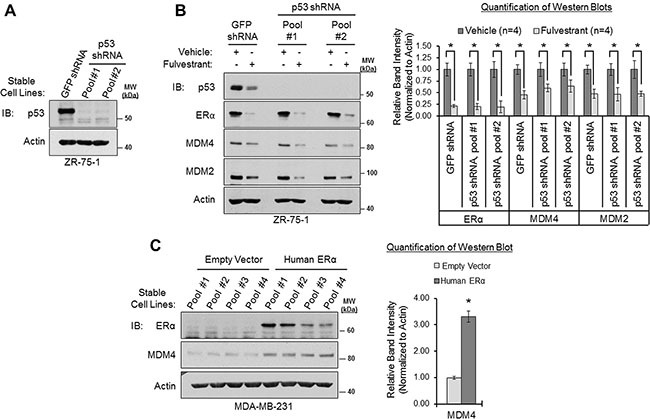
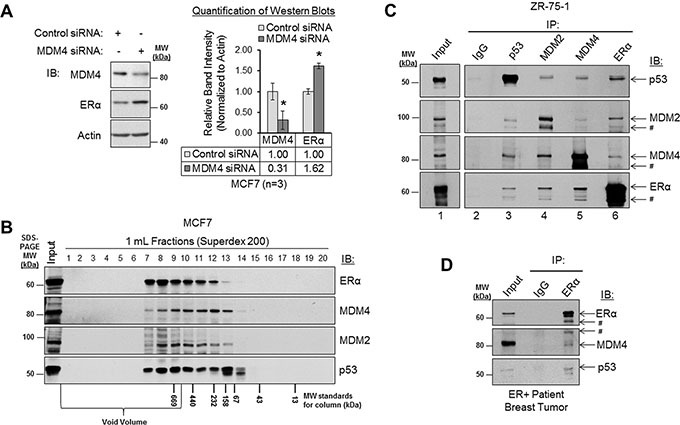
MDM2 and MDM4 are heterodimeric, non-redundant oncoproteins that potently inhibit the p53 tumor suppressor protein. MDM2 and MDM4 also enhance the tumorigenicity of breast cancer cells in in vitro and in vivo models and are overexpressed in primary human breast cancers. Prior studies have characterized Estrogen Receptor Alpha (ERα/ESR1) as a regulator of MDM2 expression and an MDM2- and p53-interacting protein. However, similar crosstalk between ERα and MDM4 has not been investigated. Moreover, signaling pathways that mediate the overexpression of MDM4 in human breast cancer remain to be elucidated. Using the Cancer Genome Atlas (TCGA) breast invasive carcinoma patient cohort, we have analyzed correlations between ERα status and MDM4 and MDM2 expression in primary, treatment-naïve, invasive breast carcinoma samples. We report that the expression of MDM4 and MDM2 is elevated in primary human breast cancers of luminal A/B subtypes and associates with ERα-positive disease, independently of p53 mutation status. Furthermore, in cell culture models, ERα positively regulates MDM4 and MDM2 expression via p53-independent mechanisms, and these effects can be blocked by the clinically-relevant endocrine therapies fulvestrant and tamoxifen. Additionally, ERα also positively regulates p53 expression. Lastly, we report that endogenous MDM4 negatively regulates ERα expression and forms a protein complex with ERα in breast cancer cell lines and primary human breast tumor tissue. This suggests direct signaling crosstalk and negative feedback loops between ERα and MDM4 expression in breast cancer cells. Collectively, these novel findings implicate ERα as a central component of the p53-MDM2-MDM4 signaling axis in human breast cancer.
MDM2和MDM4是异二聚体、非冗余的癌蛋白,可有效抑制p53肿瘤抑制蛋白。MDM2和MDM4还可增强体外和体内模型中乳腺癌细胞的致瘤性,并且在原发性人类乳腺癌中过表达。先前的研究已将雌激素受体α(ERα/ESR1)表征为MDM2表达的调节剂以及与MDM2和p53相互作用的蛋白。然而,尚未研究ERα与MDM4之间类似的相互作用。此外,介导人类乳腺癌中MDM4过表达的信号通路仍有待阐明。利用癌症基因组图谱(TCGA)乳腺浸润性癌患者队列,我们分析了原发性、未经治疗的浸润性乳腺癌样本中ERα状态与MDM4和MDM2表达之间的相关性。我们报告称,MDM4和MDM2的表达在腔面A/B亚型的原发性人类乳腺癌中升高,并且与ERα阳性疾病相关,与p53突变状态无关。此外,在细胞培养模型中,ERα通过不依赖p53的机制正向调节MDM4和MDM2的表达,并且这些作用可被临床相关的内分泌治疗药物氟维司群和他莫昔芬阻断。此外,ERα也正向调节p53的表达。最后,我们报告称,内源性MDM4负向调节ERα的表达,并在乳腺癌细胞系和原发性人类乳腺肿瘤组织中与ERα形成蛋白复合物。这表明乳腺癌细胞中ERα与MDM4表达之间存在直接的信号相互作用和负反馈环。总的来说,这些新发现表明ERα是人类乳腺癌中p53-MDM2-MDM4信号轴的核心组成部分。