Syoji Yumiko, Kobayashi Ryota, Miyamura Nako, Hirohara Tsukasa, Kubota Yoshiko, Uotsu Nobuo, Yui Kei, Shimazu Yoshihito, Takeda Mamoru
1Laboratory of Food and Physiological Sciences, Department of Life and Food Sciences, School of Life and Environmental Sciences, Azabu University, 1-17-71, Fuchinobe, Chuo-ku, Sagamihara, Kanagawa 252-5201 Japan.
FANCL Health Science Research Center, Research Institute, FANCL Corporation, 12-13, Kamishinano, Totsuka-ku, Yokohama, Kanagawa 244-0806 Japan.
J Inflamm (Lond). 2018 Nov 26;15:24. doi: 10.1186/s12950-018-0200-0. eCollection 2018.
Lutein is a dietary constituent known to inhibit inflammation; however, its effect on nociceptive neuron-associated hyperalgesia remains to be determined. The present study therefore investigated under in vivo conditions whether administration of lutein attenuates the inflammation-induced hyperexcitability of trigeminal spinal nucleus caudalis (SpVc) neurons that is associated with mechanical hyperalgesia.
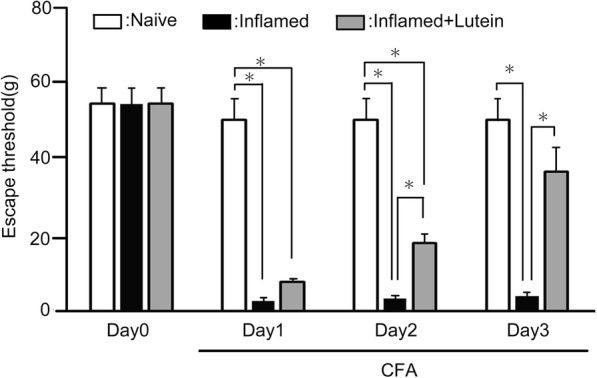
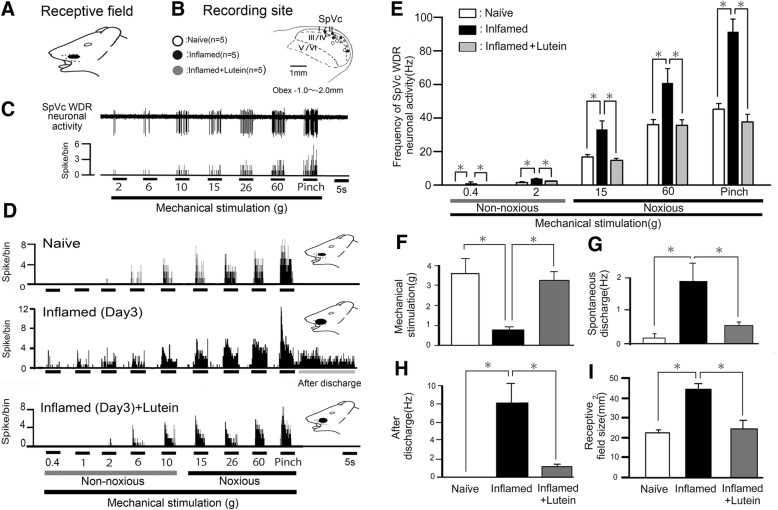
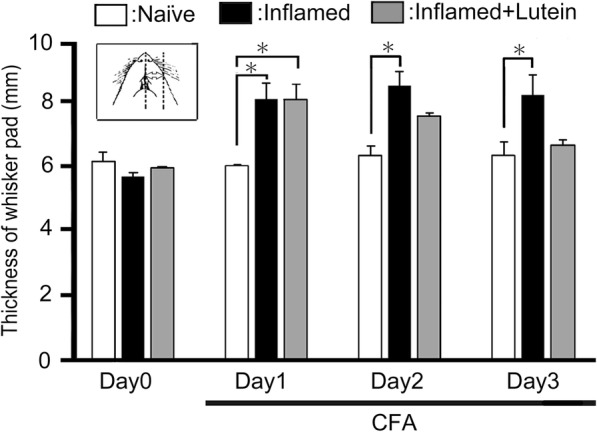
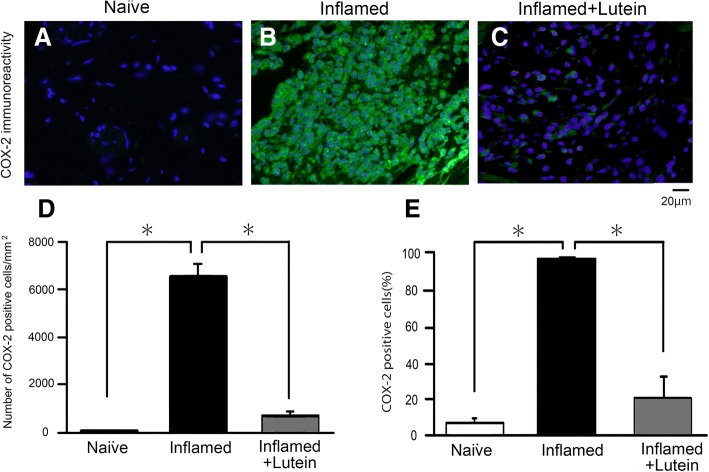
Complete Freund's adjuvant (CFA) was injected into the whisker pads of rats to induce inflammation, and then mechanical stimulation was applied to the orofacial area to assess the threshold of escape. The mechanical threshold was significantly lower in inflamed rats compared to uninjected naïve rats, and this lowered threshold was returned to control levels by 3 days after administration of lutein (10 mg/Kg, i.p.) Also the lutein administration, inflammation-induced thickness of edema was returned to control levels. The mean increased number of cyclooxygenase-2 (Cox-2)-immunoreactive cells in the whisker pads of inflamed rats was also returned to control levels by administration with lutein. The mean discharge frequency of SpVc wide-dynamic range (WDR) neurons to both nonnoxious and noxious mechanical stimuli in inflamed rats was significantly decreased after lutein administration. In addition, the increased mean spontaneous discharge of SpVc WDR in inflamed rats was significantly decreased after lutein administration. Similarly, lutein significantly diminished noxious pinch-evoked mean after discharge frequency and occurrence in inflamed rats. Finally, lutein restored the expanded mean size of the receptive field in inflamed rats to control levels.
These results together suggest that administration of lutein attenuates inflammatory hyperalgesia associated with hyperexcitability of nociceptive SpVc WDR neurons via inhibition of the peripheral Cox-2 signaling cascade. These findings support the proposed potential of lutein as a therapeutic agent in complementary alternative medicine strategies for preventing inflammatory mechanical hyperalgesia.
叶黄素是一种已知可抑制炎症的膳食成分;然而,其对伤害性神经元相关痛觉过敏的影响仍有待确定。因此,本研究在体内条件下探究了叶黄素的给药是否能减轻与机械性痛觉过敏相关的三叉神经脊束核尾侧亚核(SpVc)神经元的炎症诱导性兴奋性过高。
将完全弗氏佐剂(CFA)注射到大鼠的须垫中以诱导炎症,然后对口腔面部区域施加机械刺激以评估逃避阈值。与未注射的正常大鼠相比,炎症大鼠的机械阈值显著降低,而在给予叶黄素(10mg/Kg,腹腔注射)3天后,这种降低的阈值恢复到对照水平。同样,给予叶黄素后,炎症诱导的水肿厚度恢复到对照水平。给予叶黄素后,炎症大鼠须垫中环氧合酶-2(Cox-2)免疫反应性细胞的平均增加数量也恢复到对照水平。给予叶黄素后,炎症大鼠中SpVc广动力范围(WDR)神经元对无害和有害机械刺激的平均放电频率显著降低。此外,给予叶黄素后,炎症大鼠中SpVc WDR平均自发放电增加显著降低。同样,叶黄素显著降低了炎症大鼠中有害捏压诱发的平均后放电频率和发生率。最后,叶黄素将炎症大鼠中扩大的平均感受野大小恢复到对照水平。
这些结果共同表明,叶黄素的给药通过抑制外周Cox-2信号级联反应,减轻了与伤害性SpVc WDR神经元兴奋性过高相关的炎症性痛觉过敏。这些发现支持了叶黄素作为预防炎症性机械性痛觉过敏的补充替代医学策略中的治疗剂的潜在作用。