Department of Biology, University of Rome "Tor Vergata", 00133 Rome, Italy.
Laboratory of Cell Signaling, Istituto di Ricovero e Cura a Carattere Scientifico (IRCCS) Fondazione Santa Lucia, 00179 Rome, Italy.
Int J Mol Sci. 2018 Nov 29;19(12):3798. doi: 10.3390/ijms19123798.
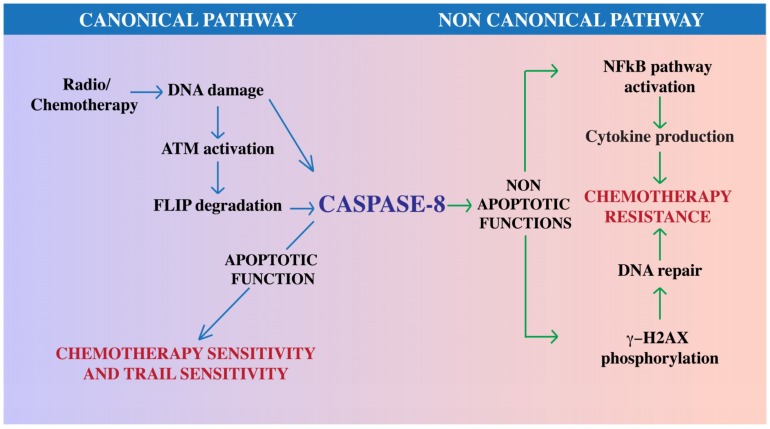
Caspase-8 was originally identified as a central player of programmed cell death triggered by death receptor stimulation. In that context, its activity is tightly regulated through several mechanisms, with the best established being the expression of FLICE-like inhibitory protein (FLIP) family proteins and the Src-dependent phosphorylation of Caspase-8 on Tyr380. Loss of apoptotic signaling is a hallmark of cancer and indeed Caspase-8 expression is often lost in tumors. This event may account not only for cancer progression but also for cancer resistance to radiotherapy and chemotherapy. Intriguingly, other tumors, such as glioblastoma, preferentially retain Caspase-8 expression, and high levels of Caspase-8 expression may correlate with a worse prognosis, suggesting that in this context this protease loses its apoptotic activity and gains additional functions. Using different cellular systems, it has been clearly shown that in cancer Caspase-8 can exhibit non-canonical functions, including promotion of cell adhesion, migration, and DNA repair. Intriguingly, in glioblastoma models, Caspase-8 can promote NF-κB-dependent expression of several cytokines, angiogenesis, and in vitro and in vivo tumorigenesis. Overall, these observations suggest that some cancer cells may hijack Caspase-8 function which in turn promote cancer progression and resistance to therapy. Here we aim to highlight the multiple functions of Caspase-8 and to discuss whether the molecular mechanisms that modulate the balance between those functions may be targeted to dismantle the aberrant activity of Caspase-8 and to restore its canonical apoptotic functionality.
Caspase-8 最初被鉴定为死亡受体刺激引发程序性细胞死亡的核心参与者。在这种情况下,其活性通过几种机制进行严格调节,其中最确定的机制是表达 FLICE 样抑制蛋白 (FLIP) 家族蛋白和Src 依赖性 Caspase-8 在 Tyr380 上的磷酸化。凋亡信号的丧失是癌症的标志,实际上 Caspase-8 的表达在肿瘤中经常丢失。这一事件不仅可能导致癌症进展,而且可能导致癌症对放疗和化疗的耐药性。有趣的是,其他肿瘤,如神经胶质瘤,优先保留 Caspase-8 的表达,并且高水平的 Caspase-8 表达可能与预后较差相关,表明在这种情况下,该蛋白酶失去其凋亡活性并获得额外的功能。使用不同的细胞系统,已经清楚地表明,在癌症中 Caspase-8 可以表现出非典型功能,包括促进细胞黏附、迁移和 DNA 修复。有趣的是,在神经胶质瘤模型中,Caspase-8 可以促进 NF-κB 依赖性表达几种细胞因子、血管生成以及体外和体内肿瘤发生。总的来说,这些观察结果表明,一些癌细胞可能劫持 Caspase-8 功能,进而促进癌症进展和对治疗的耐药性。在这里,我们旨在强调 Caspase-8 的多种功能,并讨论是否可以针对调节这些功能之间平衡的分子机制来破坏 Caspase-8 的异常活性并恢复其经典的凋亡功能。