• 文献检索
  • 文档翻译
  • 深度研究
  • 学术资讯
  • Suppr Zotero 插件Zotero 插件
  • 邀请有礼
  • 套餐&价格
  • 历史记录
应用&插件
Suppr Zotero 插件Zotero 插件浏览器插件Mac 客户端Windows 客户端微信小程序
定价
高级版会员购买积分包购买API积分包
服务
文献检索文档翻译深度研究API 文档MCP 服务
关于我们
关于 Suppr公司介绍联系我们用户协议隐私条款
关注我们

Suppr 超能文献

核心技术专利:CN118964589B侵权必究
粤ICP备2023148730 号-1Suppr @ 2026

文献检索

告别复杂PubMed语法,用中文像聊天一样搜索,搜遍4000万医学文献。AI智能推荐,让科研检索更轻松。

立即免费搜索

文件翻译

保留排版,准确专业,支持PDF/Word/PPT等文件格式,支持 12+语言互译。

免费翻译文档

深度研究

AI帮你快速写综述,25分钟生成高质量综述,智能提取关键信息,辅助科研写作。

立即免费体验

挖掘公开支付数据:2014 - 2016年行业向胸外科医生支付情况分析

Mining Open Payments Data: Analysis of Industry Payments to Thoracic Surgeons From 2014-2016.

作者信息

Na Xu, Guo Haihong, Zhang Yu, Shen Liu, Wu Sizhu, Li Jiao

机构信息

Institute of Medical Information / Medical Library, Chinese Academy of Medical Sciences & Peking Union Medical College, Beijing, China.

出版信息

J Med Internet Res. 2018 Nov 30;20(11):e11655. doi: 10.2196/11655.

DOI:10.2196/11655
PMID:30504119
原文链接:https://pmc.ncbi.nlm.nih.gov/articles/PMC6294877/
Abstract

BACKGROUND

The financial relationship between physicians and industries has become a hotly debated issue globally. The Physician Payments Sunshine Act of the US Affordable Care Act (2010) promoted transparency of the transactions between industries and physicians by making remuneration data publicly accessible in the Open Payments Program database. Meanwhile, according to the World Health Organization, the majority of all noncommunicable disease deaths were caused by cardiovascular disease.

OBJECTIVE

This study aimed to investigate the distribution of non-research and non-ownership payments made to thoracic surgeons, to explore the regularity of financial relationships between industries and thoracic surgeons.

METHODS

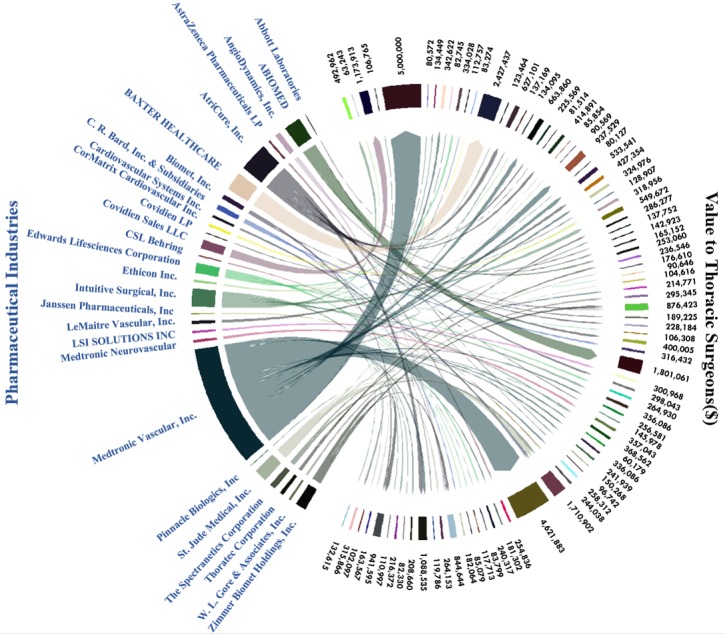
Annual statistical data were obtained from the Open Payments Program general payment dataset from 2014-2016. We characterized the distribution of annual payments with single payment transactions greater than US $10,000, quantified the major expense categories (eg, Compensation, Consulting Fees, Travel and Lodging), and identified the 30 highest-paying industries. Moreover, we drew out the financial relations between industries to thoracic surgeons using chord diagram visualization.

RESULTS

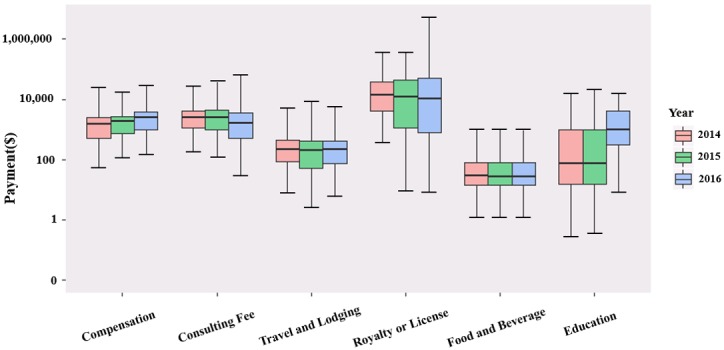
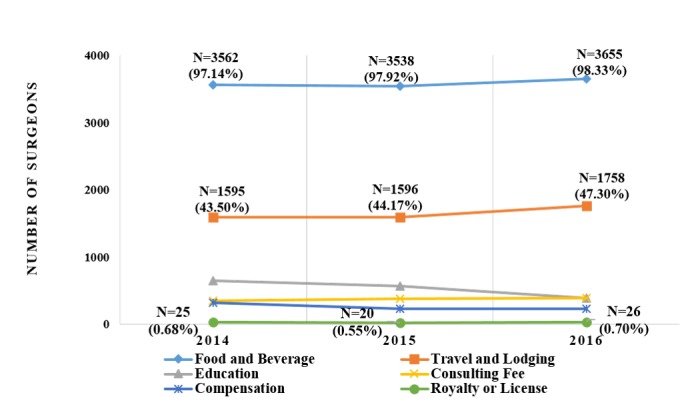
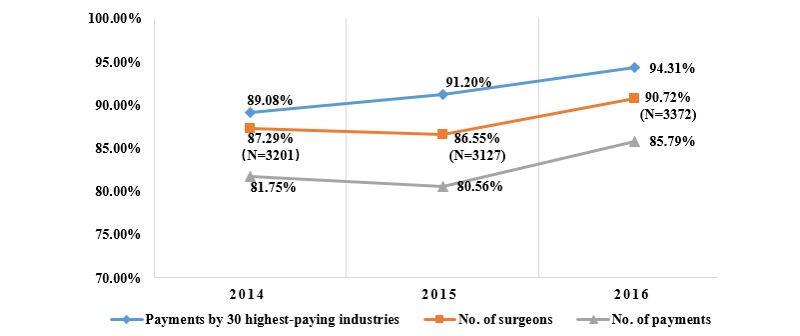
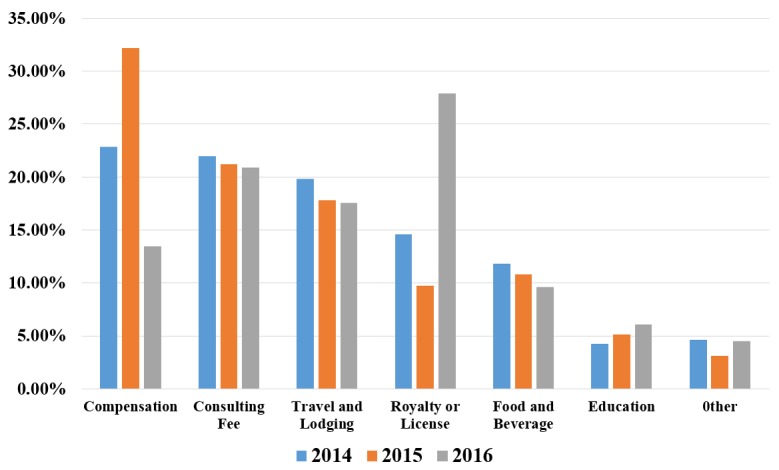
The three highest categories with single payments greater than US $10,000 were Royalty or License, Compensation, and Consulting Fees. Payments related to Royalty or License transferred from only 5.38% of industries to 0.75% of surgeons with the highest median (US $13,753, $11,992, and $10,614 respectively) in 3-year period. In contrast, payments related to Food and Beverage transferred from 93.50% of industries to 98.48% of surgeons with the lowest median (US $28, $27, and $27). The top 30 highest-paying industries made up approximately 90% of the total payments (US $21,036,972, $23,304,996, and $28,116,336). Furthermore, just under 9% of surgeons received approximately 80% of the total payments in each of the 3 years. Specifically, the 100 highest cumulative payments, accounting for 52.69% of the total, transferred from 27 (6.05%) pharmaceutical industries to 86 (1.89%) thoracic surgeons from 2014-2016; 7 surgeons received payments greater than US $1,000,000; 12 surgeons received payments greater than US $400,000. The majority (90%) of these surgeons received tremendous value from only one industry.

CONCLUSIONS

There exists a great discrepancy in the distribution of payments by categories. Royalty or License Fees, Compensation, and Consulting Fees are the primary transferring channels of single large payments. The massive transfer from industries to surgeons has a strong "apical dominance" and excludability. Further research should focus on discovering the fundamental driving factors for the strong concentration of certain medical devices and how these payments will affect the industry itself.
https://cdn.ncbi.nlm.nih.gov/pmc/blobs/fbb6/6294877/9bed3c9d8920/jmir_v20i11e11655_fig5.jpg
https://cdn.ncbi.nlm.nih.gov/pmc/blobs/fbb6/6294877/34f8ff02f47d/jmir_v20i11e11655_fig1.jpg
https://cdn.ncbi.nlm.nih.gov/pmc/blobs/fbb6/6294877/9d0b97f4c98f/jmir_v20i11e11655_fig2.jpg
https://cdn.ncbi.nlm.nih.gov/pmc/blobs/fbb6/6294877/441a1f133199/jmir_v20i11e11655_fig3.jpg
https://cdn.ncbi.nlm.nih.gov/pmc/blobs/fbb6/6294877/a512f5339386/jmir_v20i11e11655_fig4.jpg
https://cdn.ncbi.nlm.nih.gov/pmc/blobs/fbb6/6294877/9bed3c9d8920/jmir_v20i11e11655_fig5.jpg
https://cdn.ncbi.nlm.nih.gov/pmc/blobs/fbb6/6294877/34f8ff02f47d/jmir_v20i11e11655_fig1.jpg
https://cdn.ncbi.nlm.nih.gov/pmc/blobs/fbb6/6294877/9d0b97f4c98f/jmir_v20i11e11655_fig2.jpg
https://cdn.ncbi.nlm.nih.gov/pmc/blobs/fbb6/6294877/441a1f133199/jmir_v20i11e11655_fig3.jpg
https://cdn.ncbi.nlm.nih.gov/pmc/blobs/fbb6/6294877/a512f5339386/jmir_v20i11e11655_fig4.jpg
https://cdn.ncbi.nlm.nih.gov/pmc/blobs/fbb6/6294877/9bed3c9d8920/jmir_v20i11e11655_fig5.jpg
摘要

背景

医生与行业之间的财务关系已成为全球热议的话题。美国《平价医疗法案》(2010年)中的《医生薪酬阳光法案》通过使薪酬数据在“公开支付计划”数据库中公开可查,促进了行业与医生之间交易的透明度。与此同时,据世界卫生组织称,所有非传染性疾病死亡的大多数是由心血管疾病导致的。

目的

本研究旨在调查支付给胸外科医生的非研究和非所有权款项的分布情况,探索行业与胸外科医生之间财务关系的规律。

方法

从“公开支付计划”一般支付数据集获取2014 - 2016年的年度统计数据。我们对单笔支付超过10,000美元的年度支付分布进行了特征描述,量化了主要费用类别(如薪酬、咨询费、差旅费和住宿费),并确定了支付最高的30个行业。此外,我们使用弦图可视化展示了行业与胸外科医生之间的财务关系。

结果

单笔支付超过10,000美元的三大最高类别是特许权使用费或许可费、薪酬和咨询费。与特许权使用费或许可费相关的支付在3年期间仅从5.38%的行业转移到0.75%的外科医生,中位数最高(分别为13,753美元、11,992美元和10,614美元)。相比之下,与食品和饮料相关的支付从93.50%的行业转移到98.48%的外科医生,中位数最低(分别为28美元、27美元和27美元)。支付最高的前30个行业约占总支付的90%(分别为21,036,972美元、23,304,996美元和28,116,336美元)。此外,在这3年中的每一年,不到9%的外科医生获得了约80%的总支付。具体而言,从各行业累计支付最高的100笔款项,占总数的52.69%,在2014 - 2016年期间从27个(6.05%)制药行业转移到86个(1.89%)胸外科医生;7名外科医生获得的支付超过1,000,000美元;12名外科医生获得的支付超过400,000美元。这些外科医生中的大多数(90%)仅从一个行业获得了巨额款项。

结论

各类别支付分布存在巨大差异。特许权使用费或许可费、薪酬和咨询费是单笔大额支付的主要转移渠道。从行业到外科医生的大量转移具有强烈的“顶端优势”和排他性。进一步的研究应侧重于发现某些医疗设备高度集中的根本驱动因素以及这些支付将如何影响行业本身。

相似文献

1
Mining Open Payments Data: Analysis of Industry Payments to Thoracic Surgeons From 2014-2016.挖掘公开支付数据:2014 - 2016年行业向胸外科医生支付情况分析
J Med Internet Res. 2018 Nov 30;20(11):e11655. doi: 10.2196/11655.
2
A New Culture of Transparency: Industry Payments to Orthopedic Surgeons.一种新的透明文化:行业向骨科医生的付款
Orthopedics. 2016 Nov 1;39(6):e1058-e1062. doi: 10.3928/01477447-20160719-04. Epub 2016 Jul 27.
3
Industry Payments to Pediatric Orthopaedic Surgeons Reported by the Open Payments Database: 2014 to 2017.公开支付数据库报告的行业向小儿骨科外科医生的付款情况:2014年至2017年
J Pediatr Orthop. 2019 Nov/Dec;39(10):534-540. doi: 10.1097/BPO.0000000000001375.
4
Relationship between industry royalty and licensing payments and patent authorship among orthopedic spine surgeons.骨科脊柱外科医生的行业特许权使用费和许可费与专利所有权之间的关系。
Spine J. 2021 Apr;21(4):541-547. doi: 10.1016/j.spinee.2020.12.003. Epub 2020 Dec 24.
5
Nationwide patterns in industry payments to academic vascular surgeons.全国范围内向血管外科医师支付的行业报酬模式。
J Vasc Surg. 2021 Feb;73(2):675-681. doi: 10.1016/j.jvs.2020.04.527. Epub 2020 Jun 11.
6
Prevalence and extent of industry support for program directors of surgical fellowships in the United States.美国外科住院医师培训项目主任的行业支持的流行程度和范围。
Surgery. 2020 Dec;168(6):1101-1105. doi: 10.1016/j.surg.2020.07.035. Epub 2020 Sep 14.
7
Industry Compensation to Physician Vascular Specialist Authors of Highly-referenced Aortic Aneurysm Studies.行业对高度引用的主动脉瘤研究的血管外科医生作者的报酬。
Ann Vasc Surg. 2021 Jul;74:410-418. doi: 10.1016/j.avsg.2021.01.103. Epub 2021 Apr 2.
8
Analysis of Open Payments Receipts Among Surgical Faculty at a Large Academic Institution.大型学术机构外科教员的公开支付收据分析。
J Surg Res. 2019 Dec;244:599-603. doi: 10.1016/j.jss.2019.08.012. Epub 2019 Sep 16.
9
Industry payments to spine surgeons from 2014 to 2019: trends and comparison of payments to spine surgeons versus all physicians.2014 年至 2019 年脊柱外科医生的行业支付情况:脊柱外科医生与所有医生支付情况的趋势和比较。
Spine J. 2022 Jun;22(6):910-920. doi: 10.1016/j.spinee.2022.01.008. Epub 2022 Jan 15.
10
Types and Distribution of Payments From Industry to Physicians in 2015.2015年行业向医生支付款项的类型及分布情况。
JAMA. 2017 May 2;317(17):1774-1784. doi: 10.1001/jama.2017.3091.

引用本文的文献

1
Assessment of the digestive system malignancy information in Wikipedia and Baidu Encyclopedia: a longitudinal study.维基百科和百度百科中消化系统恶性肿瘤信息的评估:一项纵向研究。
Ann Transl Med. 2022 Oct;10(20):1112. doi: 10.21037/atm-22-4435.
2
A Ray of Sunshine: Transparency in Physician-Industry Relationships Is Not Enough.一缕阳光:医生-行业关系的透明度还不够。
J Gen Intern Med. 2021 Oct;36(10):3194-3198. doi: 10.1007/s11606-021-06657-0. Epub 2021 Mar 10.
3
Evaluation of the Liver Disease Information in Baidu Encyclopedia and Wikipedia: Longitudinal Study.

本文引用的文献

1
Hidden conflicts?隐藏的冲突?
Science. 2018 Jul 6;361(6397):16-20. doi: 10.1126/science.361.6397.16.
2
Physicians, Industry Payments for Food and Beverages, and Drug Prescribing.医生、食品和饮料的行业支付与药物处方
JAMA. 2017 May 2;317(17):1753-1754. doi: 10.1001/jama.2017.2477.
3
Comparing industry compensation of cardiothoracic surgeons and interventional cardiologists.比较心胸外科医生和介入心脏病专家的行业薪酬。
百度百科和维基百科中的肝病信息评估:纵向研究。
J Med Internet Res. 2021 Jan 18;23(1):e17680. doi: 10.2196/17680.
J Surg Res. 2017 Feb;208:51-59. doi: 10.1016/j.jss.2016.09.022. Epub 2016 Sep 17.
4
Urology Payments from Industry in the Sunshine Act.《阳光法案》中来自行业的泌尿外科支付款项。
Urol Pract. 2016 Sep;3(5):332-337. doi: 10.1016/j.urpr.2015.12.002.
5
Exploring the Industry-Dermatologist Financial Relationship: Insight From the Open Payment Data.探索行业-皮肤科医生的财务关系:来自公开支付数据的洞察。
JAMA Dermatol. 2016 Dec 1;152(12):1307-1313. doi: 10.1001/jamadermatol.2016.3037.
6
Payments to Pediatricians in the Sunshine Act.《阳光法案》中向儿科医生的付款情况。
Clin Pediatr (Phila). 2017 Jul;56(8):723-728. doi: 10.1177/0009922816670981. Epub 2016 Sep 23.
7
A New Culture of Transparency: Industry Payments to Orthopedic Surgeons.一种新的透明文化:行业向骨科医生的付款
Orthopedics. 2016 Nov 1;39(6):e1058-e1062. doi: 10.3928/01477447-20160719-04. Epub 2016 Jul 27.
8
The U.S. Army Person-Event Data Environment: A Military-Civilian Big Data Enterprise.美军人员-事件数据环境:军民大数据企业。
Big Data. 2015 Jun;3(2):67-79. doi: 10.1089/big.2014.0055. Epub 2015 May 14.
9
Improving the Efficiency and Ease of Healthcare Analysis Through Use of Data Visualization Dashboards.通过使用数据可视化仪表板提高医疗保健分析的效率和易用性。
Big Data. 2016 Jun;4(2):129-35. doi: 10.1089/big.2015.0059.
10
Pharmaceutical Industry-Sponsored Meals and Physician Prescribing Patterns for Medicare Beneficiaries.制药业赞助的餐饮与医疗保险受益人的医师处方模式
JAMA Intern Med. 2016 Aug 1;176(8):1114-1122. doi: 10.1001/jamainternmed.2016.2765.