International Vaccine Institute, SNU Research Park, 1 Gwanak-ro, 1 Gwanak-gu, Seoul, 08826, Republic of Korea.
The Hospital for Tropical Diseases, Wellcome Trust Major Overseas Programme, Oxford University Clinical Research Unit, 764 Vo Van Kiet, Quant 5, Ho Chi Minh City, Vietnam.
Nat Commun. 2018 Nov 30;9(1):5094. doi: 10.1038/s41467-018-07370-z.
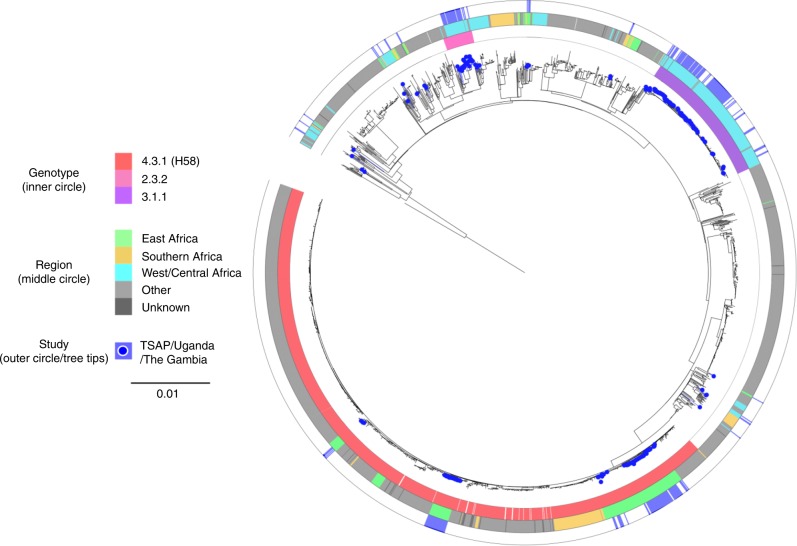
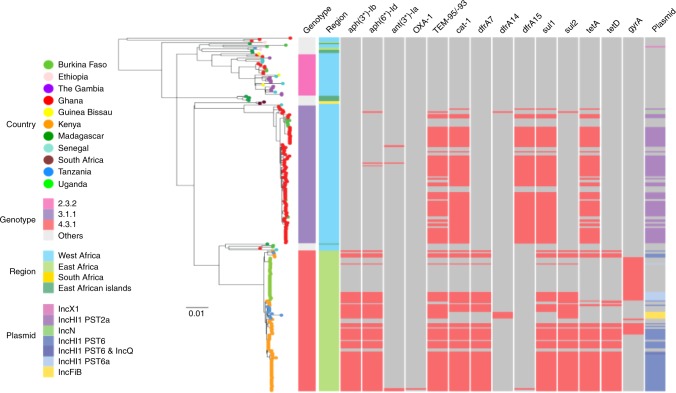
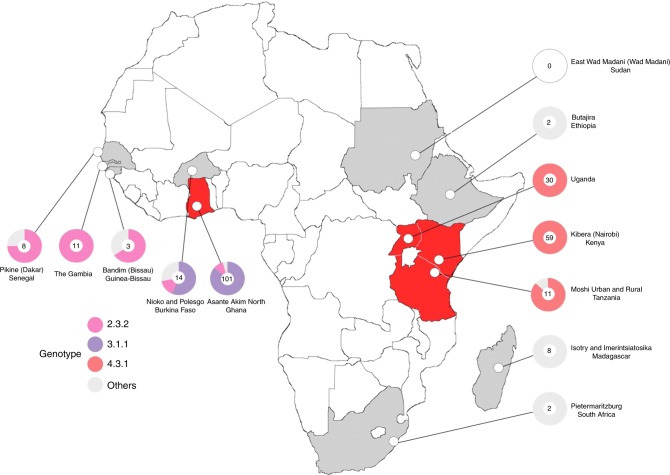
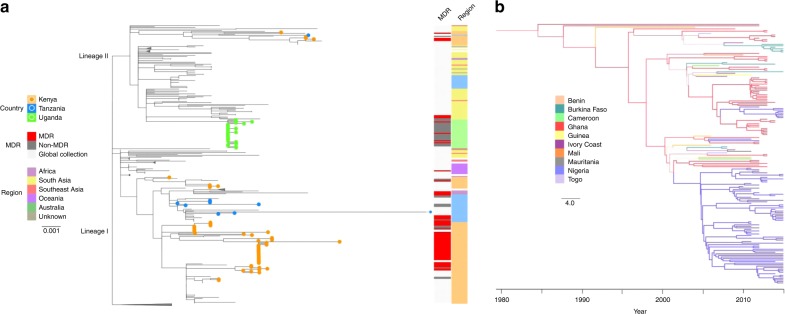
There is paucity of data regarding the geographical distribution, incidence, and phylogenetics of multi-drug resistant (MDR) Salmonella Typhi in sub-Saharan Africa. Here we present a phylogenetic reconstruction of whole genome sequenced 249 contemporaneous S. Typhi isolated between 2008-2015 in 11 sub-Saharan African countries, in context of the 2,057 global S. Typhi genomic framework. Despite the broad genetic diversity, the majority of organisms (225/249; 90%) belong to only three genotypes, 4.3.1 (H58) (99/249; 40%), 3.1.1 (97/249; 39%), and 2.3.2 (29/249; 12%). Genotypes 4.3.1 and 3.1.1 are confined within East and West Africa, respectively. MDR phenotype is found in over 50% of organisms restricted within these dominant genotypes. High incidences of MDR S. Typhi are calculated in locations with a high burden of typhoid, specifically in children aged <15 years. Antimicrobial stewardship, MDR surveillance, and the introduction of typhoid conjugate vaccines will be critical for the control of MDR typhoid in Africa.
关于撒哈拉以南非洲地区耐多药(MDR)伤寒沙门氏菌的地理分布、发病率和系统发生情况的数据很少。在这里,我们在全球 2057 个伤寒沙门氏菌基因组框架的背景下,对 2008 年至 2015 年间在 11 个撒哈拉以南非洲国家同时分离的 249 株全基因组测序的伤寒沙门氏菌进行了系统发育重建。尽管存在广泛的遗传多样性,但大多数生物体(225/249;90%)仅属于三种基因型,4.3.1(H58)(99/249;40%)、3.1.1(97/249;39%)和 2.3.2(29/249;12%)。基因型 4.3.1 和 3.1.1 分别局限于东非和西非。在这些主要基因型中,发现超过 50%的生物体具有 MDR 表型。在伤寒负担较高的地区,特别是在<15 岁的儿童中,发现了高比例的 MDR 伤寒沙门氏菌。抗菌药物管理、MDR 监测以及引入伤寒结合疫苗对于控制非洲的 MDR 伤寒将至关重要。