Moon Soo Young, Lim Ji-Hyun, Kim Eun-Hee, Nam Youngwon, Yu Kyung-Sang, Hong Kyung Taek, Choi Jung Yoon, Hong Che Ry, Kim Hyery, Kang Hyoung Jin, Shin Hee Young, Lee Kyunghoon, Song Junghan, Lee Soo-Youn, Song Sang Hoon
Department of Laboratory Medicine, Seoul National University College of Medicine.
Institute of Biomedical Research, Seoul National University College of Medicine.
Ther Drug Monit. 2019 Feb;41(1):75-85. doi: 10.1097/FTD.0000000000000575.
Concentrations of 6-thioguanine (6TG) nucleotides and 6-methylmercaptopurine (6MMP) nucleotides in RBCs were measured using liquid chromatography-tandem mass spectrometry (LC-MS/MS). This assay was validated for clinical use and was applied to blood samples from patients taking mercaptopurine (6MP).
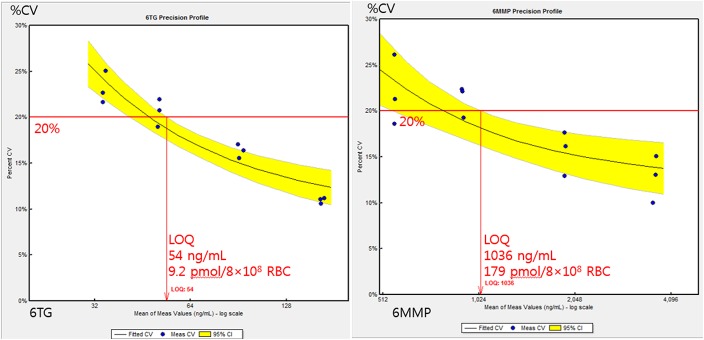
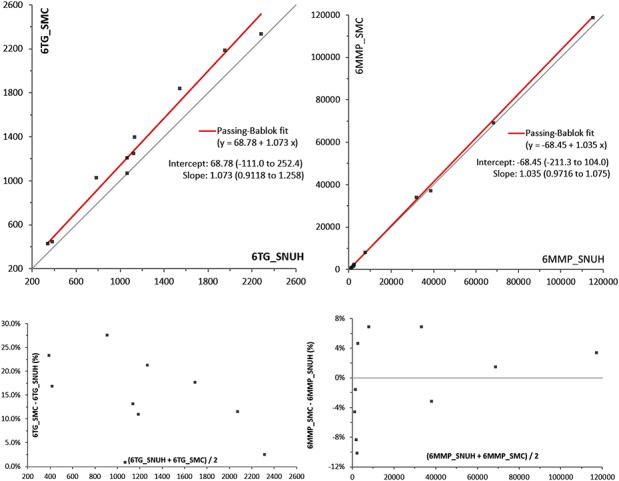
RBCs were hemolyzed and deproteinized using perchloric acid, followed by heating for the hydrolysis of nucleotides, and the resultant base was measured using LC-MS/MS. Precision, recovery, linearity, matrix effect, and limit of quantification was validated for clinical application. Our results were compared with another institution's established LC-MS/MS assay. We measured the concentrations of 6TG and 6MMP in RBCs of pediatric patients with acute lymphoblastic leukemia (ALL), and the clinical impact of those metabolites was investigated.
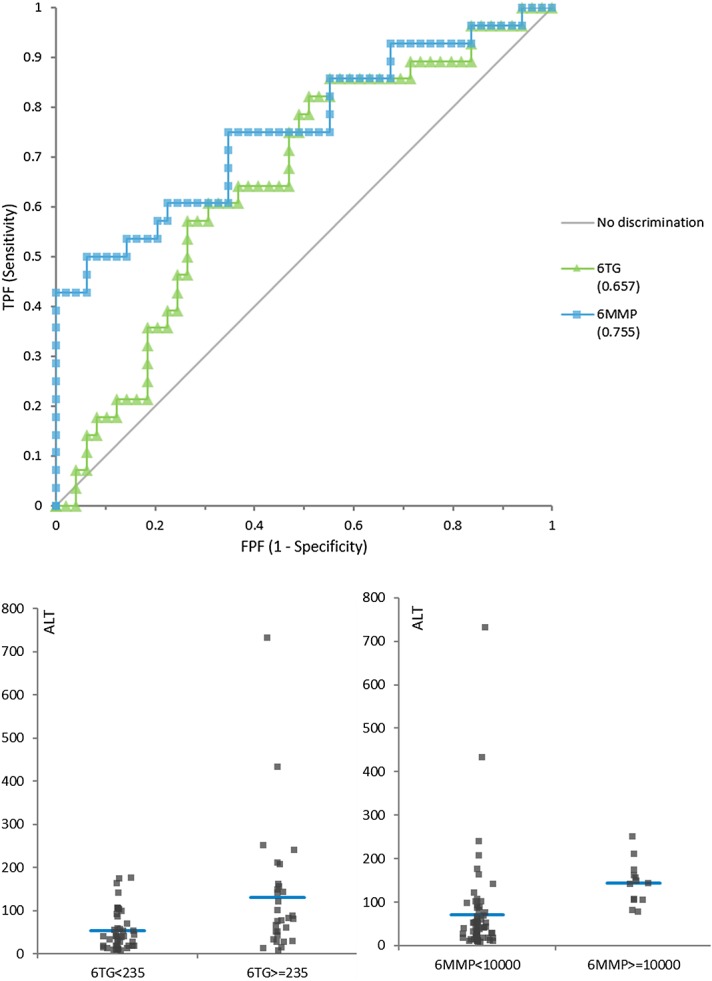
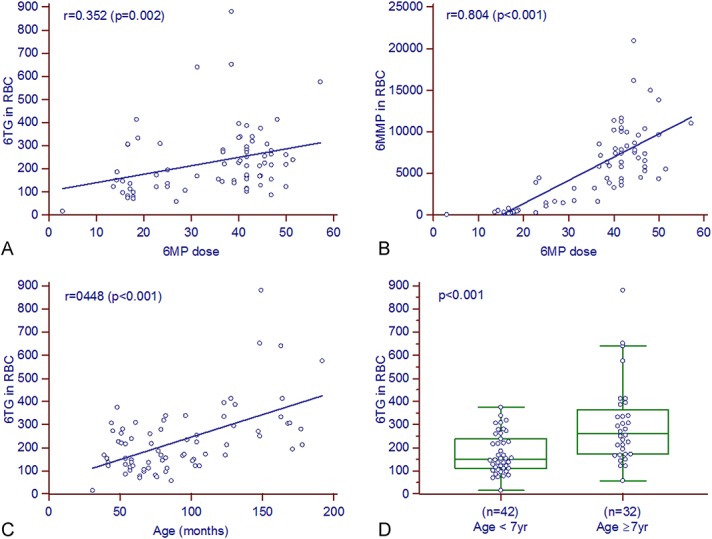
The imprecision coefficient of variations of 6TG and 6MMP were 5.7%-8.1%, and the bias was within 5%. Lower limits of quantification were set at 54 ng/mL for 6TG and 1036 ng/mL for 6MMP. Correlation coefficients for 6TG and 6MMP were 0.997 and 1.0 in a comparison study. For clinical proof-of-concept, 74 blood samples were collected from 37 pediatric ALL patients receiving maintenance therapy. Concentration of 6TG ranged from 16.1 to 880 pmol/8 × 10 RBCs and that of 6MMP from 55 to 20,937 pmol/8 × 10 RBCs. The 6MP metabolites were not correlated with WBC or absolute neutrophil count. On the other hand, the higher 6MMP level was associated with elevated alanine aminotransferase and aspartate aminotransferase.
In this study, an assay for the quantification of 6TG and 6MMP in RBCs was established and applied to pediatric ALL patients. Interindividual variability in 6MP metabolite concentrations was considerable and associated with elevation of liver enzymes, which may be useful in the clinical monitoring of 6MP maintenance therapy in pediatric ALL patients.
采用液相色谱-串联质谱法(LC-MS/MS)测定红细胞中6-硫鸟嘌呤(6TG)核苷酸和6-甲基巯基嘌呤(6MMP)核苷酸的浓度。该检测方法已通过临床验证,并应用于服用巯嘌呤(6MP)患者的血样检测。
用高氯酸对红细胞进行溶血和脱蛋白处理,然后加热使核苷酸水解,水解后的碱基用LC-MS/MS测定。对临床应用的精密度、回收率、线性、基质效应和定量限进行了验证。将我们的结果与另一机构已建立的LC-MS/MS检测方法进行比较。我们测定了急性淋巴细胞白血病(ALL)患儿红细胞中6TG和6MMP的浓度,并研究了这些代谢物的临床影响。
6TG和6MMP的不精密度变异系数为5.7%-8.1%,偏差在5%以内。6TG的定量下限设定为54 ng/mL,6MMP的定量下限设定为1036 ng/mL。在一项比较研究中,6TG和6MMP的相关系数分别为0.997和1.0。为了进行临床概念验证,从37例接受维持治疗的小儿ALL患者中采集了74份血样。6TG的浓度范围为16.1至880 pmol/8×10⁶红细胞,6MMP 的浓度范围为55至20937 pmol/8×10⁶红细胞。6MP代谢物与白细胞或绝对中性粒细胞计数无关。另一方面,较高的6MMP水平与丙氨酸转氨酶和天冬氨酸转氨酶升高有关。
在本研究中,建立了一种测定红细胞中6TG和6MMP的检测方法,并应用于小儿ALL患者。6MP代谢物浓度的个体间差异相当大,且与肝酶升高有关这可能有助于小儿ALL患者6MP维持治疗的临床监测。