Fudan University Shanghai Cancer Center and Institutes of Biomedical Sciences, and Key Laboratory of Medical Epigenetics and Metabolism, Fudan University, Shanghai, China.
Fudan University Shanghai Cancer Center, Fudan University, Shanghai, China.
J Mol Cell Biol. 2019 Apr 1;11(4):293-305. doi: 10.1093/jmcb/mjy072.
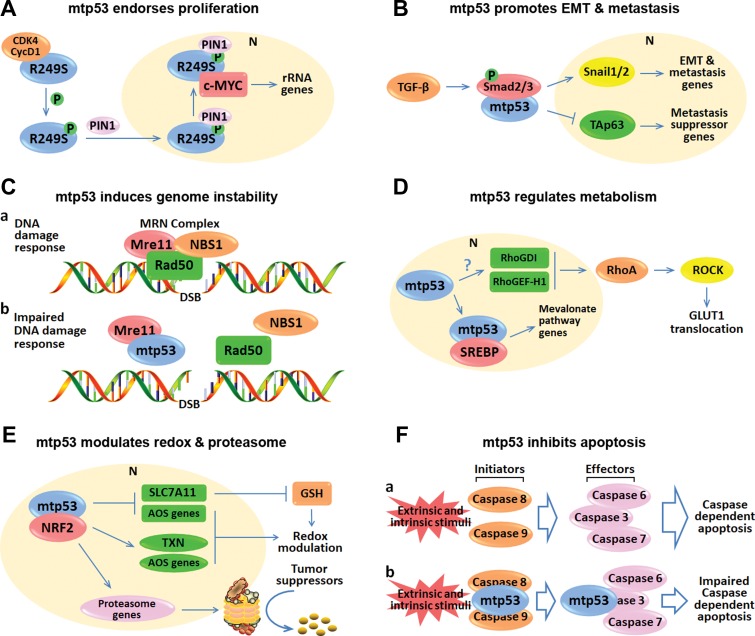
Since wild-type p53 is central for maintaining genomic stability and preventing oncogenesis, its coding gene TP53 is highly mutated in ~50% of human cancers, and its activity is almost abrogated in the rest of cancers. Approximately 80% of p53 mutations are single point mutations with several hotspot mutations. Besides loss of function and dominant-negative effect on the wild-type p53 activity, the hotspot p53 mutants also acquire new oncogenic functions, so-called 'gain-of-functions' (GOF). Because the GOF of mutant p53 is highly associated with late-stage malignance and drug resistance, these p53 mutants have become hot targets for developing novel cancer therapies. In this essay, we review some recent progresses in better understanding of the role of mutant p53 GOF in chemoresistance and the underlying mechanisms, and discuss the pros and cons of targeting mutant p53 for the development of anti-cancer therapies.
由于野生型 p53 对于维持基因组稳定性和预防肿瘤发生至关重要,其编码基因 TP53 在约 50%的人类癌症中发生高度突变,而其余癌症中的 p53 活性几乎被完全阻断。p53 的突变约有 80%为单点突变,存在几个热点突变。除了对野生型 p53 活性产生功能丧失和显性负效应外,热点 p53 突变体还获得新的致癌功能,即所谓的“获得性功能”(GOF)。由于突变型 p53 的 GOF 与晚期恶性肿瘤和耐药性高度相关,这些 p53 突变体已成为开发新型癌症治疗方法的热门靶点。在本文中,我们回顾了一些最近在更好地理解突变型 p53 GOF 在化疗耐药性中的作用及其潜在机制方面的进展,并讨论了针对突变型 p53 开发抗癌疗法的优缺点。