Ohe Yuichiro, Imamura Fumio, Nogami Naoyuki, Okamoto Isamu, Kurata Takayasu, Kato Terufumi, Sugawara Shunichi, Ramalingam Suresh S, Uchida Hirohiko, Hodge Rachel, Vowler Sarah L, Walding Andrew, Nakagawa Kazuhiko
Department of Thoracic Oncology, National Cancer Center Hospital, Chuo-ku, Tokyo, Japan.
Department of Thoracic Oncology, Osaka International Cancer Institute, Chuo-ku, Osaka, Japan.
Jpn J Clin Oncol. 2019 Jan 1;49(1):29-36. doi: 10.1093/jjco/hyy179.
The FLAURA study was a multicenter, double-blind, Phase 3 study in which patients with previously untreated epidermal growth factor receptor mutation-positive advanced non-small-cell lung carcinoma were randomized 1:1 to oral osimertinib 80 mg once daily or standard-of-care (gefitinib 250 mg or erlotinib 150 mg, once daily) to compare safety and efficacy. In the overall FLAURA study, significantly better progression-free survival was shown with osimertinib versus standard-of-care.
Selected endpoints, including progression-free survival (primary endpoint), overall survival, objective response rate, duration of response and safety were evaluated for the Japanese subset of the FLAURA study.
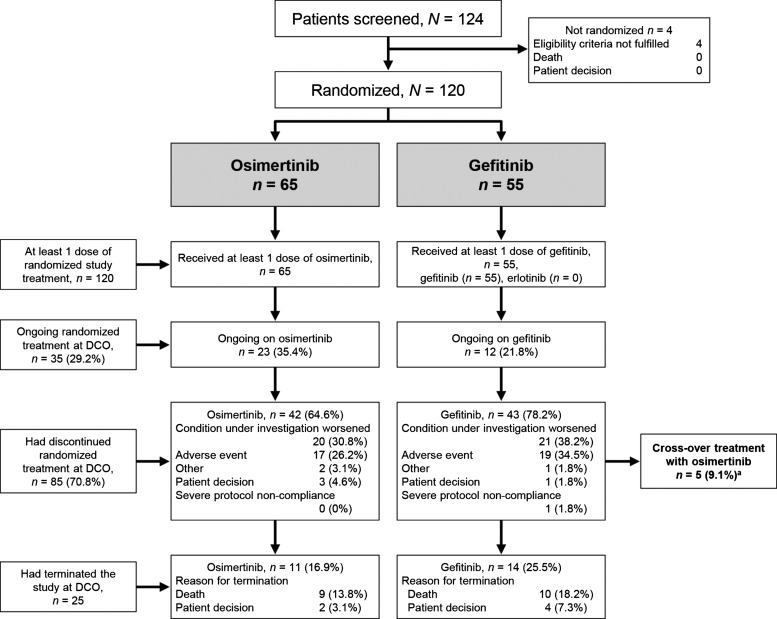
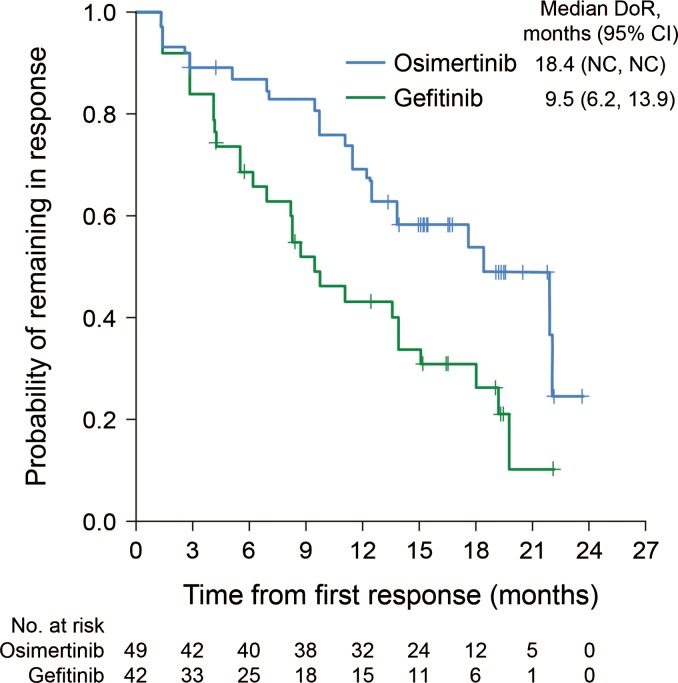
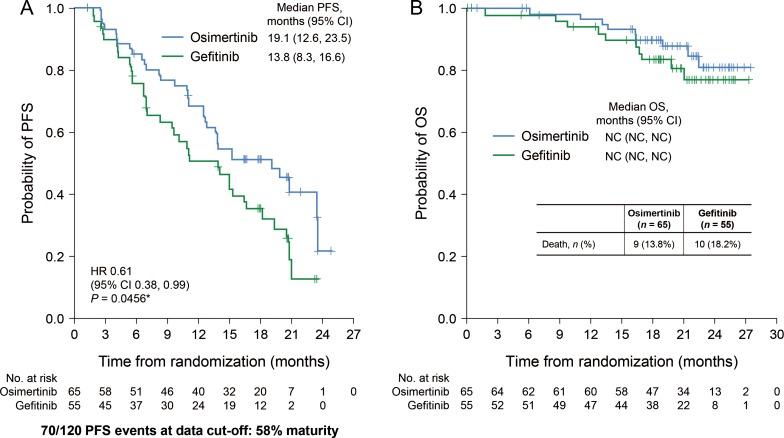
In Japan, 120 eligible Japanese patients were randomized to osimertinib (65 patients) or gefitinib (55 patients) treatment from December 2014 to June 2017. Median progression-free survival was 19.1 (95% confidence interval, 12.6, 23.5) and 13.8 (95% confidence interval, 8.3, 16.6) months with osimertinib and gefitinib, respectively (hazard ratio, 0.61; 95% confidence interval, 0.38, 0.99). Median overall survival was not reached in either treatment arm (data were immature). In the osimertinib and gefitinib arms, objective response rate was 75.4% (49/65) and 76.4% (42/55), and median duration of response from onset was 18.4 (95% confidence interval, not calculated) and 9.5 (95% confidence interval, 6.2, 13.9) months, respectively. The incidence of adverse events was similar in the two groups. The frequency of Grade ≥3 interstitial lung disease and pneumonitis in the two groups were the same (one patient).
As the first-line therapy, osimertinib showed significantly improved efficacy versus gefitinib in the Japanese population of the FLAURA study. No new safety concerns were raised.
NCT02296125 (ClinicalTrials.gov).
FLAURA研究是一项多中心、双盲、3期研究,将既往未接受治疗的表皮生长因子受体突变阳性的晚期非小细胞肺癌患者按1:1随机分组,分别接受每日一次口服80 mg奥希替尼或标准治疗(吉非替尼250 mg或厄洛替尼150 mg,每日一次),以比较安全性和疗效。在整个FLAURA研究中,与标准治疗相比,奥希替尼显示出显著更好的无进展生存期。
对FLAURA研究的日本亚组评估了选定的终点,包括无进展生存期(主要终点)、总生存期、客观缓解率、缓解持续时间和安全性。
在日本,从2014年12月至2017年6月,120例符合条件的日本患者被随机分配接受奥希替尼(65例患者)或吉非替尼(55例患者)治疗。奥希替尼组和吉非替尼组的中位无进展生存期分别为19.1(95%置信区间,12.6,23.5)个月和13.8(95%置信区间,8.3,16.6)个月(风险比,0.61;95%置信区间,0.38,0.99)。两个治疗组的中位总生存期均未达到(数据不成熟)。在奥希替尼组和吉非替尼组中,客观缓解率分别为75.4%(49/65)和76.4%(42/55),从发病开始的中位缓解持续时间分别为18.4(95%置信区间,未计算)和9.5(95%置信区间,6.2,13.9)个月。两组不良事件的发生率相似。两组中≥3级间质性肺病和肺炎的发生率相同(各1例患者)。
在FLAURA研究的日本人群中,作为一线治疗,奥希替尼与吉非替尼相比显示出显著提高的疗效。未提出新的安全性问题。
NCT02296125(ClinicalTrials.gov)。