Park Jin-Sun, Seo Kyoung-Woo, Choi Byoung-Joo, Choi So-Yeon, Yoon Myeong-Ho, Hwang Gyo-Seung, Tahk Seung-Jea, Shin Joon-Han
Department of Cardiology, Ajou University School of Medicine, Suwon, Korea.
Medicine (Baltimore). 2018 Nov;97(48):e13471. doi: 10.1097/MD.0000000000013471.
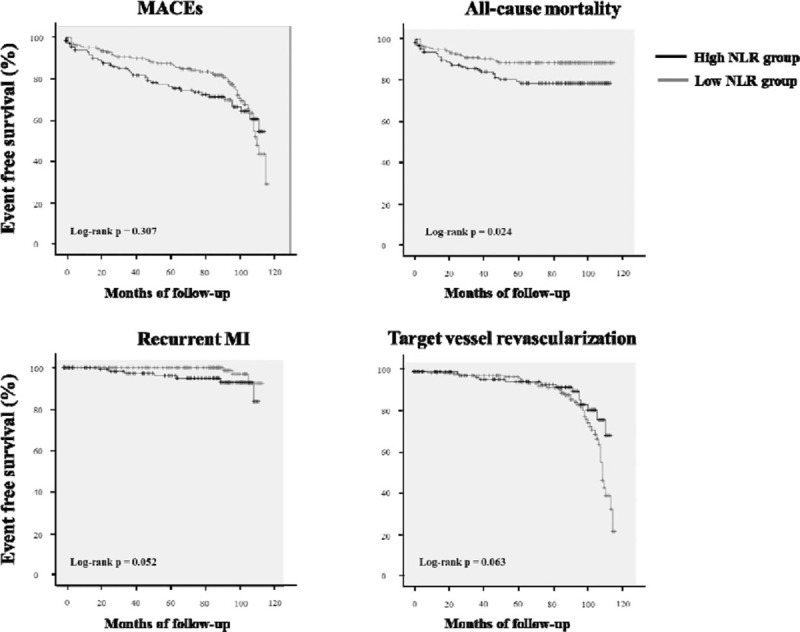
The ratio between the absolute number of neutrophils and the number of lymphocytes (NLR) has recently emerged as a potential new biomarker predicting worse clinical conditions ranging from infectious disease to cardiovascular disease. Prognostic significance of NLR in patients with ST-elevation myocardial infarction (STEMI) is not established. This study aimed to investigate prognostic impact of NLR in patients with STEMI.We analyzed the data and clinical outcomes of 30-day survivors with STEMI who received successful coronary intervention from 2006 to 2010. NLR was computed from the absolute values of neutrophils and lymphocytes from the complete blood count at admission. Occurrence of major adverse cardiovascular events (MACEs; death, recurrent MI, target vessel revascularization (TVR)) at 5 years was evaluated.We enrolled 326 patients and mean follow-up duration was 68 ± 36 months. The mean NLR was 4.7 ± 5.2. Among all patients, all-cause mortality occurred in 46 patients (14%). Initial NLR was higher in patients who experienced all-cause mortality (6.39 ± 8.9 vs 4.2 ± 3.1, P = .004). In a multivariate regression model, the higher NLR was independently associated with increased risk for all-cause mortality (Hazard ratio, 1.085; 95% confidence interval, 1.002-1.174, P = .044).Increased NLR was associated increased rate of all-cause mortality in 30-day survivors after index STEMI, who received successful coronary intervention.
中性粒细胞绝对数与淋巴细胞数之比(NLR)最近已成为一种潜在的新生物标志物,可预测从传染病到心血管疾病等一系列更差的临床状况。NLR在ST段抬高型心肌梗死(STEMI)患者中的预后意义尚未确立。本研究旨在探讨NLR对STEMI患者的预后影响。我们分析了2006年至2010年接受成功冠状动脉介入治疗的STEMI 30天幸存者的数据和临床结局。NLR由入院时全血细胞计数中的中性粒细胞和淋巴细胞绝对值计算得出。评估了5年时主要不良心血管事件(MACE;死亡、复发性心肌梗死、靶血管血运重建(TVR))的发生情况。我们纳入了326例患者,平均随访时间为68±36个月。平均NLR为4.7±5.2。在所有患者中,46例(14%)发生了全因死亡。发生全因死亡的患者初始NLR较高(6.39±8.9 vs 4.2±3.1,P = .004)。在多变量回归模型中,较高的NLR与全因死亡风险增加独立相关(风险比,1.085;95%置信区间,1.002 - 1.174,P = .044)。NLR升高与首次STEMI后接受成功冠状动脉介入治疗的30天幸存者全因死亡率增加相关。