Eldessouki Ihab, Gaber Ola, Namad Tariq, Wang Jiang, Morris John C, Abdel Karim Nagla
Department of Hematology-Oncology, Vontz Center for Molecular Studies, University of Cincinnati, 3125 Eden Ave, Cincinnati, OH 45267, USA.
Department of Pathology, University of Cincinnati, Laboratory Medicine Building, Suite 110, 234 Goodman Street, Cincinnati, OH 45219-0533, USA.
J Oncol. 2018 Nov 1;2018:9761826. doi: 10.1155/2018/9761826. eCollection 2018.
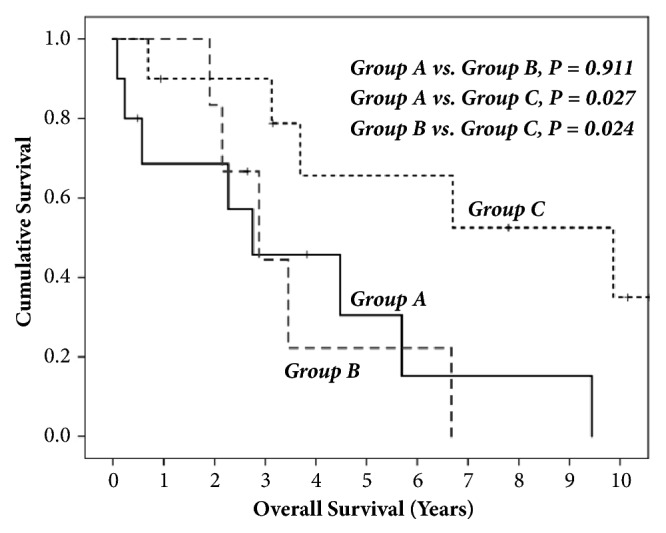
Large cell neuroendocrine cancer (LCNEC) of the lung exhibits morphological and immunohistochemical characteristics of both neuroendocrine and large cell carcinomas. No defined optimal therapy has been described for this subset of patients and the question of whether these patients should be treated with non-small cell lung cancer (NSCLC) treatment protocols, according to the National Comprehensive Cancer Network (NCCN) guidelines, or with small cell lung cancer (SCLC) due to histological and clinical similarities is still uncertain. We conducted a retrospective review of patients identified with diagnosis of LCNEC of the lung at the University of Cincinnati Cancer Center from the year 2002 to 2012 to determine which treatment approach resulted in improved outcomes in this rare category of disease. Patients who received chemotherapy whether NSCLC (group A) or SCLC (group B) protocols did not show significant changes in OS (P=0.911). Meanwhile, patients who underwent surgery (group C) had better OS compared to groups A and B (P= 0.027 and 0.024, respectively). This analysis reveals that outcomes for SCLC or NSCLC treatment strategies in LCNEC patients did not result in survival advantages and future research should be addressing it as a separate entity.
肺大细胞神经内分泌癌(LCNEC)兼具神经内分泌癌和大细胞癌的形态学及免疫组化特征。对于这类患者,尚未有明确的最佳治疗方案,并且根据美国国立综合癌症网络(NCCN)指南,鉴于其组织学和临床特征与非小细胞肺癌(NSCLC)相似,这些患者是否应采用NSCLC治疗方案,还是因其与小细胞肺癌(SCLC)的相似性而采用SCLC治疗方案,目前仍不明确。我们对2002年至2012年在辛辛那提大学癌症中心确诊为肺LCNEC的患者进行了回顾性研究,以确定哪种治疗方法能改善这类罕见疾病的预后。接受化疗的患者,无论是采用NSCLC(A组)还是SCLC(B组)方案,总生存期(OS)均无显著变化(P = 0.911)。同时,接受手术的患者(C组)与A组和B组相比,OS更好(分别为P = 0.027和0.024)。该分析表明,LCNEC患者采用SCLC或NSCLC治疗策略均未带来生存优势,未来的研究应将其作为一个独立的实体来探讨。