Wallenborn Jordyn T, Joseph Anny-Claude, Graves Whitney C, Masho Saba W
Virginia Commonwealth University, School of Medicine, Division of Epidemiology, Department of Family Medicine and Population Health, 830 East Main Street, Suite 821, P.O. Box 980212, Richmond, VA 23298-0212, USA.
J Pregnancy. 2018 Nov 1;2018:4825727. doi: 10.1155/2018/4825727. eCollection 2018.
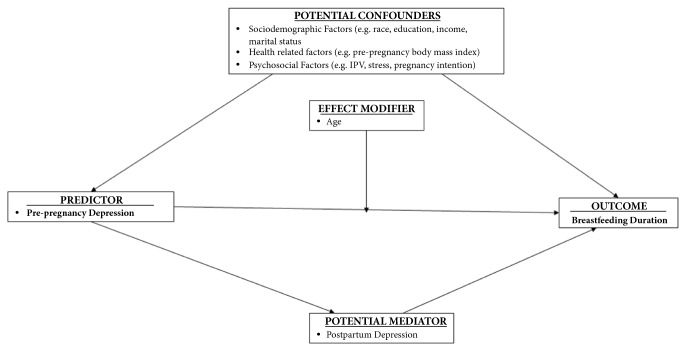
In the United States, major depressive disorder affects one in five women aged 20-40 years. During these childbearing years, depression can negatively impact maternal behaviors that are crucial for infant growth and development. This study examined the relationship between prepregnancy depression and breastfeeding duration by maternal age.
Data from Phase 7 (2012-2013) of the Pregnancy Risk Assessment Monitoring System (N=62,483) were analyzed. Prepregnancy depression was dichotomized while breastfeeding duration was categorized as never breastfed, breastfed 8 weeks or less, and breastfed more than 8 weeks. Maternal age was a significant effect modifier; therefore, results were stratified by maternal age. Multinomial logistic regression was used to obtain odds ratios and 95% confidence intervals (CI).
For women aged 20-24, 25-29, and 30-34 years with prepregnancy depression, the odds of never breastfeeding and breastfeeding 8 weeks or less were significantly higher than in women with no history of prepregnancy depression. Notably, among women aged 25-29 with prepregnancy depression, the odds of never breastfeeding and breastfeeding 8 weeks or less were 93% (adjusted odds ratio (AOR) = 1.93, 95% CI =1.57-2.37) and 65% (AOR = 1.65, 95% CI = 1.37-1.99) higher compared to women with no history of prepregnancy depression, respectively.
Having a history of poor mental health before pregnancy may increase the likelihood of premature breastfeeding cessation. A woman's mental health status before pregnancy should be considered in reproductive and prenatal care models. Efforts should be made to understand challenges women of specific age groups face when trying to breastfeed.
在美国,重度抑郁症影响着五分之一年龄在20至40岁的女性。在这些生育年龄段,抑郁症会对婴儿成长和发育至关重要的母亲行为产生负面影响。本研究按母亲年龄考察了孕前抑郁症与母乳喂养持续时间之间的关系。
对妊娠风险评估监测系统第7阶段(2012 - 2013年)的数据(N = 62483)进行了分析。孕前抑郁症被二分法分类,而母乳喂养持续时间被分为从未母乳喂养、母乳喂养8周或更短时间以及母乳喂养超过8周。母亲年龄是一个显著的效应修饰因素;因此,结果按母亲年龄进行了分层。使用多项逻辑回归来获得比值比和95%置信区间(CI)。
对于年龄在20 - 24岁、25 - 29岁和30 - 34岁且有孕前抑郁症的女性,从未母乳喂养以及母乳喂养8周或更短时间的几率显著高于无孕前抑郁症病史的女性。值得注意的是,在年龄为25 - 29岁且有孕前抑郁症的女性中,从未母乳喂养以及母乳喂养8周或更短时间的几率分别比无孕前抑郁症病史的女性高93%(调整后的比值比(AOR)= 1.93,95% CI = 1.57 - 2.37)和65%(AOR = 1.65,95% CI = 1.37 - 1.99)。
孕前心理健康状况不佳可能会增加过早停止母乳喂养的可能性。在生殖和产前护理模式中应考虑女性孕前的心理健康状况。应努力了解特定年龄组女性在尝试母乳喂养时面临的挑战。