Department of Biomedical Sciences, Department Faculty of Health Sciences, University of Hull, Hull, UK.
Centre de Recherche Cardio-Thoracique de Bordeaux U1045, Université de Bordeaux, Bordeaux, France.
J Cardiovasc Electrophysiol. 2019 Mar;30(3):383-391. doi: 10.1111/jce.13805. Epub 2018 Dec 28.
K 3.1, also known as TASK-1, is a twin-pore acid-sensitive repolarizing K channel, responsible for a background potassium current that significantly contributes to setting the resting membrane potential of cardiac myocytes. Inhibition of I alters cardiac repolarization and is proarrhythmogenic. In this study, we have examined the expression of K 3.1 and function of this channel in tissue and myocytes from across the left ventricular free wall.
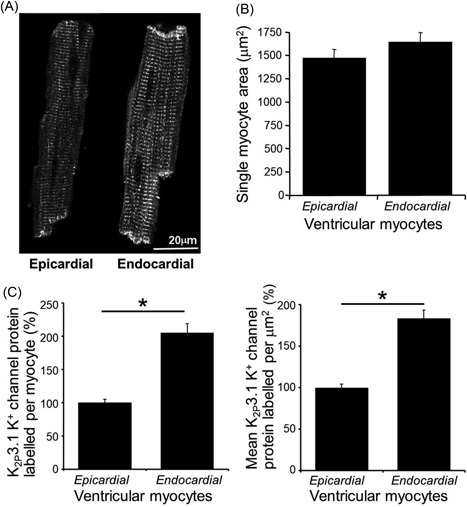
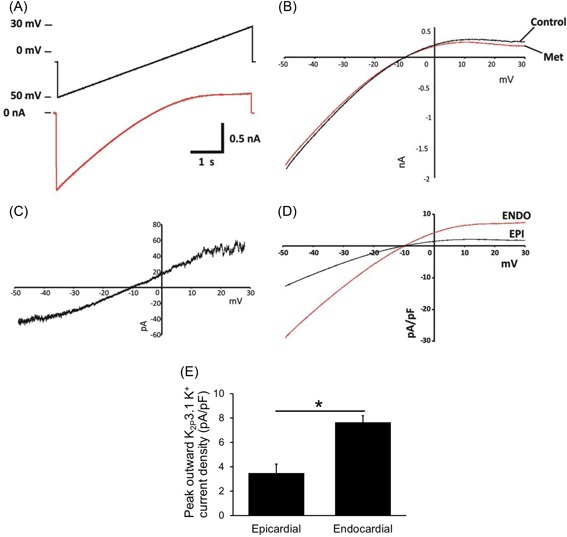
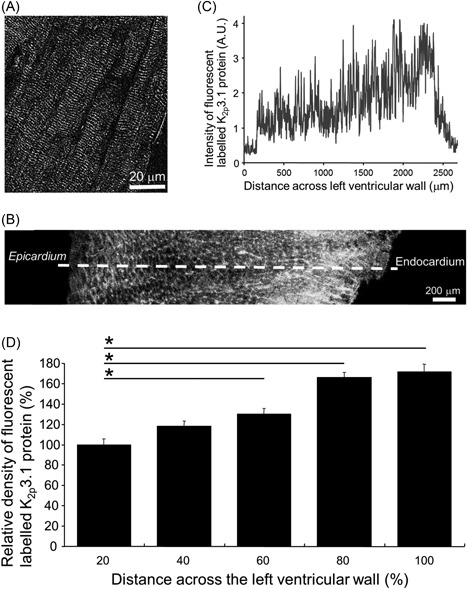
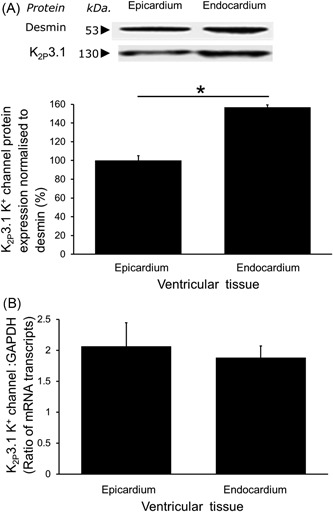
Using fluorescence immunocytochemistry, the expression of K 3.1 protein in myocytes from the subendocardial region was found to be twice (205% ± 13.5%) that found in myocytes from the subepicardial region of the left ventricle (100% ± 5.3%). The left ventricular free wall exhibited a marked transmural gradient of K 3.1 protein expression. Western blot analysis confirmed significantly higher K 3.1 protein expression in subendocardial tissue (156% ± 2.5%) than subepicardial tissue (100% ± 5.0%). However, there was no difference in K 3.1 messenger RNA expression. Whole-cell patch clamp identified I current density to be significantly greater in myocytes isolated from the subendocardium (7.66 ± 0.53 pA/pF) compared with those from the subepicardium (3.47 ± 0.74 pA/pF).
This is the first study to identify a transmural gradient of K 3.1 in the left ventricle. This gradient has implications for understanding ventricular arrhythmogenesis under conditions of ischemia but also in response to other modulatory factors, such as adrenergic stimulation and the presence of anesthetics that inhibits or activates this channel.
K 3.1,也称为 TASK-1,是一种双孔酸敏感复极化钾通道,负责背景钾电流,对心肌细胞的静息膜电位有重要贡献。I 的抑制会改变心脏复极化,导致心律失常。在这项研究中,我们检查了左心室游离壁各处组织和心肌细胞中 K 3.1 的表达和功能。
使用荧光免疫细胞化学,发现心内膜下区域心肌细胞中 K 3.1 蛋白的表达是心外膜下区域心肌细胞(100%±5.3%)的两倍(205%±13.5%)。左心室游离壁表现出明显的 K 3.1 蛋白表达的穿壁梯度。Western blot 分析证实心内膜下组织中 K 3.1 蛋白表达明显高于心外膜下组织(156%±2.5%比 100%±5.0%)。然而,K 3.1 信使 RNA 表达没有差异。全细胞膜片钳技术鉴定出心内膜下分离的心肌细胞 I 电流密度(7.66±0.53 pA/pF)明显大于心外膜下分离的心肌细胞(3.47±0.74 pA/pF)。
这是第一项研究表明左心室存在 K 3.1 的穿壁梯度。这种梯度对于理解缺血条件下的心室心律失常发生机制具有重要意义,但也对其他调节因素(如肾上腺素能刺激和抑制或激活这种通道的麻醉剂)具有重要意义。