Center for Applied Studies in Health Economics, Department of Public Health Sciences, Penn State College of Medicine, Hershey, Pennsylvania.
J Patient Saf. 2020 Dec;16(4):e317-e323. doi: 10.1097/PTS.0000000000000553.
The aim of the study was to examine whether miscarriage treatment-related morbidities and adverse events vary across facility types.
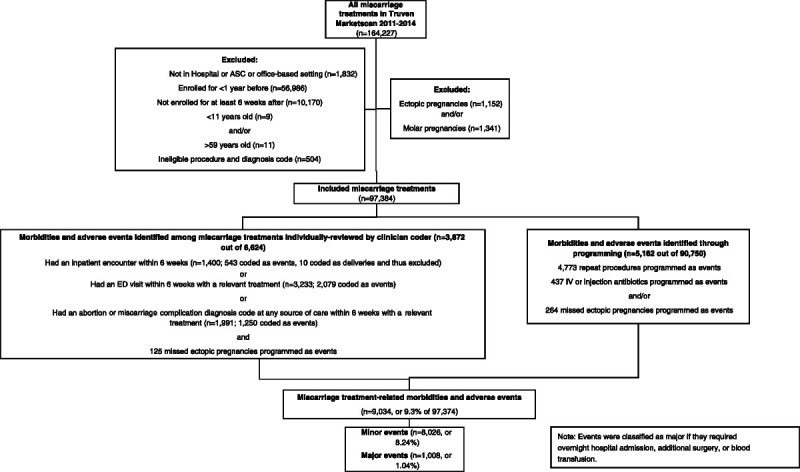
A retrospective cohort study compared miscarriage treatment-related morbidities and adverse events across hospitals, ambulatory surgery centers (ASCs), and office-based settings. Data on women who had miscarriage treatment between 2011 and 2014 and were continuously enrolled in their insurance plan for at least 1 year before and at least 6 weeks after treatment were obtained from a large national private insurance claims database. The main outcome was miscarriage treatment-related morbidities and adverse events occurring within 6 weeks of miscarriage treatment. Secondary outcomes were major events and infections.
A total of 97,374 miscarriage treatments met inclusion criteria. Most (75%) were provided in hospitals, 10% ASCs, and 15% office-based settings. A total of 9.3% had miscarriage treatment-related events, 1.0% major events, and 1.5% infections. In adjusted analyses, there were fewer events in ASCs (6.5%) than office-based settings (9.4%) and hospitals (9.6%), but no significant difference between office-based settings and hospitals. There were no significant differences in major events between ASCs (0.7%) and office-based settings (0.8%), but more in hospitals (1.1%) than ASCs and office-based settings. There were fewer infections in ASCs (0.9%) than office-based settings (1.2%) and more in hospitals (1.6%) than ASCs and office-based settings. In analyses stratified by miscarriage treatment type, the difference between ASCs and office-based settings was no longer significant for miscarriages treated with procedures.
Although there seem to be slightly more events in hospitals than ASCs or office-based settings, findings do not support limiting miscarriage treatment to particular settings.
本研究旨在探讨流产治疗相关并发症和不良事件是否因医疗机构类型而异。
本回顾性队列研究比较了医院、门诊手术中心(ASC)和办公室环境中流产治疗相关并发症和不良事件。从一家大型私人保险理赔数据库中获取了 2011 年至 2014 年期间接受流产治疗且在治疗前至少 1 年和治疗后至少 6 周内持续参加其保险计划的女性的流产治疗相关数据。主要结局为流产治疗后 6 周内发生的流产治疗相关并发症和不良事件。次要结局为主要事件和感染。
共有 97374 例流产治疗符合纳入标准。其中 75%在医院进行,10%在 ASC,15%在办公室环境中进行。共有 9.3%发生流产治疗相关事件,1.0%发生主要事件,1.5%发生感染。调整分析显示,ASC(6.5%)的事件发生率低于办公室环境(9.4%)和医院(9.6%),但办公室环境和医院之间无显著差异。ASC(0.7%)和办公室环境(0.8%)之间主要事件发生率无显著差异,但医院(1.1%)的发生率高于 ASC 和办公室环境。ASC(0.9%)的感染发生率低于办公室环境(1.2%),而医院(1.6%)的感染发生率高于 ASC 和办公室环境。按流产治疗类型分层分析时,对于采用手术治疗的流产,ASC 和办公室环境之间的差异不再显著。
尽管医院的事件发生率似乎略高于 ASC 或办公室环境,但这些发现并不支持将流产治疗限于特定场所。