Zhang Jun-Feng, Zhang Jian-Shui, Zhao Zhao-Hua, Yang Peng-Bo, Ji Sheng-Feng, Li Nan, Shi Qin-Dong, Tan Jing, Xu Xi, Xu Cang-Bao, Zhao Ling-Yu
1Shaanxi Key Laboratory of Ischemic Cardiovascular Disease, Institute of Basic and Translational Medicine, Xi'an Medical University, Xi'an, 710021 Shaanxi People's Republic of China.
2Department of Human Anatomy, Xi'an Medical University, Xi'an, 710021 Shaanxi People's Republic of China.
Cancer Cell Int. 2018 Dec 3;18:195. doi: 10.1186/s12935-018-0694-9. eCollection 2018.
MicroRNAs play crucial roles in tumorigenesis and tumor progression. miR-770 has been reported to be downregulated in several cancers and affects cancer cell proliferation, apoptosis, metastasis and drug resistance. However, the role and underlying molecular mechanism of miR-770 in human glioma remain unknown and need to be further elucidated.
The expression of miR-770 in glioma tissues and cell lines was measured by quantitative real-time PCR (qRT-PCR) to explore the association of miR-770 expression with clinicopathological characteristics. The expression of CDK8 was detected by qRT-PCR and Western blotting in glioma tissues. A target prediction program and a dual-luciferase reporter assay were used to confirm that CDK8 is a target gene of miR-770. MTT and cell counting assays were used to assess the effect of miR-770 on glioma cell proliferation. The cell cycle distribution and apoptosis were examined by flow cytometry. CDK8 siRNA and overexpression were used to further confirm the function of the target gene.
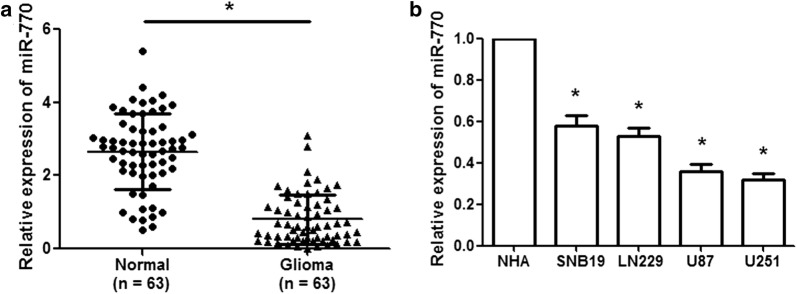
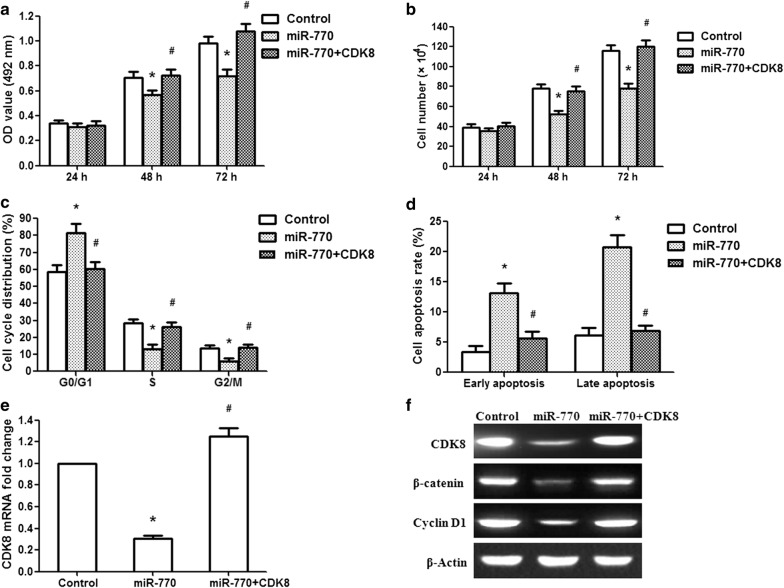
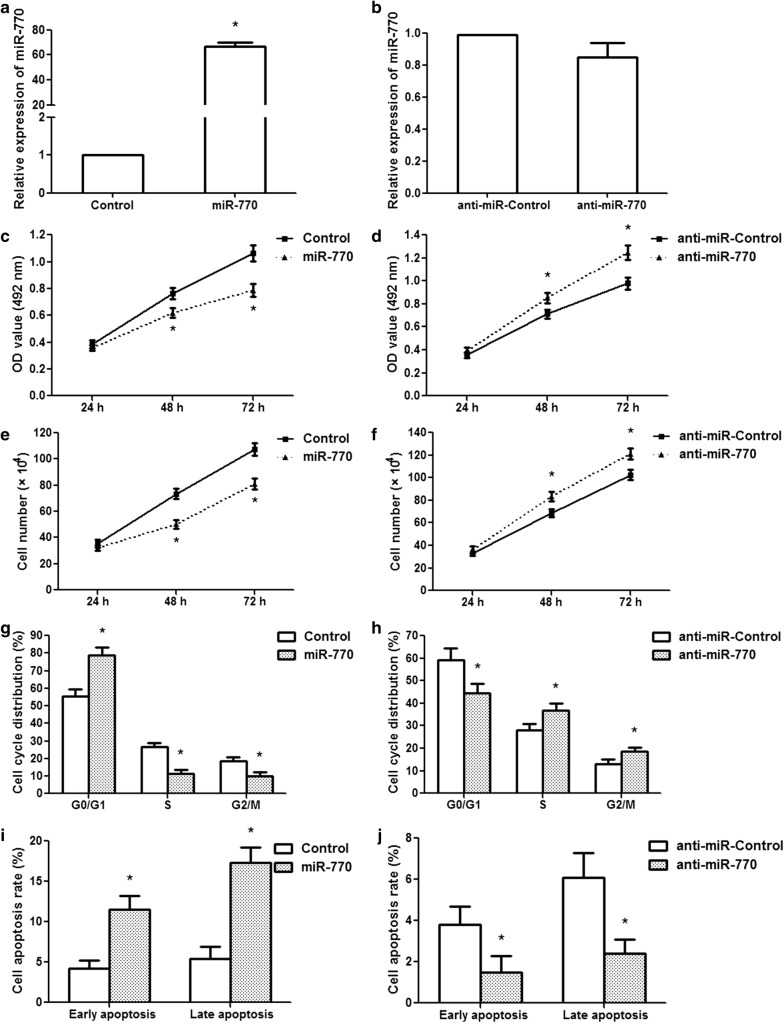
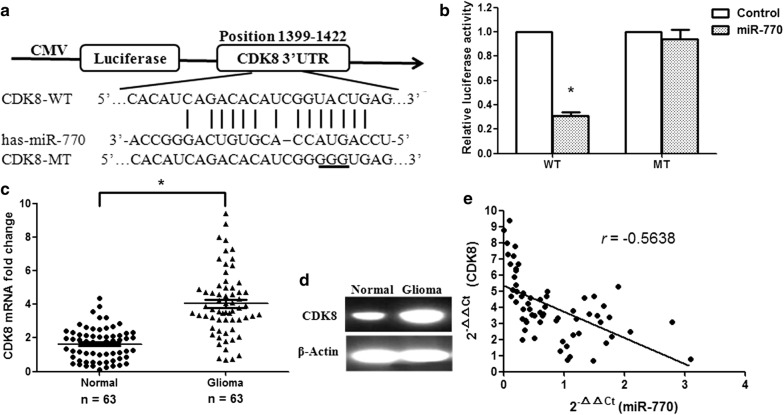
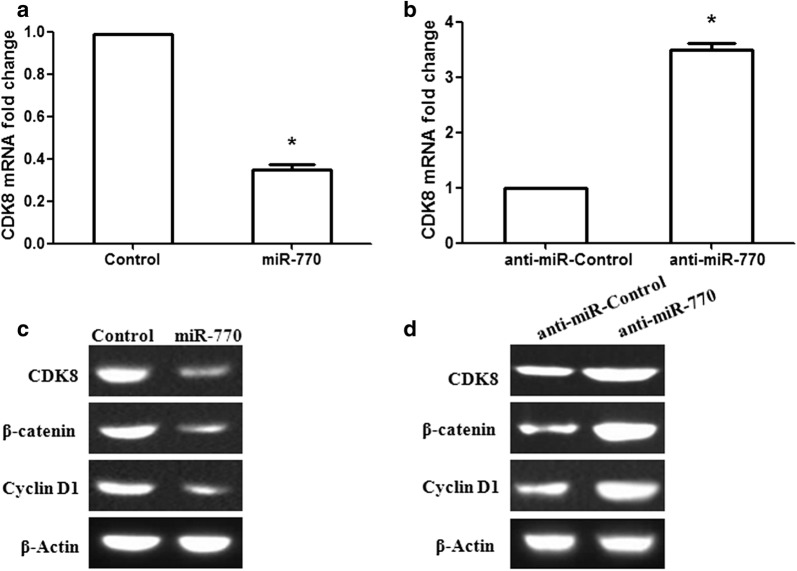
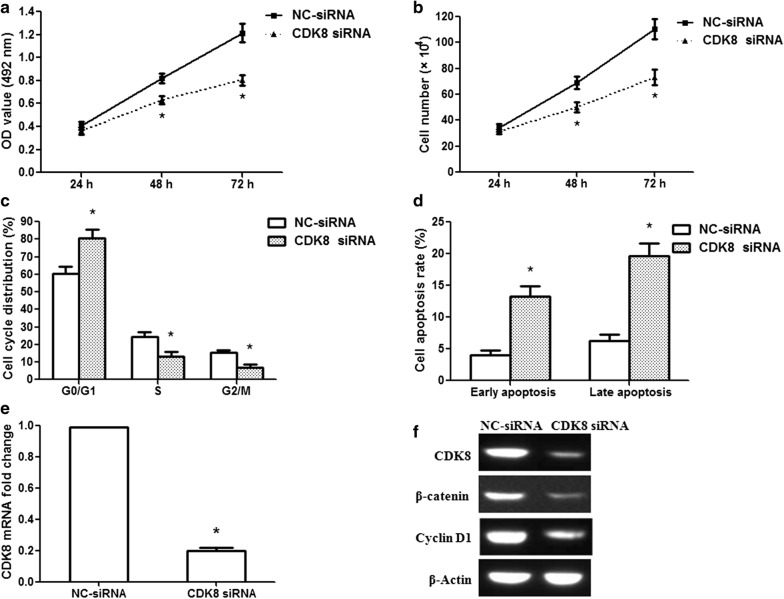
We demonstrated that miR-770 expression was downregulated in human glioma tissues and cell lines. The overexpression of miR-770 inhibited glioma cell proliferation and cell cycle G1-S transition and induced apoptosis. The inhibition of miR-770 facilitated cell proliferation and G1-S transition and suppressed apoptosis. miR-770 expression was inversely correlated with CDK8 expression in glioma tissues. CDK8 was confirmed to be a direct target of miR-770 by using a luciferase reporter assay. The overexpression of miR-770 decreased CDK8 expression at both the mRNA and protein levels, and the suppression of miR-770 increased CDK8 expression. Importantly, CDK8 silencing recapitulated the cellular and molecular effects observed upon miR-770 overexpression, and CDK8 overexpression eliminated the effects of miR-770 overexpression on glioma cells. Moreover, both exogenous expression of miR-770 and silencing of CDK8 resulted in suppression of the Wnt/β-catenin signaling pathway.
Our study demonstrates that miR-770 inhibits glioma cell proliferation and G1-S transition and induces apoptosis through suppression of the Wnt/β-catenin signaling pathway by targeting CDK8. These findings suggest that miR-770 plays a significant role in glioma progression and serves as a potential therapeutic target for glioma.
微小RNA在肿瘤发生和肿瘤进展中起关键作用。据报道,miR-770在多种癌症中表达下调,并影响癌细胞的增殖、凋亡、转移和耐药性。然而,miR-770在人类胶质瘤中的作用及潜在分子机制仍不清楚,有待进一步阐明。
采用定量实时PCR(qRT-PCR)检测miR-770在胶质瘤组织和细胞系中的表达,以探讨miR-770表达与临床病理特征的关系。通过qRT-PCR和蛋白质印迹法检测胶质瘤组织中CDK8的表达。使用靶标预测程序和双荧光素酶报告基因检测来证实CDK8是miR-770的靶基因。采用MTT法和细胞计数法评估miR-770对胶质瘤细胞增殖的影响。通过流式细胞术检测细胞周期分布和凋亡情况。使用CDK8 siRNA和过表达进一步证实靶基因的功能。
我们证明miR-770在人类胶质瘤组织和细胞系中表达下调。miR-770的过表达抑制了胶质瘤细胞的增殖和细胞周期G1-S期转换,并诱导了凋亡。miR-770的抑制促进了细胞增殖和G1-S期转换,并抑制了凋亡。在胶质瘤组织中,miR-770表达与CDK8表达呈负相关。通过荧光素酶报告基因检测证实CDK8是miR-770的直接靶标。miR-770的过表达在mRNA和蛋白质水平上均降低了CDK8的表达,而miR-770的抑制则增加了CDK8的表达。重要的是,CDK8沉默重现了miR-770过表达时观察到的细胞和分子效应,而CDK8过表达消除了miR-770过表达对胶质瘤细胞的影响。此外,miR-770的外源性表达和CDK8的沉默均导致Wnt/β-连环蛋白信号通路的抑制。
我们的研究表明,miR-770通过靶向CDK8抑制Wnt/β-连环蛋白信号通路,从而抑制胶质瘤细胞的增殖和G1-S期转换并诱导凋亡。这些发现表明,miR-770在胶质瘤进展中起重要作用,并可作为胶质瘤的潜在治疗靶点。