Department of Cellular and Integrative Physiology, University of Texas Health Science Center at San Antonio, San Antonio, Texas.
Addiction Research, Treatment & Training Center of Excellence, University of Texas Health Science Center at San Antonio, San Antonio, Texas.
Int J Neuropsychopharmacol. 2019 Feb 1;22(2):137-142. doi: 10.1093/ijnp/pyy099.
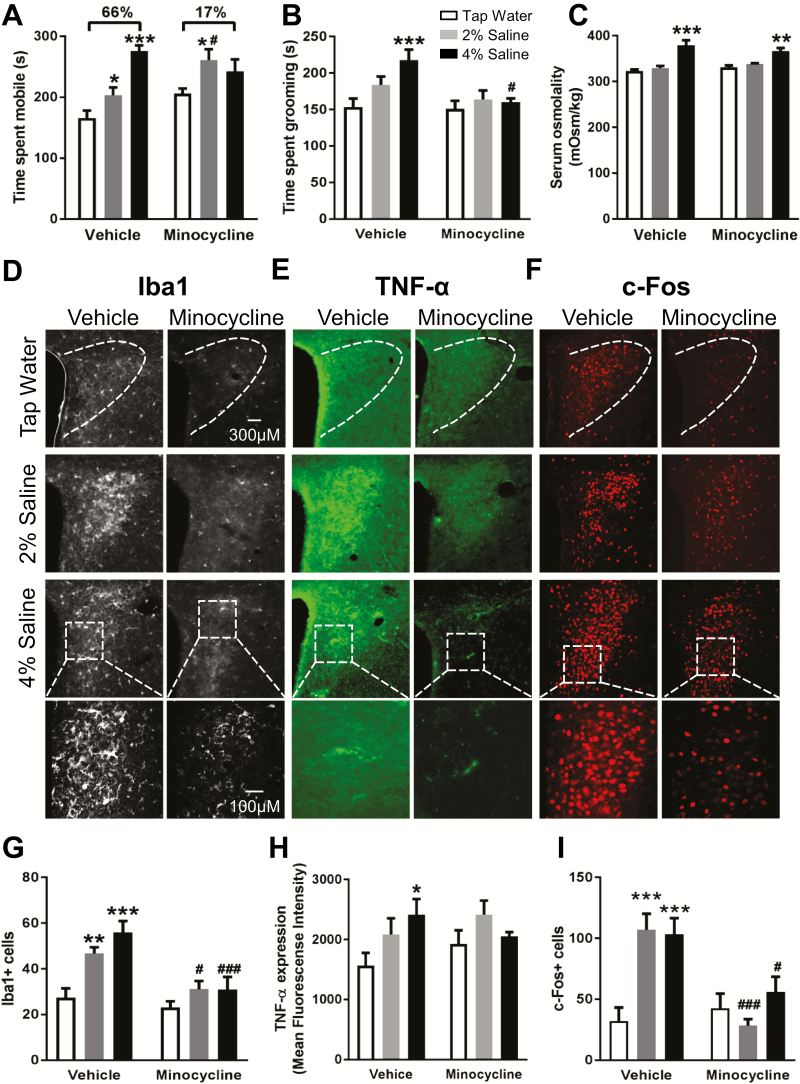
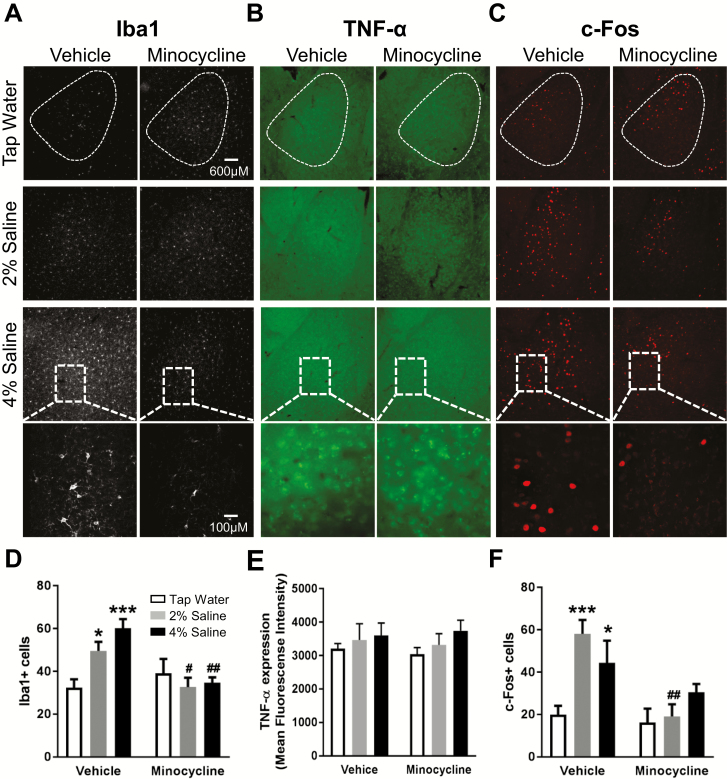
High dietary salt intake increases risk of stress-related neuropsychiatric disorders. Here, we explored the contribution of high dietary salt intake-induced neuroinflammation in key stress-responsive brain regions, the hypothalamic paraventricular nucleus and basolateral amygdala, in promoting exaggerated neuronal activation and coping behaviors in response to acute psychogenic stress. Mice that underwent high dietary salt intake exhibited increased active stress coping behaviors during and after an acute swim stress, and these were reduced by concurrent administration of minocycline, an inhibitor of microglial activation, without affecting body fluid hyperosmolality caused by high dietary salt intake. Moreover, minocycline attenuated high dietary salt intake-induced increases of paraventricular nucleus tumor necrosis factor-α, activated microglia (ionized calcium-binding adaptor molecule 1), and acute swim stress-induced neuronal activation (c-Fos). In the basolateral amygdala, similar effects were observed on ionized calcium-binding adaptor molecule 1+ and c-Fos+ counts, but not tumor necrosis factor-α levels. These data indicate that high dietary salt intake promotes neuroinflammation, increasing recruitment of neurons in key stress-associated brain regions and augmenting behavioral hyper-responsivity to acute psychological stress.
高盐饮食会增加与压力相关的神经精神疾病的风险。在这里,我们探讨了高盐饮食引起的神经炎症在促进关键应激反应性脑区(下丘脑室旁核和外侧杏仁核)中神经元过度激活和应对行为中的作用,这些脑区对急性心理应激有反应。接受高盐饮食的小鼠在急性游泳应激期间和之后表现出更多的主动应激应对行为,而这种行为可被米诺环素(一种小胶质细胞激活抑制剂)同时给药所减少,而不影响高盐饮食引起的体液高渗性。此外,米诺环素减轻了高盐饮食诱导的室旁核肿瘤坏死因子-α、激活的小胶质细胞(钙结合衔接蛋白 1)和急性游泳应激诱导的神经元激活(c-Fos)的增加。在外侧杏仁核中,也观察到钙结合衔接蛋白 1+和 c-Fos+计数的类似作用,但肿瘤坏死因子-α水平没有变化。这些数据表明,高盐饮食促进了神经炎症,增加了关键应激相关脑区神经元的募集,并增强了对急性心理应激的行为高反应性。