Laboratory of Immunoregulation, National Institute of Allergy and Infectious Diseases, NIH, Bethesda, Maryland, USA.
Laboratory of Viral Diseases, National Institute of Allergy and Infectious Diseases, NIH, Bethesda, Maryland, USA.
mBio. 2018 Dec 11;9(6):e00955-18. doi: 10.1128/mBio.00955-18.
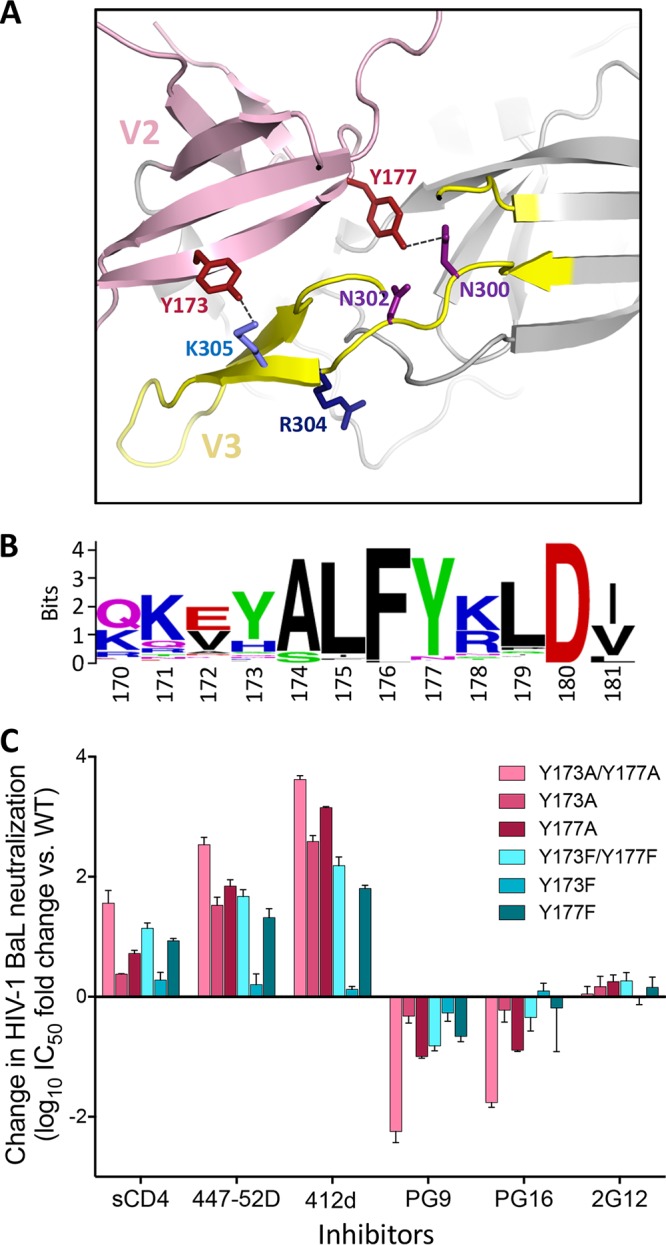
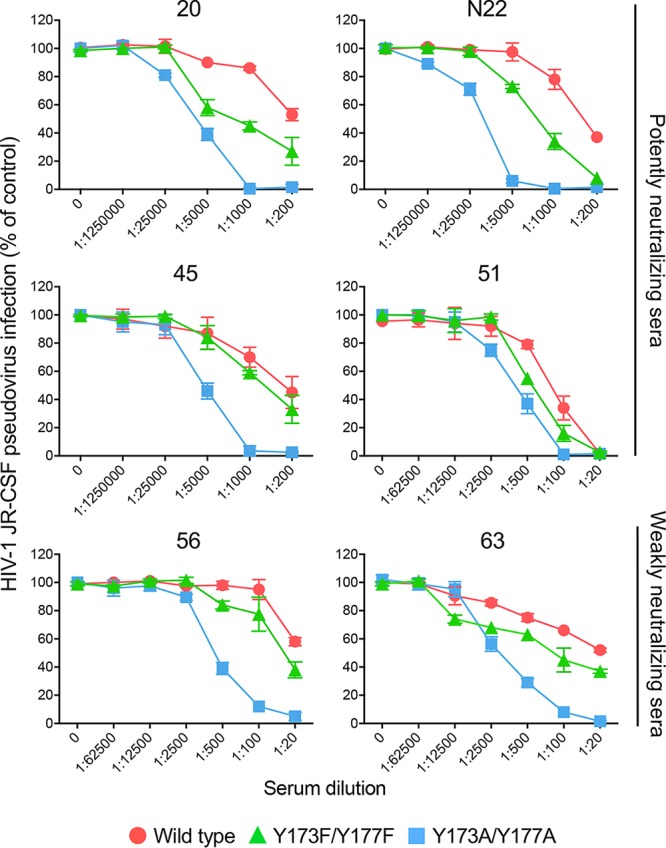
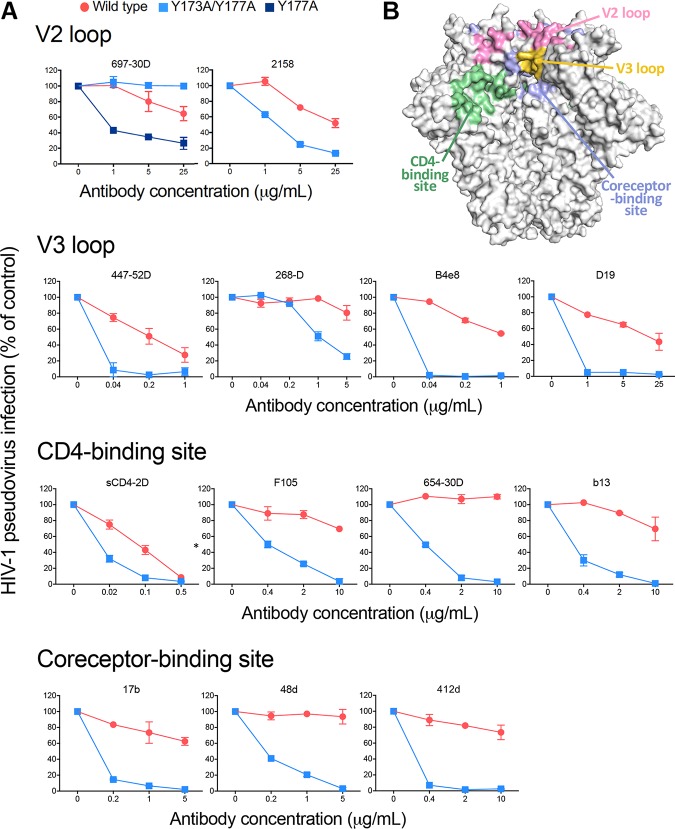
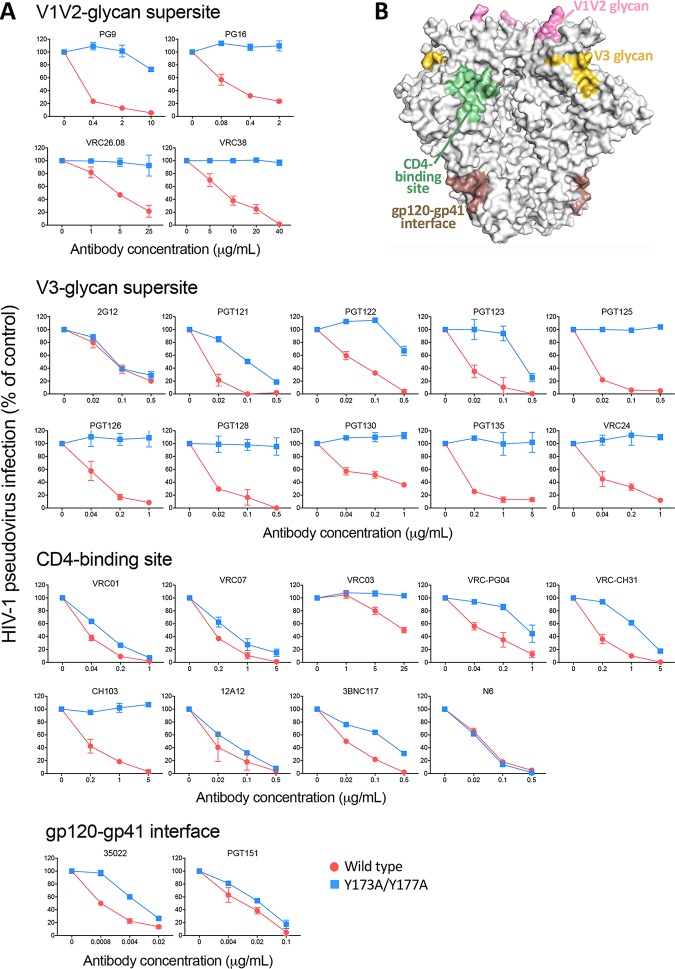
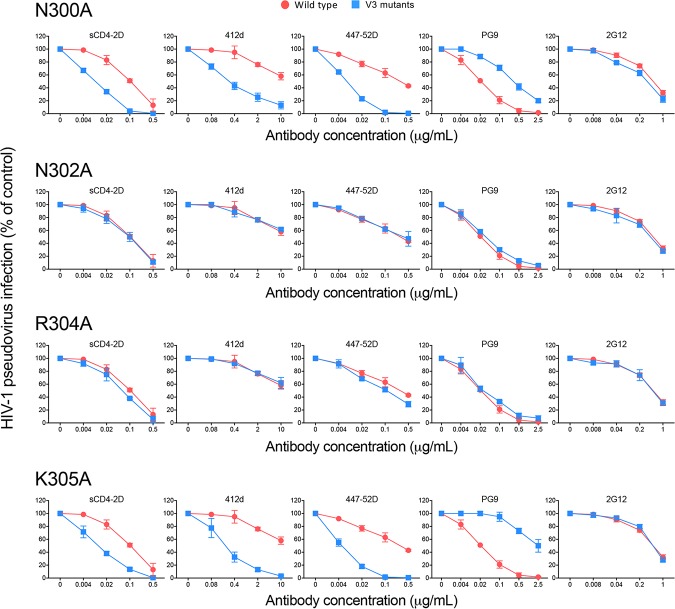
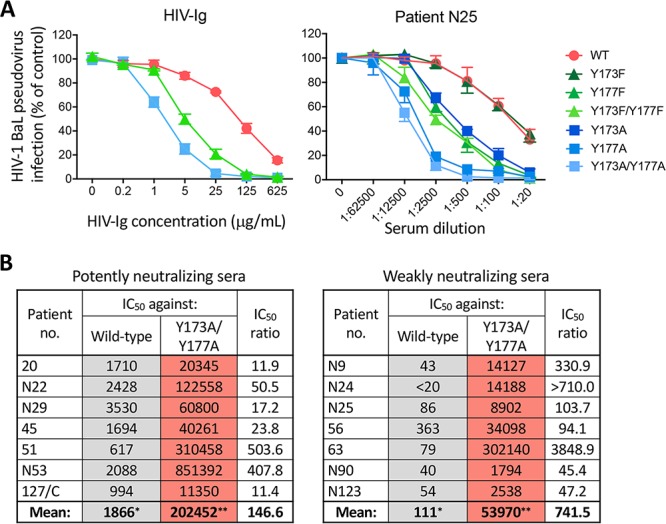
The human immunodeficiency virus type 1 (HIV-1) envelope (Env) trimer evades antibody recognition by adopting a closed prefusion conformation. Here, we show that two conserved tyrosines (Y173, Y177) within the second variable (V2) loop of the gp120 Env glycoprotein are key regulators of the closed, antibody-protected state of the trimer by establishing intramolecular interaction with the base of the third variable (V3) loop. Mutation of Y177 and/or Y173 to phenylalanine or alanine dramatically altered the susceptibility of diverse HIV-1 strains to neutralization, increasing sensitivity to weakly and nonneutralizing antibodies directed against diverse Env regions, consistent with the adoption of an open trimer configuration. Conversely, potent broadly neutralizing antibodies (bNAbs) against different supersites of HIV-1 vulnerability exhibited reduced potency against V2 loop tyrosine mutants, consistent with their preferential targeting of the closed trimer. Mutation of V3 loop residues predicted to interact with the V2 loop tyrosines yielded a similar neutralization phenotype. Sera from chronically HIV-1-infected patients contained very high titers of antibodies capable of neutralizing V2 loop tyrosine mutants but not wild-type viruses, indicating that the bulk of antibodies produced in infected hosts are unable to penetrate the protective shield of the closed trimer. These results identify the tyrosine-mediated V2-V3 loop complex at the trimer apex as a key structural constraint that facilitates HIV-1 evasion from the bulk of host antibodies. The extraordinary ability of human immunodeficiency virus type 1 (HIV-1) to evade host immunity represents a major obstacle to the development of a protective vaccine. Thus, elucidating the mechanisms whereby HIV-1 protects its external envelope (Env), which is the sole target of virus-neutralizing antibodies, is an essential step toward vaccine design. We identified a key structural element that maintains the HIV-1 Env trimer in a closed, antibody-resistant conformation. A major role is played by two conserved tyrosines at the apex of the Env spike, whose mutation causes a global opening of the trimer structure, exposing multiple concealed targets for neutralizing antibodies. We also found that HIV-infected individuals produce very large amounts of antibodies that neutralize the open Env form; however, the bulk of these antibodies are unable to penetrate the tight defensive shield of the native virus. This work may help to devise new strategies to overcome the viral defensive mechanisms and facilitate the development of an effective HIV-1 vaccine.
人类免疫缺陷病毒 1 型(HIV-1)包膜(Env)三聚体通过采用封闭的预融合构象来逃避抗体识别。在这里,我们表明,gp120 Env 糖蛋白第二可变环(V2)中的两个保守酪氨酸(Y173、Y177)是通过与第三可变环(V3)环的底部建立分子内相互作用来调节三聚体封闭、抗体保护状态的关键调节剂。将 Y177 和/或 Y173 突变为苯丙氨酸或丙氨酸会极大地改变不同 HIV-1 株对中和的敏感性,增加对针对不同 Env 区域的弱中和和非中和抗体的敏感性,与采用开放三聚体构象一致。相反,针对 HIV-1 易感性不同超位点的有效广谱中和抗体(bNAbs)对 V2 环酪氨酸突变体的效力降低,与它们对封闭三聚体的优先靶向一致。突变预测与 V2 环酪氨酸相互作用的 V3 环残基产生了类似的中和表型。来自慢性 HIV-1 感染患者的血清含有能够中和 V2 环酪氨酸突变体但不能中和野生型病毒的高滴度抗体,表明感染宿主中产生的大量抗体无法穿透封闭三聚体的保护屏蔽。这些结果确定了三聚体顶端的酪氨酸介导的 V2-V3 环复合物作为促进 HIV-1逃避宿主大量抗体的关键结构约束。人类免疫缺陷病毒 1(HIV-1)逃避宿主免疫的非凡能力是开发保护性疫苗的主要障碍。因此,阐明 HIV-1 保护其外部包膜(Env)的机制,Env 是病毒中和抗体的唯一靶标,是疫苗设计的重要步骤。我们确定了一个关键的结构元素,该元素使 HIV-1 Env 三聚体保持在封闭的、抗体抵抗的构象中。Env 刺突顶端的两个保守酪氨酸起着主要作用,其突变导致三聚体结构的整体打开,暴露出多个用于中和抗体的隐蔽靶标。我们还发现,HIV 感染个体产生大量中和开放 Env 形式的抗体;然而,这些抗体的大部分都无法穿透天然病毒的紧密防御护盾。这项工作可能有助于设计克服病毒防御机制的新策略,并促进有效的 HIV-1 疫苗的开发。