CHESS, Centre for Health Equity Studies, Department of Public Health Sciences, SE-106 91 Stockholm University, Stockholm, Sweden.
Department of Economics, University of Bonn, Adenauerallee 24-42, 53113, Bonn, Germany.
Nat Commun. 2018 Dec 11;9(1):5124. doi: 10.1038/s41467-018-07617-9.
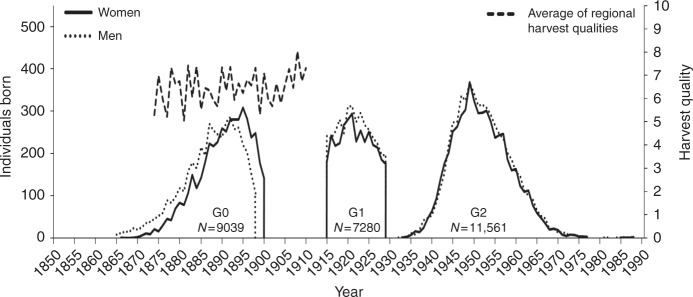
Studies of animals and plants suggest that nutritional conditions in one generation may affect phenotypic characteristics in subsequent generations. A small number of human studies claim to show that pre-pubertal nutritional experience trigger a sex-specific transgenerational response along the male line. A single historical dataset, the Överkalix cohorts in northern Sweden, is often quoted as evidence. To test this hypothesis on an almost 40 times larger dataset we collect harvest data during the pre-pubertal period of grandparents (G0, n = 9,039) to examine its potential association with mortality in children (G1, n = 7,280) and grandchildren (G2, n = 11,561) in the Uppsala Multigeneration Study. We find support for the main Överkalix finding: paternal grandfather's food access in pre-puberty predicts his male, but not female, grandchildren's all-cause mortality. In our study, cancer mortality contributes strongly to this pattern. We are unable to reproduce previous results for diabetes and cardiovascular mortality.
对动植物的研究表明,一代人的营养状况可能会影响后代的表型特征。少数人类研究声称,青春期前的营养体验会沿着男性路线引发特定于性别的跨代反应。瑞典北部的Överkalix 队列经常被引用为这一证据。为了在一个几乎大 40 倍的数据集上检验这一假设,我们收集了祖父母(G0,n=9039)青春期前的收获数据,以检验其与儿童(G1,n=7280)和孙辈(G2,n=11561)死亡率的潜在关联在乌普萨拉多代研究中。我们支持Överkalix 的主要发现:祖父在青春期前的食物获取情况预测了他的男性孙辈,但不是女性孙辈的全因死亡率。在我们的研究中,癌症死亡率对这种模式有很大贡献。我们无法重现之前关于糖尿病和心血管死亡率的结果。