Quintieri Giada, Saccone Marco, Spengler Matthias, Giese Michael, Gröschel André H
Physical Chemistry, University of Duisburg-Essen, 47057 Duisburg, Germany.
Organic Chemistry, University of Duisburg-Essen, 41125 Essen, Germany.
Nanomaterials (Basel). 2018 Dec 10;8(12):1029. doi: 10.3390/nano8121029.
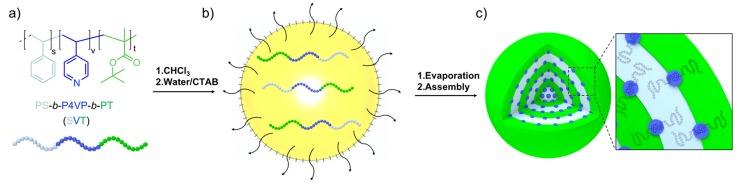
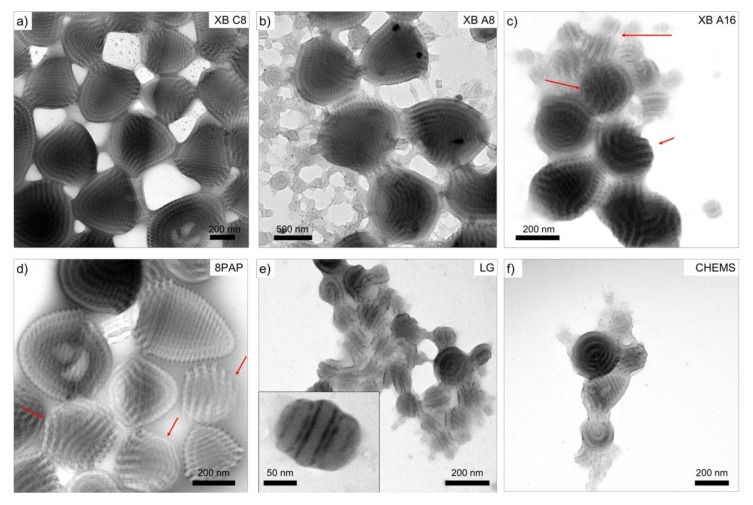
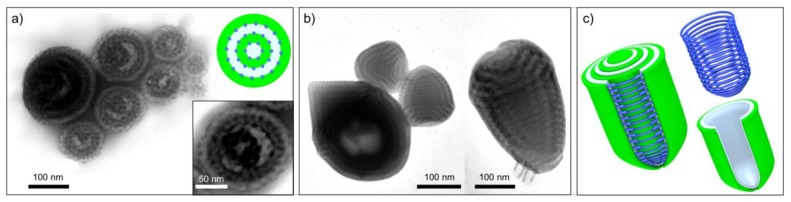
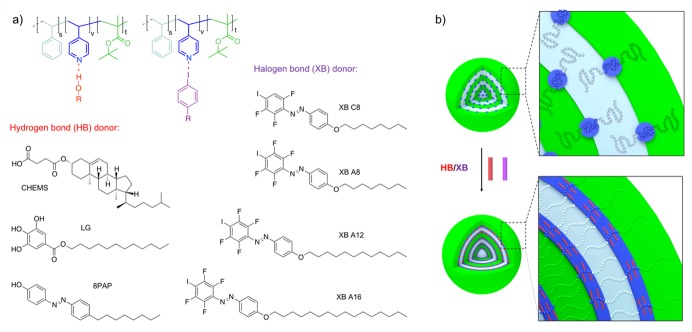
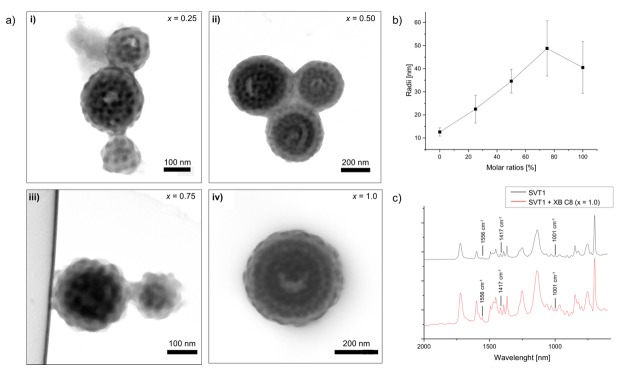
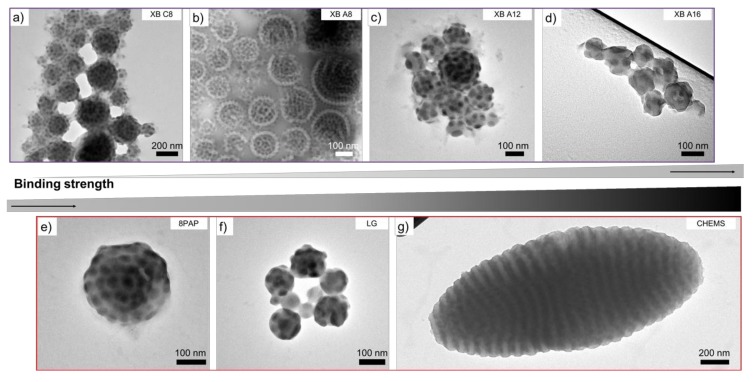
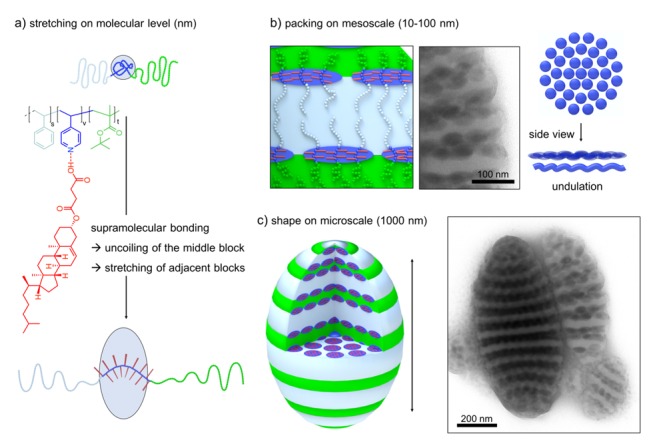
The self-assembly of AB diblock copolymers in three-dimensional (3D) soft confinement of nanoemulsions has recently become an attractive bottom up route to prepare colloids with controlled inner morphologies. In that regard, ABC triblock terpolymers show a more complex morphological behavior and could thus give access to extensive libraries of multicompartment microparticles. However, knowledge about their self-assembly in confinement is very limited thus far. Here, we investigated the confinement assembly of polystyrene--poly(4-vinylpyridine)--poly(-butyl methacrylate) (PS--P4VP--PT or SVT) triblock terpolymers in nanoemulsion droplets. Depending on the block weight fractions, we found spherical microparticles with concentric lamella⁻sphere () morphology, i.e., PS/PT lamella intercalated with P4VP spheres, or unusual conic microparticles with concentric lamella⁻cylinder () morphology. We further described how these morphologies can be modified through supramolecular additives, such as hydrogen bond (HB) and halogen bond (XB) donors. We bound donors to the 4VP units and analyzed changes in the morphology depending on the binding strength and the length of the alkyl tail. The interaction with the weaker donors resulted in an increase in volume of the P4VP domains, which depends upon the molar fraction of the added donor. For donors with a high tendency of intermolecular packing, a visible change in the morphology was observed. This ultimately caused a shape change in the microparticle. Knowledge about how to control inner morphologies of multicompartment microparticles could lead to novel carbon supports for catalysis, nanoparticles with unprecedented topologies, and potentially, reversible shape changes by light actuation.
最近,AB二嵌段共聚物在纳米乳液的三维(3D)软受限环境中的自组装已成为一种颇具吸引力的自下而上的方法,用于制备具有可控内部形态的胶体。在这方面,ABC三嵌段三元共聚物表现出更复杂的形态行为,因此可以获得大量多隔室微粒库。然而,到目前为止,关于它们在受限环境中的自组装的知识非常有限。在这里,我们研究了聚苯乙烯-聚(4-乙烯基吡啶)-聚(甲基丙烯酸丁酯)(PS-P4VP-PT或SVT)三嵌段三元共聚物在纳米乳液滴中的受限组装。根据嵌段重量分数,我们发现了具有同心片层-球体()形态的球形微粒,即PS/PT片层与P4VP球体相间排列,或具有同心片层-圆柱体()形态的不寻常锥形微粒。我们进一步描述了如何通过超分子添加剂,如氢键(HB)和卤键(XB)供体来改变这些形态。我们将供体与4VP单元结合,并根据结合强度和烷基链长度分析形态变化。与较弱供体的相互作用导致P4VP域的体积增加,这取决于添加供体的摩尔分数。对于具有高分子间堆积倾向的供体,观察到形态有明显变化。这最终导致微粒形状发生变化。关于如何控制多隔室微粒内部形态的知识可能会带来用于催化的新型碳载体、具有前所未有的拓扑结构的纳米颗粒,以及潜在地通过光驱动实现可逆形状变化。